Award-Winning AP Physics C: Mechanics Tutors
serving San Jose, CA
AP Physics C: Mechanics
Tutors in San Jose
Private 1-on-1 tutoring, weekly live classes for academic support, test prep & enrichment, practice tests and diagnostics, and more to elevate grades and test scores.
Based on 3.4M Learner Ratings
UniversitiesSchools & Universities
DeliveredHours Delivered
ProficiencyGrowth in Proficiency
Who needs tutoring?
No obligation. Takes ~1 minute.
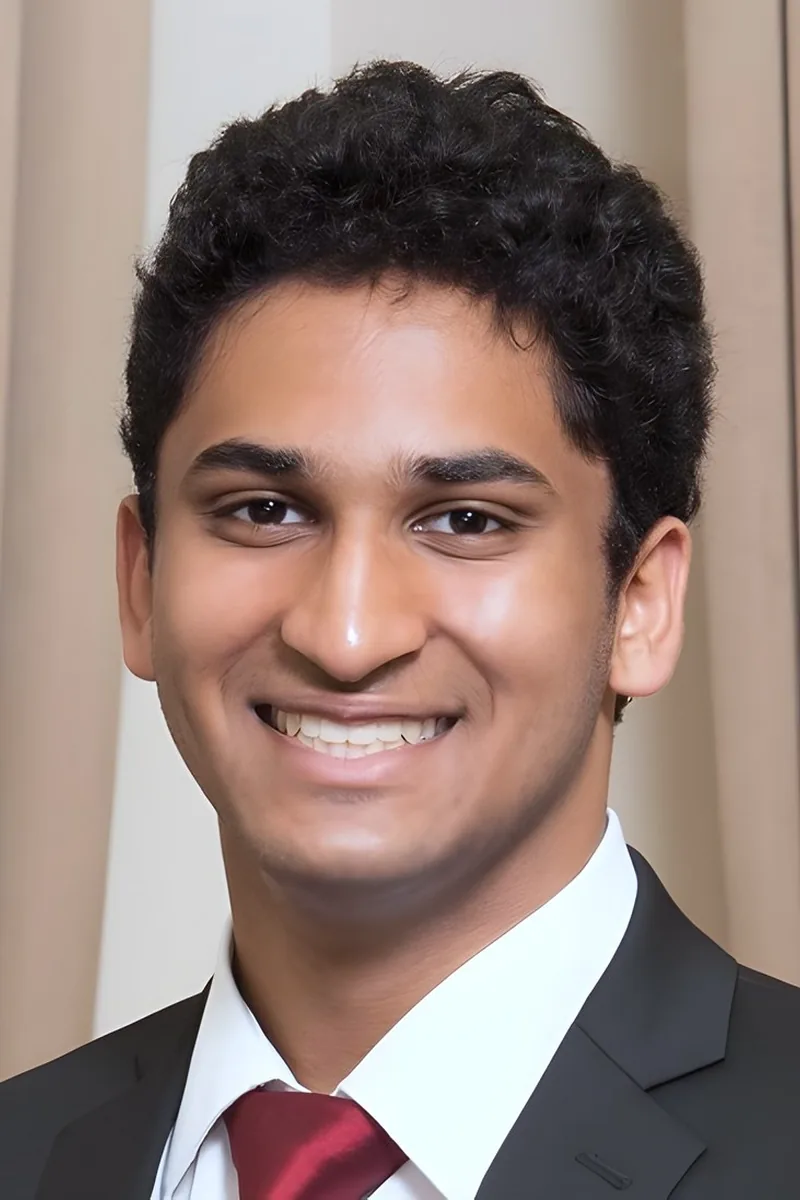
Cornell pre-med students rarely double down on calculus-based physics, but Pratik tutors AP Physics C: Mechanics alongside AP Chemistry and AP Biology — giving him a cross-disciplinary lens that's especially useful when mechanics problems involve biological or chemical systems in free-response scenarios. His 35 ACT confirms the quantitative fluency needed to walk students through setting up torque equations or integrating variable forces without losing sight of the underlying physics.

Having earned a BS in both physics and math from Yale, Anthony did the calculus-based mechanics — Lagrangian setups, variable-force integrations, rotational energy derivations — before pivoting to a PhD in economics, which means he teaches the material with the clarity of someone who's already fully digested it rather than still learning alongside students. His 1560 SAT and 5.0 tutoring rating back up what his physics training makes obvious: he can untangle the spots where the calculus and the physical reasoning collide, especially on free-response problems that demand both.
Studying Mechanical & Aerospace Engineering at Princeton, Nicolas solves calculus-based mechanics problems daily that go well beyond what the AP exam asks — rigid body dynamics, energy methods for complex systems, and the vector calculus behind rotational motion. That depth lets him quickly pinpoint whether a student's mistake lives in the physics reasoning or the integral setup, and fix the actual gap. Rated 5.0 by students.
Kimanthi's biomedical engineering degree from Duke required the same calculus-heavy mechanics — torque on prosthetic joints, force integrals through fluid systems, energy methods applied to biomechanical models — that AP Physics C tests in a more abstract form. That background means she can ground rotational dynamics and work-energy problems in tangible physical scenarios, giving students an intuitive hook before the math gets dense. Rated 5.0 by students.
I'm pursuing a double major in Mathematics and English at Vanderbilt University. I have been tutoring math since High School and have native proficiency in Mandarin Chinese. I am dedicated to helping students explore the study methods that will fit their individual needs.
Biology majors at Cornell don't usually seek out calculus-based physics — but Drishti's 1500 SAT and her comfort across both AP Calculus BC and AP Physics C suggest she genuinely clicks with the quantitative side of science, not just the biological. She's especially useful for students who need someone to slow down on the free-body-diagram-to-integral pipeline, translating the physical setup into the calculus without assuming steps are obvious. Rated 5.0 by students.
Having scored a 1580 SAT and studied computer science, Rishik brings a programmer's discipline to AP Physics C: Mechanics — treating each problem like an algorithm where you define your variables (forces, constraints, coordinate system) before executing the calculus. He also tutors both AP Physics C exams alongside AP Calculus BC, so he's comfortable moving between the electricity side and the mechanics side while keeping the underlying math sharp. Rated 4.6 by students.
Having TA'd multiple engineering courses at WashU while earning dual degrees in mechanical and energy engineering, Ava spent semesters breaking down the same calculus-based force analysis, work-energy theorems, and rotational dynamics that define the AP Physics C: Mechanics curriculum. Her 35 ACT speaks to the quantitative precision she brings to exam prep, and her current graduate work in environmental engineering keeps her fluent in the applied physics and differential equations students encounter on test day.
Richard holds both a B.S. in Math and a B.S. in Physics, which means the calculus and the mechanics aren't two separate languages for him — they developed together, and he teaches AP Physics C that way, treating the math as inseparable from the physical reasoning rather than an add-on. His graduate work in atmospheric sciences demanded constant modeling of force systems and fluid dynamics, so problems involving variable forces or energy conservation across complex scenarios are second nature. He can also tutor entirely in Spanish for bilingual students who think more clearly in their first language.
I am a graduate of Cornell University's College of Arts and Sciences. I received my Bachelor of Arts in Chemistry with Distinction in 2015. Since graduation, I was a physics/chemistry teacher and soccer coach at a private school in Virginia for a year, where I led the soccer team to an undefeated season. Before teaching and coaching professionally, I was a Teaching Assistant for the Cornell Math and Physics Departments, where I taught many subjects including calculus, mechanics, electromagnetism. Throughout my time at Cornell and as a teacher, I tutored subjects ranging from the SAT to AP Physics and Algebra II, which is where my true talents lie: in small group or one-on-one settings where I can give students the full attention they deserve and tailor my approach specifically to their learning styles. This is why I am now pursuing tutoring as a part-time occupation at Varsity Tutors. I embrace teaching all math and science subjects, especially physics and calculus, at both the college and high school level and will go above and beyond to make sure all of my students succeed, according to their definition of success. In my spare time, I enjoy playing league soccer, basketball, tennis and guitar, and also like to travel and see as much of the world as I can.
Rachel's business economics major might not scream physics, but her 35 ACT and deep math background — she tutors through AP Calculus BC — mean she's comfortable with the calculus-based problem-solving that Mechanics demands. She approaches kinematics and force problems the way an economics student would: set up the model carefully, define your variables, then let the math do the work.
A PhD in Chemical and Biomolecular Engineering from Buffalo built on a nuclear engineering foundation means Sabry has spent years solving the calculus-heavy mechanics problems — work-energy integrals, rigid body torque derivations, variable-force differential equations — that AP Physics C tests in compressed form. He co-instructed both undergraduate and graduate physics and mechanics courses during his doctoral program, so he knows exactly where students confuse the physical setup with the mathematical execution and can address each independently.
Testimonials
Because the right AP Physics C: Mechanics tutor makes all the difference.
Average Session Rating – Based on 3.4M Learner Ratings
Practice AP Physics C: Mechanics
Free practice tests, flashcards, and AI tutoring for AP Physics C: Mechanics
Nearby AP Physics C: Mechanics Tutors
Other San Jose Tutors
Related Science Tutors in San Jose
Frequently Asked Questions
AP Physics C: Mechanics focuses on classical mechanics and includes kinematics, Newton's laws, work and energy, momentum, circular motion, oscillations, and gravitation. The course emphasizes calculus-based problem solving, which distinguishes it from AP Physics 1. For students in San Jose, understanding these core topics deeply is essential since the AP exam requires both conceptual understanding and the ability to apply calculus to physics problems.
The main difficulty lies in integrating calculus with physics concepts—students must not only understand the physics but also manipulate derivatives and integrals to solve problems. Many students struggle with the transition from algebra-based physics to calculus-based reasoning, and the time pressure on the exam makes it easy to make computational errors. Personalized tutoring helps identify whether gaps are in physics understanding or mathematical execution, allowing targeted practice in weak areas.
The exam consists of two sections: a 45-minute multiple-choice section (35 questions) and a 45-minute free-response section (3 questions). The multiple-choice section tests breadth of knowledge and quick problem-solving, while free-response questions require detailed explanations and multi-step solutions. Understanding how to manage time across both sections and knowing when to show work versus estimate is critical for maximizing your score.
Score improvement depends on your starting point and how consistently you engage with practice. Students who work with tutors typically see gains of 1-2 points on the 1-5 AP scale, though improvement varies based on initial understanding and effort. The most significant gains come from identifying specific problem areas—whether it's circular motion, energy conservation, or calculus application—and drilling those concepts with targeted practice tests and problem sets.
Practice tests are essential for AP Physics C: Mechanics success. They help you understand the exam's pacing, identify weak topics, and build test-taking stamina. Ideally, you should take full-length practice tests under timed conditions every 2-3 weeks leading up to the exam, then review mistakes carefully. Tutors can help you analyze which types of problems consistently trip you up and develop strategies to address them before test day.
Your first session typically involves assessing your current understanding of key mechanics concepts, reviewing your course materials, and identifying specific challenges—whether that's free-body diagrams, energy problems, or calculus integration. The tutor will also discuss your timeline and goals (improving your grade, preparing for the AP exam, etc.) to create a personalized study plan. This diagnostic approach ensures your tutoring focuses on areas where you'll see the most improvement.
Common mistakes include misapplying Newton's second law in non-inertial reference frames, making sign errors with vectors, and incorrectly setting up calculus expressions for kinematics problems. Students also often rush through free-response questions without clearly showing their work, losing points for reasoning even when their final answer is correct. Time management is another issue—students frequently run out of time on the free-response section. Tutors help you slow down, use systematic problem-solving approaches, and practice showing complete solutions.
Look for tutors with strong backgrounds in physics and calculus, ideally with experience teaching or tutoring AP-level material. Tutors familiar with the College Board's exam format and scoring rubrics can provide valuable insight into what graders are looking for on free-response questions. Varsity Tutors connects you with expert tutors who understand the specific challenges of AP Physics C: Mechanics and can tailor instruction to your learning style and goals.
Let’s find your perfect tutor
Answer a few quick questions. We’ll recommend the right plan and match you with a top 5% tutor.