Award-Winning AP Physics C: Mechanics Tutors
serving Denton, TX
AP Physics C: Mechanics
Tutors in Denton
Private 1-on-1 tutoring, weekly live classes for academic support, test prep & enrichment, practice tests and diagnostics, and more to elevate grades and test scores.
Based on 3.4M Learner Ratings
UniversitiesSchools & Universities
DeliveredHours Delivered
ProficiencyGrowth in Proficiency
Who needs tutoring?
No obligation. Takes ~1 minute.

Bidyut's biomedical engineering coursework at Johns Hopkins fuses calculus-based mechanics with real physical systems — analyzing forces on prosthetic joints, modeling fluid dynamics in arteries — so the Newtonian mechanics and rotational problems on the AP Physics C exam feel like simplified versions of what he already does daily. He scored a 36 ACT and holds a 5.0 tutoring rating, and he's particularly sharp at showing students how to translate a word problem into the correct integral or differential equation before touching any numbers.
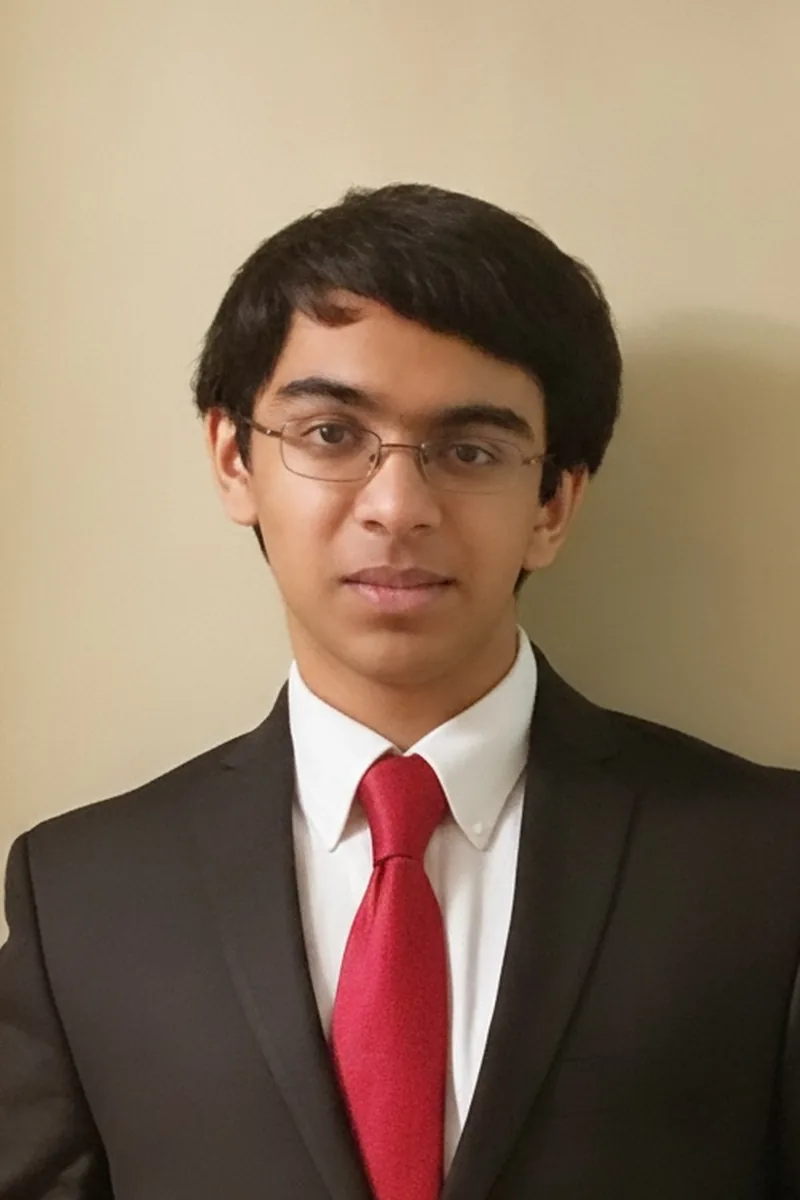
Biophysics at Rice means Aadith solves mechanics problems where the calculus isn't optional — modeling forces on protein structures, analyzing torque in molecular motors, applying Newton's laws to systems most students never picture in a physics classroom. That cross-disciplinary lens gives him a knack for teaching students how to read a physical scenario and decide whether to reach for an energy integral or a force-based differential equation. His 1590 SAT underscores the mathematical precision he brings to every free-response setup.
Computational mathematics at Rice is essentially applied calculus with the volume turned up — Vinson's coursework in differential equations and numerical methods maps directly onto the mechanics problems where students need to set up Newton's second law as a differential equation and solve it, not just memorize kinematic formulas. His 36 ACT and National AP Scholar status (including AP Physics and the full calculus sequence) mean he's been through the exact exam pressure these students face. Rated 4.8 by students.
Decades of chemical engineering work gave Steven a particular fluency with the calculus-based mechanics that AP Physics C demands — he's applied Newton's laws, energy methods, and differential equations to real industrial systems, not just textbook scenarios. He explains each concept multiple ways, layering physical intuition with worked examples until the connection between the physics and the integral clicks. Rated 4.9 by students.
Rice's mechanical engineering program puts Ashton through calculus-based statics, dynamics, and kinematics every semester — the same core mechanics that AP Physics C tests, just applied to real structural and machine systems. That daily exposure means he can spot whether a student's free-response mistake is a physics misread or a calculus execution error, and address the right one. His 32 ACT underscores the quantitative fluency backing his approach.
John scored a 36 on the ACT and tutors the full calculus-to-physics pipeline — AP Calculus AB, AP Physics 1, and AP Physics C: Mechanics — so he sees exactly where students' math skills break down under the pressure of a mechanics problem. He teaches students to recognize which physical scenarios call for integration versus differentiation before they even write an equation, turning the free-response section into a series of deliberate decisions rather than panicked formula hunts. Rated 4.9 by students.
AP Physics C: Mechanics isn't the obvious fit for a political science major — but Lila also tutors calculus, pre-calculus, and both AP Physics C courses, and her 36 ACT reflects the quantitative chops that calculus-based mechanics actually demands. She's especially useful for students who need someone to slow down and rebuild the connection between a free-body diagram and the integral it implies, rather than racing through derivations.
Biomedical engineering at Rice means Aurnab regularly applies calculus-based mechanics to biological systems — modeling forces on skeletal structures, analyzing motion in prosthetic designs — so the kinematics and Newton's laws on the AP Physics C exam map directly onto problems he's already solving in his coursework. His 36 ACT and 1590 SAT point to the mathematical precision that matters most when students need to cleanly set up a work-energy integral or differentiate a position function under exam time pressure. Rated 4.9 by students.
Mechanical engineering at UT Austin means Shroothi isn't just reviewing AP Physics C: Mechanics concepts — she's applying them in coursework where getting a free-body diagram wrong has real design consequences. That engineering context sharpens how she teaches the transition from kinematics to force analysis, especially when problems layer in friction, variable forces, or constraints that demand careful calculus setup. Rated 5.0 by students.
Computational engineering at UT Austin means Atharva lives at the intersection of calculus, physics, and code — so when an AP Physics C problem requires setting up a differential equation for a variable-force scenario or computing rotational inertia through integration, he's drawing on skills he uses across multiple disciplines daily. His 33 ACT and 5.0 tutoring rating back up an approach that emphasizes building the free-body diagram and mathematical model together, so students see exactly where the physics ends and the calculus begins.
What makes Miguel's approach to AP Physics C: Mechanics distinctive is his dual background in computer science and English — he treats each mechanics problem like a piece of code to debug and a paragraph to interpret, teaching students to read force diagrams and word problems with the same precision they'd need to parse a function or an argument. His 35 ACT confirms the quantitative chops, but it's the CS training that sharpens his method for breaking variable-force and rotational problems into clean, sequential logic rather than a tangle of half-remembered equations. Rated 4.9 by students.
Freshman-year statics and dynamics at Purdue's mechanical engineering program threw Austin into calculus-based mechanics problems every week — variable-force work integrals, moment-of-inertia derivations, and the kind of multi-body free-body diagrams that mirror the hardest AP Physics C free-response questions. His 34 ACT and 1520 SAT back up the mathematical fluency needed to teach students not just which equation applies, but how to build it from Newton's second law in differential form. Rated 4.9 by students.
My name is Raghav and I am excited to be your tutor. With years of experience, I've uncovered valuable strategies that helped me excel, and I'm eager to share them with you. Tutoring is my passion, and I'm dedicated to helping students like you reach their academic goals. Having successfully worked with over 100 students from various countries and subjects for over a year, I'm confident I can assist you in achieving your goals. Since each student learns differently, I adapt my teaching to your unique learning style, ensuring that you grasp the material thoroughly. At the moment, I am studying Aerospace Engineering at the University of Illinois at Urbana-Champaign and I am a private pilot working on my instrument rating(I'd love to chat about it with you). With me as your tutor, you will get someone patient and willing to explain everything in detail. I am particularly specialized in Math such as AP Calculus amd beyond, Sciences such as AP Physics, and AP Economics as well as SAT/ACT.
Engineering science at the undergraduate level means Stan works through the calculus-based statics, dynamics, and energy methods that AP Physics C: Mechanics tests — except his coursework applies them to actual structural and mechanical systems. He's particularly strong at teaching students to draw clean free-body diagrams and then translate those diagrams into the integrals and derivatives the exam's free-response questions demand. His 33 ACT and 4.9 tutoring rating back up the quantitative chops.
Currently pursuing her physics degree at UT Austin, Bonita is taking the same calculus-based mechanics courses that feed directly into AP Physics C — Lagrangian setups, variable-force integrations, and the rotational dynamics problems that make the free-response section unforgiving. She also tutors calculus, Python, and quantum computing, which means she can attack a mechanics problem from the math side, the computational side, or the pure physics side depending on where a student is getting stuck.
I am a mechanical engineering student at the esteemed University of Texas at Austin, with an expected graduation in 2026. I am thrilled to have this opportunity to share my passion for teaching with students of all ages.
Hi! I'm an Aerospace Engineering student at UT Austin with experience tutoring physics and a passion for helping students succeed in STEM. I focus on making challenging topics clear, engaging, and approachable through personalized, student centered instruction. As a Microsoft Certified Educator, I aim to build confidence, strengthen understanding, and help students reach their academic goals in a supportive learning environment.
Rami's physics degree at UT Austin means he's solving the same kinds of variable-force integrals, rotational inertia derivations, and differential equations for oscillatory systems that AP Physics C: Mechanics tests — just at a deeper level. He also tutors AP Calculus BC, so when a student gets stuck, he can tell whether the gap is in the physics setup or the calculus execution and address the right one. Rated 4.9 by students.
Thompson's mechanical engineering degree didn't just teach him Newtonian mechanics — it forced him to apply it, designing systems where getting a free-body diagram or moment of inertia calculation wrong means the structure fails. That practical instinct shapes how he teaches AP Physics C: Mechanics, especially when students need to move from a physical setup to the correct calculus formulation on free-response problems. Rated 4.8 by students.
Chemical engineering at McCombs means Mahan spent semesters grinding through the same calculus-based force analysis, work-energy integrals, and rigid body problems that AP Physics C tests — except his versions usually involved fluid systems and thermodynamic constraints on top of the mechanics. That dual fluency in physics and applied math makes him especially effective when a problem requires setting up Newton's second law as a differential equation and then actually solving it without losing the physical meaning along the way.
Kimanthi's biomedical engineering degree from Duke required the same calculus-heavy mechanics — torque on prosthetic joints, force integrals through fluid systems, energy methods applied to biomechanical models — that AP Physics C tests in a more abstract form. That background means she can ground rotational dynamics and work-energy problems in tangible physical scenarios, giving students an intuitive hook before the math gets dense. Rated 5.0 by students.
Emergency medicine demands snap physics intuition — understanding how forces transfer through a body, how momentum changes in a collision, how energy dissipates on impact — and Victoria built that intuition through her pre-med physics coursework before medical school at Boston University. She teaches AP Physics C: Mechanics by grounding each calculus setup in a concrete physical scenario, making sure students can articulate *why* they're integrating a force over a displacement before they ever pick up a pencil. Her math-and-physics double focus across 25 tutoring subjects means she catches the exact moment a student's confusion shifts from the mechanics to the calculus.
Jonathan earned his PhD in physics, which means the calculus-based mechanics in AP Physics C — from deriving equations of motion for coupled oscillators to setting up torque integrals for non-uniform rigid bodies — is territory he's navigated at a research level. His teaching fellowship during graduate school had him running students through exactly these problems, building intuition for when to apply Newton's second law in differential form versus jumping straight to energy methods. Rated 5.0 by students.
Dylan's physics major at Vanderbilt means he's working through the same calculus-based Newtonian mechanics — torque integrals, rotational kinematics, differential equations for oscillating systems — that AP Physics C: Mechanics demands, and his 36 ACT reflects the quantitative precision that carries over to exam performance. He leans on graphical and physical intuition to make abstract quantities like angular momentum feel tangible before translating them into the calculus setup the free-response section scores on.
Hello, my name is Yosef and I would be happy to serve as a math tutor. I place strong emphasis on a good balance between knowledge of mathematical content and proficiency in problem-solving, reasoning, and conveying mathematical ideas in writing. There are times when a student needs to be informed of a solution, times when he or she also needs to hear the explanation of why the solution works, and times when he or she should be guided to finding the solution on his or her own. It is important for the tutor to recognize which approach is appropriate. Frequently, when students struggle, it is because they do not understand the notation or terminology in use. In such cases, it is important to reassure the student, reminding him or her that he or she is only struggling with understanding a single word, not the entire mathematical concept. As a rule, people perform better and are better motivated when they have self-confidence, not when the task ahead seems frighteningly daunting. It is also important to recognize that different students learn best through different means. As an example, some students are visual learners and can understand the material best through pictures and gestures. Other students learn best through hearing the procedures vocalized, while still others learn best through writing out the steps of the solution procedure. I know to adapt my teaching style to the individual student. with these considerations in mind, I promise to provide the best assistance that I can, taking your individual needs into consideration.
Vaughn's physics degree and 1590 SAT mean the calculus-based problem-solving AP Physics C: Mechanics demands — setting up Newton's second law as a differential equation, computing work done by variable forces — is squarely in his wheelhouse. He zeroes in on dimensional analysis and unit tracking as a way to catch errors before they cascade through multi-step free-response problems, a habit that pays off especially in rotational dynamics where signs and reference frames get tricky.
AP Physics C: Mechanics often trips up students who are comfortable with calculus in a math class but freeze when they need to apply it to a pulley system or a variable-force spring problem. Andrew pairs his strong math background — he's pursuing a double focus in finance and mathematics at Boston College — with hands-on physics tutoring across multiple levels, including the SAT Physics subject test. That cross-subject fluency means he can spot whether a student's stuck on the physics setup or the calculus execution and address the right one.
Designing control systems for Northwestern's solar car means Michael applies Newtonian mechanics, rotational dynamics, and energy conservation principles daily — the exact topics AP Physics C: Mechanics tests. He teaches students to translate word problems into free-body diagrams and then into the calculus-based equations that earn full marks on free-response questions.
A PhD in math and a bachelor's in applied math mean Aaron lives in the calculus that most AP Physics C students find intimidating — he can teach the physics and simultaneously strengthen the differential equations and integration techniques underneath it. His problem-solving background shows up in how he approaches mechanics: start from a physical scenario, identify what's conserved or what's changing, then build the math rather than memorize which formula fits. Rated 5.0 by students.
Data analytics trains you to model systems mathematically and interpret what the numbers actually mean — skills Vishank applies directly when tackling AP Physics C: Mechanics problems that require setting up kinematic equations or integrating variable forces. His coursework in calculus through linear algebra, combined with tutoring across both math and science, means he can diagnose whether a student's struggle on a free-response problem is a physics misunderstanding or a calculus execution error. Rated 4.9 by students.
I am a graduate of Cornell University's College of Arts and Sciences. I received my Bachelor of Arts in Chemistry with Distinction in 2015. Since graduation, I was a physics/chemistry teacher and soccer coach at a private school in Virginia for a year, where I led the soccer team to an undefeated season. Before teaching and coaching professionally, I was a Teaching Assistant for the Cornell Math and Physics Departments, where I taught many subjects including calculus, mechanics, electromagnetism. Throughout my time at Cornell and as a teacher, I tutored subjects ranging from the SAT to AP Physics and Algebra II, which is where my true talents lie: in small group or one-on-one settings where I can give students the full attention they deserve and tailor my approach specifically to their learning styles. This is why I am now pursuing tutoring as a part-time occupation at Varsity Tutors. I embrace teaching all math and science subjects, especially physics and calculus, at both the college and high school level and will go above and beyond to make sure all of my students succeed, according to their definition of success. In my spare time, I enjoy playing league soccer, basketball, tennis and guitar, and also like to travel and see as much of the world as I can.
Having scored a 1580 SAT and studied computer science, Rishik brings a programmer's discipline to AP Physics C: Mechanics — treating each problem like an algorithm where you define your variables (forces, constraints, coordinate system) before executing the calculus. He also tutors both AP Physics C exams alongside AP Calculus BC, so he's comfortable moving between the electricity side and the mechanics side while keeping the underlying math sharp. Rated 4.6 by students.
Testimonials
Because the right AP Physics C: Mechanics tutor makes all the difference.
Average Session Rating – Based on 3.4M Learner Ratings
Practice AP Physics C: Mechanics
Free practice tests, flashcards, and AI tutoring for AP Physics C: Mechanics
Nearby AP Physics C: Mechanics Tutors
Other Denton Tutors
Related Science Tutors in Denton
Frequently Asked Questions
AP Physics C: Mechanics focuses on classical mechanics and includes kinematics, Newton's laws, work and energy, momentum, circular motion, oscillations, and gravitation. The course is calculus-based, so you'll use derivatives and integrals to solve problems—which is different from AP Physics 1. For students in Denton preparing for the exam, understanding how these topics connect through calculus is essential, and personalized tutoring can help you master both the physics concepts and the mathematical tools you'll need.
Score improvement depends on your starting point and how consistently you engage with tutoring, but most students see meaningful gains when they work with a tutor to identify weak areas and practice problem-solving systematically. The AP Physics C: Mechanics exam rewards deep conceptual understanding combined with strong problem-solving skills—both areas where personalized 1-on-1 instruction makes a real difference. Varsity Tutors connects you with expert tutors who can create a targeted study plan based on your current level and goals.
Many students struggle with the calculus integration required to solve mechanics problems, especially when translating word problems into mathematical equations. Time management during the exam is another major challenge—the free-response section requires clear reasoning and multiple steps, so pacing matters. Additionally, students often mix up concepts like work versus energy, or struggle to apply Newton's laws in non-obvious situations. A tutor can help you build confidence in these areas through targeted practice and by teaching you strategies to approach unfamiliar problem types.
Practice tests are critical for AP Physics C: Mechanics because they help you get comfortable with the exam format, identify which topics need more work, and build your speed and accuracy under timed conditions. Taking full-length practice tests regularly—ideally every 2-3 weeks as your exam date approaches—lets you see exactly where you're losing points. A tutor can review your practice test results with you, pinpoint patterns in your mistakes, and adjust your study plan accordingly to maximize your score.
Your first session is about building a partnership and understanding where you stand. Your tutor will likely assess your current understanding of key mechanics concepts, discuss your goals (whether you're aiming for a 3, 4, or 5), and learn about any specific topics that feel confusing or challenging. Together, you'll create a study plan that focuses on your weak areas while reinforcing your strengths. This personalized approach means every session after that is designed specifically for your needs.
Varsity Tutors connects you with expert tutors in Denton who specialize in AP Physics C: Mechanics and understand the specific demands of the calculus-based curriculum. You can get matched with a tutor who fits your schedule and learning style, and personalized 1-on-1 instruction means your tutor can focus entirely on your goals and pace. Simply share your needs, and we'll help you find the right fit.
Test anxiety often stems from feeling unprepared or uncertain about how to approach problems—both things that tutoring directly addresses. When you work through challenging problems repeatedly with a tutor, solve practice tests under timed conditions, and get immediate feedback, your confidence naturally builds. Your tutor can also teach you test-taking strategies like how to manage your time, which problems to tackle first, and how to check your work efficiently, all of which reduce anxiety on exam day.
Ideally, you should aim for consistent study throughout the school year rather than cramming before the exam. A typical schedule might include 3-4 hours of weekly study starting several months before the AP exam, with tutoring sessions 1-2 times per week to guide your learning and tackle difficult concepts. As exam day approaches (the last 4-6 weeks), increase to full-length practice tests every week and review your weak areas intensively. Your tutor can help you build and adjust this schedule based on your progress and how much time you have before May.
Let’s find your perfect tutor
Answer a few quick questions. We’ll recommend the right plan and match you with a top 5% tutor.