Award-Winning College Physics Tutors
serving Denver, CO
College Physics
Tutors in Denver
Private 1-on-1 tutoring, weekly live classes for academic support, test prep & enrichment, practice tests and diagnostics, and more to elevate grades and test scores.
Based on 3.4M Learner Ratings
UniversitiesSchools & Universities
DeliveredHours Delivered
ProficiencyGrowth in Proficiency
Who needs tutoring?
No obligation. Takes ~1 minute.

Biomedical engineering at UVA means Colton spent four years where physics meets the human body — modeling forces on prosthetics, analyzing fluid flow through vessels, and applying circuit theory to bioelectrical systems. He also TA'd courses in cell biology and MATLAB, so he's comfortable walking students through both the conceptual reasoning and the computational side of calculus-based physics problems. Rated 4.7 by students.
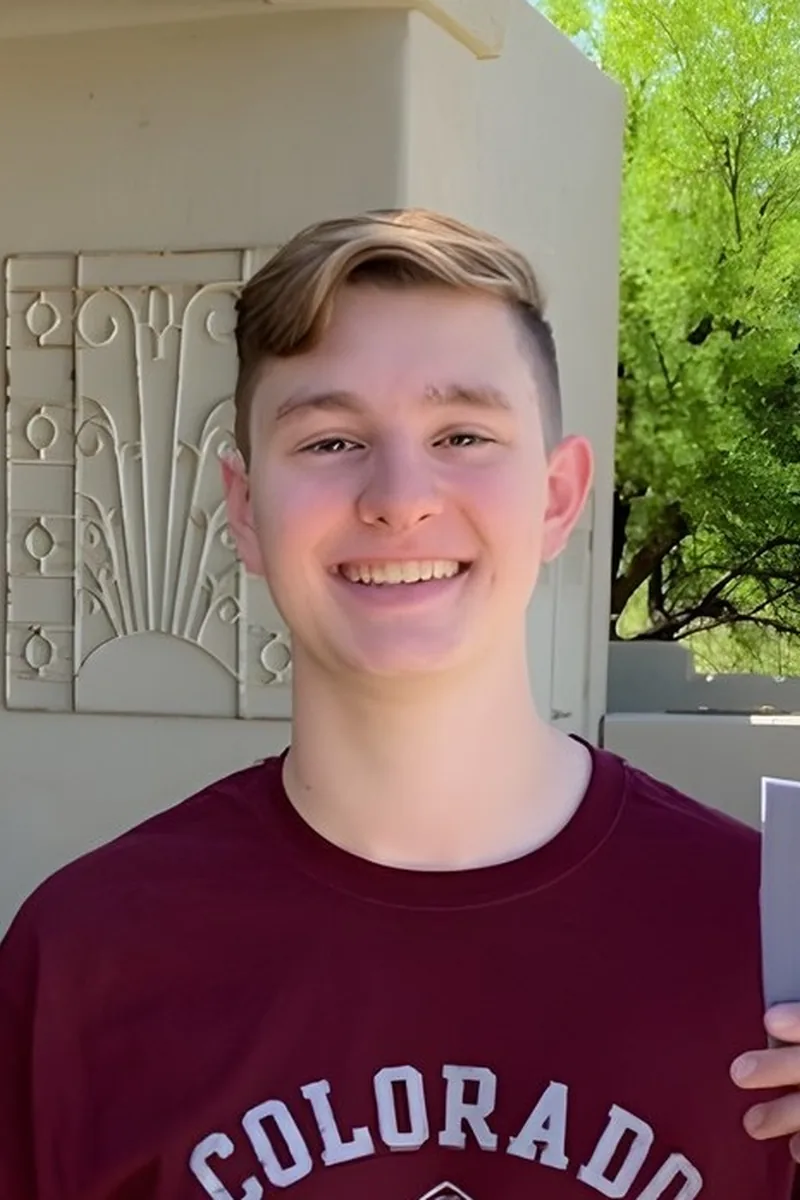
Studying engineering physics at Colorado School of Mines means Jude is taking the same calculus-based physics courses his students are — mechanics, E&M, waves, thermo — and solving the same style of problems week after week. That proximity to the material keeps his instincts sharp on exactly where a problem setup falls apart, whether it's misidentifying the system in a free-body diagram or botching a line integral through a non-uniform field. He scored a 36 ACT and holds a 4.9 tutoring rating.
Studying astrophysics and chemistry at CU Boulder means Graham lives inside the calculus-based physics that makes college courses demanding — orbital mechanics, electromagnetic radiation, thermodynamic processes in stellar atmospheres — and carries a 4.0 GPA through it. He breaks problems down by identifying the governing principle first, whether that's a conservation law or a field equation, then walks through the math step by step so the physics stays visible. Rated 5.0 by students.
Studying physical therapy at UCD means Michelle regularly applies physics to the human body — analyzing force vectors in joint movement, understanding torque during gait, and calculating work done by muscle groups — which gives her a practical anchor for the mechanics topics that dominate introductory college physics. Her biology degree from Trinity and a 4.8 tutoring rating back up her emphasis on conceptual problem-solving: mapping out the physics of a scenario before plugging anything into an equation.
Few tutors bring the depth of a dedicated Engineering Physics program to college-level physics. Cody tackles topics like Lagrangian mechanics, Maxwell's equations, and quantum fundamentals with the rigor of someone who studied them as core coursework at Colorado School of Mines. He also uses Mathematica to visualize complex systems, which is especially useful for students in calculus-based physics sequences.
Evan's physics degree means he didn't just pass college physics — he kept going, tackling thermodynamics, special relativity, and upper-division mechanics well beyond the introductory sequence. That depth lets him trace a tricky concept like rotational inertia or wave superposition back to the underlying principle instead of just drilling the formula. Rated 5.0 by students.
Three years of tutoring introductory physics while completing dual bachelor's degrees in physics and mathematics gave Justin a detailed map of exactly where students lose the thread — the jump from one-dimensional kinematics to rotational analogs, the shift from intuitive force reasoning to formal energy methods. His PhD in Computational Mathematics at the University of Chicago deepened that foundation, adding fluency with the differential equations and vector calculus that make the leap from algebra-based to calculus-based physics so steep. Rated 5.0 by students.
Studying computer science and applied math at Harvard means Derek uses physics constantly — from electromagnetism in circuit design to mechanics in computational modeling. He tackles college-level topics like Lagrangian dynamics and wave equations by connecting the math to physical intuition, making dense derivations feel less abstract.
Chemical engineering at Georgia Tech means Aimee's spent years solving problems that blend thermodynamics, fluid mechanics, and energy balances — the same physics concepts that make college-level courses demanding, except she's applied them to reactor design and process optimization. Her biosystems engineering graduate work adds another layer, connecting classical mechanics and heat transfer to biological systems in ways that make abstract problem sets feel more concrete. Rated 4.9 by students.
A physics PhD means Jonathan didn't just take college physics — he spent years teaching it, earning a teaching fellowship that kept him in front of students even while running his own research. That depth shows when he tackles the conceptual leaps that derail most introductory students, like connecting free-body diagrams to real force interactions or translating a word problem into the right conservation law. Rated 5.0 by students.
A chemistry degree from Yale means Zosia spent years in courses where physics does the heavy lifting — thermodynamics driving reaction spontaneity, quantum mechanics explaining atomic structure, electrostatics governing molecular interactions — so she knows these concepts from the inside out. She's particularly effective at teaching students to translate word-heavy problem statements into clean free-body diagrams or energy bar charts before touching an equation. Rated 4.9 by students.
Biomedical engineering at Johns Hopkins means Christine solves physics problems daily that most students only see in textbooks — fluid dynamics in blood flow, pressure gradients across membranes, mechanics of prosthetic joints — giving her a concrete, application-heavy lens for the material. She's particularly strong on the thermodynamics and mechanics portions of college physics, where her coursework overlaps most directly with standard problem sets. Holds a 5.0 rating.
Neuroscience gave Julie a deep working knowledge of the physics that governs biological systems — membrane capacitance, electrical potentials across ion channels, fluid dynamics in neural vasculature — so she brings a concrete, applied lens to college physics topics that other tutors treat purely abstractly. Her strong quantitative background (1480 SAT, dual B.S. in Neuroscience) means she's comfortable walking through the calculus-based derivations in mechanics and E&M without losing sight of what the physics actually describes. Rated 5.0 by students.
Environmental engineering is essentially physics with consequences — Kate's master's work required her to model fluid flow, heat transfer, and pressure systems in real infrastructure, which means she's solved the same types of problems that show up on college physics exams but with actual design constraints attached. That applied perspective makes her particularly effective at teaching students to set up force balances and energy equations from a physical scenario rather than reverse-engineering from a formula sheet. Rated 4.9 by students.
A bio-organic chemistry degree means Alex spent semesters in calculus-based physics courses where thermodynamics, electromagnetism, and mechanics weren't electives — they were prerequisites for understanding molecular behavior. That chemistry-physics overlap gives him a knack for unpacking energy conservation and electric potential in ways that click for students who think in terms of atoms and reactions rather than pulleys and ramps.
A molecular biology background means Andrew regularly encountered physics in disguise — diffusion rates, membrane potentials, fluid dynamics in biological systems — before his doctoral work added another layer of analytical rigor. He breaks down mechanics and thermodynamics problems by connecting them to tangible phenomena, which makes the abstract math feel less like symbol-pushing. Rated 4.8 by students.
Between earning a mechanical engineering bachelor's and pursuing his master's, Aaron has taken calculus-based physics from every angle — statics, dynamics, thermodynamics, fluid mechanics — and now applies those principles daily in graduate-level research and coursework. He breaks down problems by teaching students to sketch the physical situation first, identify constraints, and only then select the right conservation law or force equation. Holds a 5.0 rating.
Biomedical engineering at VCU meant Waleed spent years applying physics to biological systems — modeling forces on prosthetic joints, analyzing fluid flow through vessels, understanding the electromagnetic principles behind imaging equipment like MRI and ultrasound. That gives him a concrete hook for the mechanics, thermodynamics, and E&M topics that fill college physics problem sets, since he can ground abstract equations in systems students can actually picture. Holds a 5.0 rating.
Testimonials
Because the right College Physics tutor makes all the difference.
Average Session Rating – Based on 3.4M Learner Ratings
Nearby College Physics Tutors
Other Denver Tutors
Related Science Tutors in Denver
Frequently Asked Questions
College Physics generally covers mechanics (motion, forces, energy, momentum), waves and sound, thermodynamics, electricity and magnetism, and often includes an introduction to modern physics. The exact curriculum depends on your course and institution, but most College Physics courses emphasize both the conceptual understanding of these principles and their mathematical applications.
A tutor can help you connect these topics to real-world applications—from how bridges withstand forces to how electricity powers everyday devices—making abstract concepts more tangible and memorable.
Absolutely. Many College Physics courses include hands-on lab components where you design experiments, collect data, and analyze results. Tutors can help you understand the scientific principles behind your experiments, troubleshoot data collection issues, and develop stronger lab reports.
Beyond just getting the right answer, a tutor can guide you through the scientific method—forming hypotheses, controlling variables, and interpreting findings—skills that strengthen your experimental thinking and prepare you for advanced coursework.
Effective College Physics problem-solving involves breaking complex problems into manageable steps: identifying what you know, determining what you need to find, selecting the right equations or principles, and checking whether your answer makes sense. Many students struggle with unit conversions or choosing the correct formula—common sticking points that tutors specifically address.
Rather than just memorizing equations, working with a tutor helps you develop a systematic approach to different problem types, so you can tackle unfamiliar questions with confidence.
College Physics requires grasping underlying principles, not just plugging numbers into formulas. For example, understanding why forces cause acceleration (Newton's second law) matters more than memorizing F=ma. This is where visualizing abstract concepts—imagining how objects move, how energy transfers, or how fields interact—becomes crucial.
A tutor can work through real-world scenarios and thought experiments with you, helping you build mental models of physics concepts. This deeper understanding makes problem-solving more intuitive and prepares you for exams that test reasoning, not just calculation.
Students often struggle with visualizing invisible forces and fields, converting between units, balancing equations, and connecting abstract mathematical relationships to physical reality. Many also find the transition from algebra-based physics to calculus-based physics challenging, especially if their math skills need reinforcement.
For students in Denver, connecting with a tutor who can slow down on these specific pain points—whether that's spending extra time on vector analysis, electromagnetic fields, or energy conservation—can make the difference between frustration and mastery.
Strong College Physics exam preparation involves practicing problems across different topics, understanding both conceptual questions and calculations, and reviewing any weak areas well in advance. Spaced repetition—revisiting concepts over days and weeks rather than cramming—helps information stick better and builds stronger problem-solving intuition.
A tutor can help you create a focused study plan, identify which concepts you haven't fully mastered, and practice exam-style questions under realistic conditions—giving you targeted preparation rather than unfocused review.
Varsity Tutors connects you with expert tutors for College Physics for students in Denver who have strong backgrounds in physics and proven teaching experience. When you get matched with a tutor, they'll tailor their approach to your specific course, instructor, and learning style—whether you need help with lecture concepts, lab preparation, or exam review.
The right tutor can adapt explanations to your pace, answer your specific questions, and help you build both conceptual understanding and problem-solving skills.
Let’s find your perfect tutor
Answer a few quick questions. We’ll recommend the right plan and match you with a top 5% tutor.