Other Lines - SSAT Upper Level Quantitative
Card 0 of 260
What is the slope of the given linear equation?
2x + 4y = -7
What is the slope of the given linear equation?
2x + 4y = -7
Tap to see back →
We can convert the given equation into slope-intercept form, y=mx+b, where m is the slope. We get y = (-1/2)x + (-7/2)
We can convert the given equation into slope-intercept form, y=mx+b, where m is the slope. We get y = (-1/2)x + (-7/2)
Find the slope of the line 6X – 2Y = 14
Find the slope of the line 6X – 2Y = 14
Tap to see back →
Put the equation in slope-intercept form:
y = mx + b
-2y = -6x +14
y = 3x – 7
The slope of the line is represented by M; therefore the slope of the line is 3.
Put the equation in slope-intercept form:
y = mx + b
-2y = -6x +14
y = 3x – 7
The slope of the line is represented by M; therefore the slope of the line is 3.
What is the slope of the line:
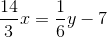
What is the slope of the line:
Tap to see back →
First put the question in slope intercept form (y = mx + b):
–(1/6)y = –(14/3)x – 7 =>
y = 6(14/3)x – 7
y = 28x – 7.
The slope is 28.
First put the question in slope intercept form (y = mx + b):
–(1/6)y = –(14/3)x – 7 =>
y = 6(14/3)x – 7
y = 28x – 7.
The slope is 28.
If 2x – 4y = 10, what is the slope of the line?
If 2x – 4y = 10, what is the slope of the line?
Tap to see back →
First put the equation into slope-intercept form, solving for y: 2x – 4y = 10 → –4y = –2x + 10 → y = 1/2*x – 5/2. So the slope is 1/2.
First put the equation into slope-intercept form, solving for y: 2x – 4y = 10 → –4y = –2x + 10 → y = 1/2*x – 5/2. So the slope is 1/2.
What is the slope of the line with equation 4_x_ – 16_y_ = 24?
What is the slope of the line with equation 4_x_ – 16_y_ = 24?
Tap to see back →
The equation of a line is:
y = mx + b, where m is the slope
4_x_ – 16_y_ = 24
–16_y_ = –4_x_ + 24
y = (–4_x_)/(–16) + 24/(–16)
y = (1/4)x – 1.5
Slope = 1/4
The equation of a line is:
y = mx + b, where m is the slope
4_x_ – 16_y_ = 24
–16_y_ = –4_x_ + 24
y = (–4_x_)/(–16) + 24/(–16)
y = (1/4)x – 1.5
Slope = 1/4
Find the slope of the line that passes through the points 
Find the slope of the line that passes through the points
Tap to see back →
Use the following formula to find the slope:
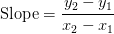

Use the following formula to find the slope:
Given the graph of the line below, find the equation of the line.
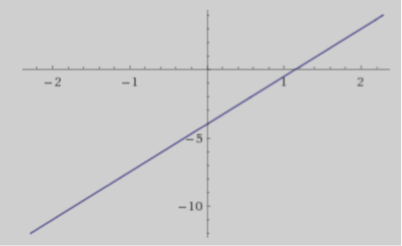
Given the graph of the line below, find the equation of the line.
Tap to see back →
To solve this question, you could use two points such as (1.2,0) and (0,-4) to calculate the slope which is 10/3 and then read the y-intercept off the graph, which is -4.
To solve this question, you could use two points such as (1.2,0) and (0,-4) to calculate the slope which is 10/3 and then read the y-intercept off the graph, which is -4.
Give the equation of the line through  and
and  .
.
Give the equation of the line through
Tap to see back →
First, find the slope:

Apply the point-slope formula:


Rewriting in standard form:


First, find the slope:
Apply the point-slope formula:
Rewriting in standard form:
A line can be represented by  . What is the slope of the line that is perpendicular to it?
A line can be represented by
Tap to see back →
You will first solve for Y, to get the equation in  form.
form.
 represents the slope of the line, which would be
  .
.
A perpendicular line's slope would be the negative reciprocal of that value, which is  .
.
You will first solve for Y, to get the equation in
A perpendicular line's slope would be the negative reciprocal of that value, which is

Examine the above diagram. What is  ?
?
Examine the above diagram. What is
Tap to see back →
Use the properties of angle addition:


Use the properties of angle addition:
Give the equation of a line that passes through the point  and has an undefined slope.
Give the equation of a line that passes through the point
Tap to see back →
A line with an undefined slope has equation  for some number
  ; since this line passes through a point with
  -coordinate 4, then this line must have equation
A line with an undefined slope has equation
Give the equation of a line that passes through the point  and has slope 1.
Give the equation of a line that passes through the point
Tap to see back →
We can use the point slope form of a line, substituting  .
.


or

We can use the point slope form of a line, substituting
or
Find the equation the line goes through the points  and
and  .
.
Find the equation the line goes through the points
Tap to see back →
First, find the slope of the line.

Now, because the problem tells us that the line goes through  , our y-intercept must be
  .
.
Putting the pieces together, we get the following equation:

First, find the slope of the line.
Now, because the problem tells us that the line goes through
Putting the pieces together, we get the following equation:
A line passes through the points  and
and  . Find the equation of this line.
A line passes through the points
Tap to see back →
To find the equation of a line, we need to first find the slope.

Now, our equation for the line looks like the following:

To find the y-intercept, plug in one of the given points and solve for  . Using
  , we get the following equation:

Solve for  .
.


Now, plug the value for  into the equation.

To find the equation of a line, we need to first find the slope.
Now, our equation for the line looks like the following:
To find the y-intercept, plug in one of the given points and solve for
Solve for
Now, plug the value for
What is the equation of a line that passes through the points  and
and  ?
?
What is the equation of a line that passes through the points
Tap to see back →
First, we need to find the slope of the line.

Next, find the  -intercept. To find the
  -intercept, plug in the values of one point into the equation
  , where
  is the slope that we just found and
  is the
  -intercept.

Solve for  .
.


Now, put the slope and  -intercept together to get
First, we need to find the slope of the line.
Next, find the
Solve for
Now, put the slope and
Are the following two equations parallel?


Are the following two equations parallel?
Tap to see back →
When two lines are parallal, they must have the same slope.
Look at the equations when they are in slope-intercept form,  where b represents the slope.
We must first reduce the second equation since all of the constants are divisible by  .
.
This leaves us with  . Since both equations have a slope of
  , they are parallel.
When two lines are parallal, they must have the same slope.
Look at the equations when they are in slope-intercept form,
We must first reduce the second equation since all of the constants are divisible by
This leaves us with
Reduce the following expression:

Reduce the following expression:
Tap to see back →
For this expression, you must take each variable and deal with them separately.
First divide you two constants  .
.
Then you move onto  and when you divide like exponents you must subtract the exponents leaving you with
  .
.
 is left by itself since it is already in a natural position.
Whenever you have a negative exponential term, you must it in the denominator.
This leaves the expression of  .
.
For this expression, you must take each variable and deal with them separately.
First divide you two constants
Then you move onto
Whenever you have a negative exponential term, you must it in the denominator.
This leaves the expression of
A line is defined by the following equation:

What is the slope of that line?
A line is defined by the following equation:
What is the slope of that line?
Tap to see back →
The equation of a line is
y=mx + b where m is the slope
Rearrange the equation to match this:
7x + 28y = 84
28y = -7x + 84
y = -(7/28)x + 84/28
y = -(1/4)x + 3
m = -1/4
The equation of a line is
y=mx + b where m is the slope
Rearrange the equation to match this:
7x + 28y = 84
28y = -7x + 84
y = -(7/28)x + 84/28
y = -(1/4)x + 3
m = -1/4
For the line

Which one of these coordinates can be found on the line?
For the line
Which one of these coordinates can be found on the line?
Tap to see back →
To test the coordinates, plug the x-coordinate into the line equation and solve for y.
y = 1/3x -7
Test (3,-6)
y = 1/3(3) – 7 = 1 – 7 = -6 YES!
Test (3,7)
y = 1/3(3) – 7 = 1 – 7 = -6 NO
Test (6,-12)
y = 1/3(6) – 7 = 2 – 7 = -5 NO
Test (6,5)
y = 1/3(6) – 7 = 2 – 7 = -5 NO
Test (9,5)
y = 1/3(9) – 7 = 3 – 7 = -4 NO
To test the coordinates, plug the x-coordinate into the line equation and solve for y.
y = 1/3x -7
Test (3,-6)
y = 1/3(3) – 7 = 1 – 7 = -6 YES!
Test (3,7)
y = 1/3(3) – 7 = 1 – 7 = -6 NO
Test (6,-12)
y = 1/3(6) – 7 = 2 – 7 = -5 NO
Test (6,5)
y = 1/3(6) – 7 = 2 – 7 = -5 NO
Test (9,5)
y = 1/3(9) – 7 = 3 – 7 = -4 NO
Consider the lines described by the following two equations:
4y = 3x2
3y = 4x2
Find the vertical distance between the two lines at the points where x = 6.
Consider the lines described by the following two equations:
4y = 3x2
3y = 4x2
Find the vertical distance between the two lines at the points where x = 6.
Tap to see back →
Since the vertical coordinates of each point are given by y, solve each equation for y and plug in 6 for x, as follows:

Taking the difference of the resulting y -values give the vertical distance between the points (6,27) and (6,48), which is 21.
Since the vertical coordinates of each point are given by y, solve each equation for y and plug in 6 for x, as follows:
Taking the difference of the resulting y -values give the vertical distance between the points (6,27) and (6,48), which is 21.