How to find whether lines are parallel - SSAT Upper Level Quantitative
Card 0 of 28
Line A has equation  .
.
Line B has equation  .
.
Which statement is true of the two lines?
Line A has equation
Line B has equation
Which statement is true of the two lines?
Tap to see back →
Write each statement in slope-intercept form:
Line A:


The slope is  .
.
Line B:


The slope is  .
.
The lines have differing slopes, so they are neither identical nor parallel. The product of the slopes is  , so they are not perpendicular. The correct response is that they are distinct lines that are neither parallel nor perpendicular.
Write each statement in slope-intercept form:
Line A:
The slope is
Line B:
The slope is
The lines have differing slopes, so they are neither identical nor parallel. The product of the slopes is
You are given three lines as follows:
Line A includes points  and
and  .
.
Line B includes point  and has
  -intercept
  .
.
Line C includes the origin and point  .
.
Which lines are parallel?
You are given three lines as follows:
Line A includes points
Line B includes point
Line C includes the origin and point
Which lines are parallel?
Tap to see back →
Find the slope of all three lines using the slope formula  :
:
Line A:


Line B:


Line C:


Lines A and C have the same slope; Line B has a different slope. Only Lines A and C are parallel.
Find the slope of all three lines using the slope formula
Line A:
Line B:
Line C:
Lines A and C have the same slope; Line B has a different slope. Only Lines A and C are parallel.
Line P passes through the origin and point  .
.
Line Q passes through the origin and point  .
.
Line R passes through the origin and point  .
.
Line S passes through the origin and point  .
.
Which of these lines is parallel to the line of the equation  ?
?
Line P passes through the origin and point
Line Q passes through the origin and point
Line R passes through the origin and point
Line S passes through the origin and point
Which of these lines is parallel to the line of the equation
Tap to see back →
First, find the slope of the line of the equation  by rewriting it in slope-intercept form:


The slope of this line is  , so we are looking for a line which also has this slope.
Find the slopes of all four lines by using the slope formula  . Since each line passes through the origin, this formula can be simplified to

using the other point.
Line P:

Line Q:

Line R:

Line S:

Line S has the desired slope and is the correct choice.
First, find the slope of the line of the equation
The slope of this line is
Find the slopes of all four lines by using the slope formula
using the other point.
Line P:
Line Q:
Line R:
Line S:
Line S has the desired slope and is the correct choice.

Figure NOT drawn to scale
In the above figure,  . Evaluate
  .
.
Figure NOT drawn to scale
In the above figure,
Tap to see back →
The two marked angles are same-side exterior angles of two parallel lines formed by a transversal  ,; by the Parallel Postulate, the angles are supplementary - the sum of their measures is 180 degrees. Therefore,


The two marked angles are same-side exterior angles of two parallel lines formed by a transversal
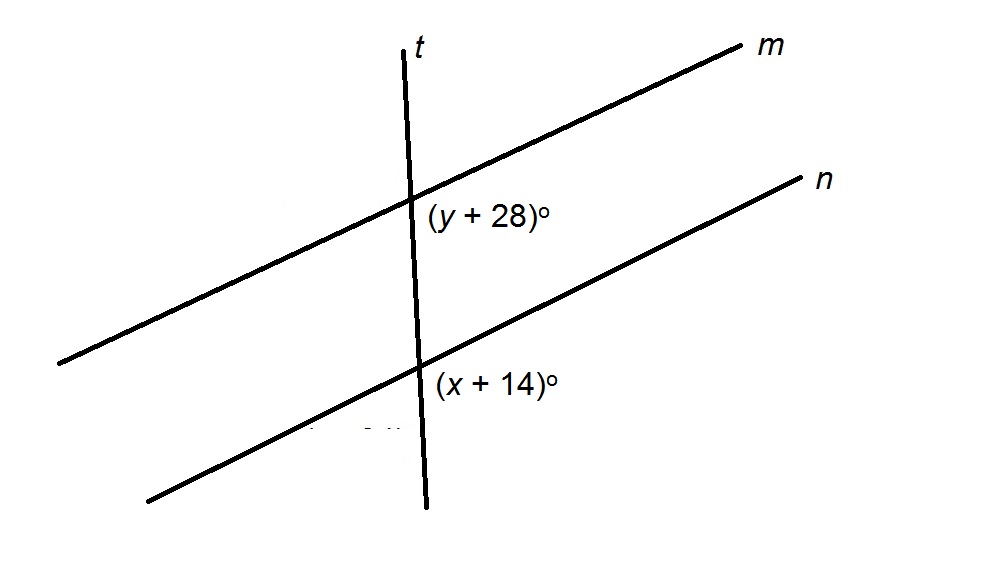
Figure NOT drawn to scale
In the above figure,  . Express
  in terms of
  .
.
Figure NOT drawn to scale
In the above figure,
Tap to see back →
The two marked angles are corresponding angles of two parallel lines formed by a transversal, so the angles are congruent. Therefore,

Solving for  by subtracting 28 from both sides:


The two marked angles are corresponding angles of two parallel lines formed by a transversal, so the angles are congruent. Therefore,
Solving for

Figure NOT drawn to scale
In the above figure,  . Express
  in terms of
  .
.
Figure NOT drawn to scale
In the above figure,
Tap to see back →
The two marked angles are same-side interior angles of two parallel lines formed by a transversal  ; by the Parallel Postulate, the angles are supplementary - the sum of their measures is 180 degrees. Therefore,


Solve for  by moving the other terms to the other side and simplifying:


The two marked angles are same-side interior angles of two parallel lines formed by a transversal
Solve for

Figure NOT drawn to scale
In the above figure,  . Evaluate
  .
.
Figure NOT drawn to scale
In the above figure,
Tap to see back →
Angles of degree measures  and
and  form a linear pair, making the angles supplementary - that is, their degree measures total 180. Therefore,

Solving for  :
:


The angles of measures  and
and  form a pair of alternating interior angles of parallel lines, so, as a consequence of the Parallel Postulate, they are congruent, and

Substituting for  :
:

Angles of degree measures
Solving for
The angles of measures
Substituting for
Line A has equation .
Line B has equation .
Which statement is true of the two lines?
Line A has equation
Line B has equation
Which statement is true of the two lines?
Tap to see back →
Write each statement in slope-intercept form:
Line A:
The slope is .
Line B:
The slope is .
The lines have differing slopes, so they are neither identical nor parallel. The product of the slopes is , so they are not perpendicular. The correct response is that they are distinct lines that are neither parallel nor perpendicular.
Write each statement in slope-intercept form:
Line A:
The slope is
Line B:
The slope is
The lines have differing slopes, so they are neither identical nor parallel. The product of the slopes is
You are given three lines as follows:
Line A includes points and .
Line B includes point and has -intercept .
Line C includes the origin and point .
Which lines are parallel?
You are given three lines as follows:
Line A includes points
Line B includes point
Line C includes the origin and point
Which lines are parallel?
Tap to see back →
Find the slope of all three lines using the slope formula :
Line A:
Line B:
Line C:
Lines A and C have the same slope; Line B has a different slope. Only Lines A and C are parallel.
Find the slope of all three lines using the slope formula
Line A:
Line B:
Line C:
Lines A and C have the same slope; Line B has a different slope. Only Lines A and C are parallel.
Line P passes through the origin and point .
Line Q passes through the origin and point .
Line R passes through the origin and point .
Line S passes through the origin and point .
Which of these lines is parallel to the line of the equation ?
Line P passes through the origin and point
Line Q passes through the origin and point
Line R passes through the origin and point
Line S passes through the origin and point
Which of these lines is parallel to the line of the equation
Tap to see back →
First, find the slope of the line of the equation by rewriting it in slope-intercept form:
The slope of this line is , so we are looking for a line which also has this slope.
Find the slopes of all four lines by using the slope formula . Since each line passes through the origin, this formula can be simplified to
using the other point.
Line P:
Line Q:
Line R:
Line S:
Line S has the desired slope and is the correct choice.
First, find the slope of the line of the equation
The slope of this line is
Find the slopes of all four lines by using the slope formula
using the other point.
Line P:
Line Q:
Line R:
Line S:
Line S has the desired slope and is the correct choice.
Figure NOT drawn to scale
In the above figure, . Evaluate .
Figure NOT drawn to scale
In the above figure,
Tap to see back →
The two marked angles are same-side exterior angles of two parallel lines formed by a transversal ,; by the Parallel Postulate, the angles are supplementary - the sum of their measures is 180 degrees. Therefore,
The two marked angles are same-side exterior angles of two parallel lines formed by a transversal
Figure NOT drawn to scale
In the above figure, . Express in terms of .
Figure NOT drawn to scale
In the above figure,
Tap to see back →
The two marked angles are corresponding angles of two parallel lines formed by a transversal, so the angles are congruent. Therefore,
Solving for by subtracting 28 from both sides:
The two marked angles are corresponding angles of two parallel lines formed by a transversal, so the angles are congruent. Therefore,
Solving for
Figure NOT drawn to scale
In the above figure, . Express in terms of .
Figure NOT drawn to scale
In the above figure,
Tap to see back →
The two marked angles are same-side interior angles of two parallel lines formed by a transversal ; by the Parallel Postulate, the angles are supplementary - the sum of their measures is 180 degrees. Therefore,
Solve for by moving the other terms to the other side and simplifying:
The two marked angles are same-side interior angles of two parallel lines formed by a transversal
Solve for
Figure NOT drawn to scale
In the above figure, . Evaluate .
Figure NOT drawn to scale
In the above figure,
Tap to see back →
Angles of degree measures and form a linear pair, making the angles supplementary - that is, their degree measures total 180. Therefore,
Solving for :
The angles of measures and form a pair of alternating interior angles of parallel lines, so, as a consequence of the Parallel Postulate, they are congruent, and
Substituting for :
Angles of degree measures
Solving for
The angles of measures
Substituting for
Line A has equation .
Line B has equation .
Which statement is true of the two lines?
Line A has equation
Line B has equation
Which statement is true of the two lines?
Tap to see back →
Write each statement in slope-intercept form:
Line A:
The slope is .
Line B:
The slope is .
The lines have differing slopes, so they are neither identical nor parallel. The product of the slopes is , so they are not perpendicular. The correct response is that they are distinct lines that are neither parallel nor perpendicular.
Write each statement in slope-intercept form:
Line A:
The slope is
Line B:
The slope is
The lines have differing slopes, so they are neither identical nor parallel. The product of the slopes is
You are given three lines as follows:
Line A includes points and .
Line B includes point and has -intercept .
Line C includes the origin and point .
Which lines are parallel?
You are given three lines as follows:
Line A includes points
Line B includes point
Line C includes the origin and point
Which lines are parallel?
Tap to see back →
Find the slope of all three lines using the slope formula :
Line A:
Line B:
Line C:
Lines A and C have the same slope; Line B has a different slope. Only Lines A and C are parallel.
Find the slope of all three lines using the slope formula
Line A:
Line B:
Line C:
Lines A and C have the same slope; Line B has a different slope. Only Lines A and C are parallel.
Line P passes through the origin and point .
Line Q passes through the origin and point .
Line R passes through the origin and point .
Line S passes through the origin and point .
Which of these lines is parallel to the line of the equation ?
Line P passes through the origin and point
Line Q passes through the origin and point
Line R passes through the origin and point
Line S passes through the origin and point
Which of these lines is parallel to the line of the equation
Tap to see back →
First, find the slope of the line of the equation by rewriting it in slope-intercept form:
The slope of this line is , so we are looking for a line which also has this slope.
Find the slopes of all four lines by using the slope formula . Since each line passes through the origin, this formula can be simplified to
using the other point.
Line P:
Line Q:
Line R:
Line S:
Line S has the desired slope and is the correct choice.
First, find the slope of the line of the equation
The slope of this line is
Find the slopes of all four lines by using the slope formula
using the other point.
Line P:
Line Q:
Line R:
Line S:
Line S has the desired slope and is the correct choice.
Figure NOT drawn to scale
In the above figure, . Evaluate .
Figure NOT drawn to scale
In the above figure,
Tap to see back →
The two marked angles are same-side exterior angles of two parallel lines formed by a transversal ,; by the Parallel Postulate, the angles are supplementary - the sum of their measures is 180 degrees. Therefore,
The two marked angles are same-side exterior angles of two parallel lines formed by a transversal
Figure NOT drawn to scale
In the above figure, . Express in terms of .
Figure NOT drawn to scale
In the above figure,
Tap to see back →
The two marked angles are corresponding angles of two parallel lines formed by a transversal, so the angles are congruent. Therefore,
Solving for by subtracting 28 from both sides:
The two marked angles are corresponding angles of two parallel lines formed by a transversal, so the angles are congruent. Therefore,
Solving for
Figure NOT drawn to scale
In the above figure, . Express in terms of .
Figure NOT drawn to scale
In the above figure,
Tap to see back →
The two marked angles are same-side interior angles of two parallel lines formed by a transversal ; by the Parallel Postulate, the angles are supplementary - the sum of their measures is 180 degrees. Therefore,
Solve for by moving the other terms to the other side and simplifying:
The two marked angles are same-side interior angles of two parallel lines formed by a transversal
Solve for