How to find a complex fraction - SSAT Upper Level Quantitative
Card 0 of 32
Simplify, writing as a proper fraction.

Simplify, writing as a proper fraction.
Tap to see back →
Remember that that fraction bar is just a division symbol. Rewrite as a division, rewrite those mixed fractions as improper fractions, then rewrite as as a multiplication by the reciprocal of the second fraction.

Remember that that fraction bar is just a division symbol. Rewrite as a division, rewrite those mixed fractions as improper fractions, then rewrite as as a multiplication by the reciprocal of the second fraction.
Simplify:

Simplify:
Tap to see back →
Add the fractions in the numerator, then divide the sum by the denominator:



Add the fractions in the numerator, then divide the sum by the denominator:
Simplify:

Simplify:
Tap to see back →
Simplify the sum in the numerator, then divide by the denominator:



Simplify the sum in the numerator, then divide by the denominator:
Simplify:

Simplify:
Tap to see back →
Rewrite this as a division problem, then solve:

Rewrite this as a division problem, then solve:
Simplify:

Simplify:
Tap to see back →
Rewrite this as a division problem, then solve:

Rewrite this as a division problem, then solve:
Simplify:

Simplify:
Tap to see back →

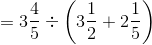
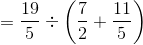
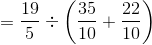


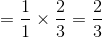
Simplify:

Simplify:
Tap to see back →

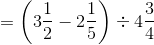
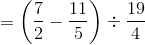
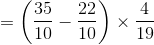


This is not among the given responses.
This is not among the given responses.
Simplify:

Simplify:
Tap to see back →

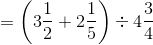
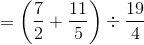
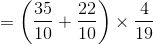


Simplify, writing as a proper fraction.
Simplify, writing as a proper fraction.
Tap to see back →
Remember that that fraction bar is just a division symbol. Rewrite as a division, rewrite those mixed fractions as improper fractions, then rewrite as as a multiplication by the reciprocal of the second fraction.
Remember that that fraction bar is just a division symbol. Rewrite as a division, rewrite those mixed fractions as improper fractions, then rewrite as as a multiplication by the reciprocal of the second fraction.
Simplify:
Simplify:
Tap to see back →
Add the fractions in the numerator, then divide the sum by the denominator:
Add the fractions in the numerator, then divide the sum by the denominator:
Simplify:
Simplify:
Tap to see back →
Simplify the sum in the numerator, then divide by the denominator:
Simplify the sum in the numerator, then divide by the denominator:
Simplify:
Simplify:
Tap to see back →
Rewrite this as a division problem, then solve:
Rewrite this as a division problem, then solve:
Simplify:
Simplify:
Tap to see back →
Rewrite this as a division problem, then solve:
Rewrite this as a division problem, then solve:
Simplify:
Simplify:
Tap to see back →
Simplify:
Simplify:
Tap to see back →
This is not among the given responses.
This is not among the given responses.
Simplify:
Simplify:
Tap to see back →
Simplify, writing as a proper fraction.
Simplify, writing as a proper fraction.
Tap to see back →
Remember that that fraction bar is just a division symbol. Rewrite as a division, rewrite those mixed fractions as improper fractions, then rewrite as as a multiplication by the reciprocal of the second fraction.
Remember that that fraction bar is just a division symbol. Rewrite as a division, rewrite those mixed fractions as improper fractions, then rewrite as as a multiplication by the reciprocal of the second fraction.
Simplify:
Simplify:
Tap to see back →
Add the fractions in the numerator, then divide the sum by the denominator:
Add the fractions in the numerator, then divide the sum by the denominator:
Simplify:
Simplify:
Tap to see back →
Simplify the sum in the numerator, then divide by the denominator:
Simplify the sum in the numerator, then divide by the denominator:
Simplify:
Simplify:
Tap to see back →
Rewrite this as a division problem, then solve:
Rewrite this as a division problem, then solve: