Rectangles - SSAT Elementary Level Quantitative
Card 1 of 2104
How many sides does a rectangle have?
How many sides does a rectangle have?
Tap to reveal answer
A rectangle is a shape with 4 sides. The opposite sides have equal lengths.
A rectangle is a shape with 4 sides. The opposite sides have equal lengths.
← Didn't Know|Knew It →
If Adam draws a rectangle with a long side of 6 cm and a short side of 5 cm, what is the perimeter?
If Adam draws a rectangle with a long side of 6 cm and a short side of 5 cm, what is the perimeter?
Tap to reveal answer
To find the perimeter of a rectangle, add all four sides:

To find the perimeter of a rectangle, add all four sides:
← Didn't Know|Knew It →

How many feet of fence do you need to surround the rectangular area in front of the house?
How many feet of fence do you need to surround the rectangular area in front of the house?
Tap to reveal answer
In order to figure out how many feet of fence you need, add up all of the segments that are going to be fenced. Thus,  . Remember, you will not need to put fence where the house is.
In order to figure out how many feet of fence you need, add up all of the segments that are going to be fenced. Thus,
← Didn't Know|Knew It →
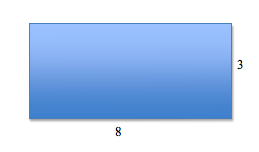
What is the perimeter of the rectangle?
What is the perimeter of the rectangle?
Tap to reveal answer
To find the perimeter of this rectangle, add all four sides together. Even though we are not given the length of all four sides, we know that opposite sides of a rectangle are always equal.

To find the perimeter of this rectangle, add all four sides together. Even though we are not given the length of all four sides, we know that opposite sides of a rectangle are always equal.
← Didn't Know|Knew It →
Which of the lists below could represent the side lengths of a rectangle?
Which of the lists below could represent the side lengths of a rectangle?
Tap to reveal answer
Rectangles have two pairs of equal sides.
Rectangles have two pairs of equal sides.
← Didn't Know|Knew It →
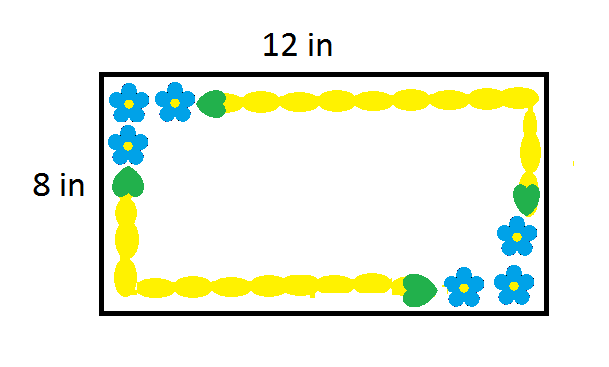
A rectangular birthday cake (shown above) measures 8 inches by 12 inches. What is the perimeter of the cake?
A rectangular birthday cake (shown above) measures 8 inches by 12 inches. What is the perimeter of the cake?
Tap to reveal answer


← Didn't Know|Knew It →
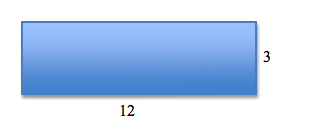
What is the perimeter of the above rectangle?
What is the perimeter of the above rectangle?
Tap to reveal answer
To find the perimeter of this rectangle, add all four sides together. Even though we are not given the length of all four sides, we know that opposite sides are always equal.

To find the perimeter of this rectangle, add all four sides together. Even though we are not given the length of all four sides, we know that opposite sides are always equal.
← Didn't Know|Knew It →
If Elijah draws a rectangle with a long side of 9 cm and a short side of 3 cm, what is the perimeter of the rectangle?
If Elijah draws a rectangle with a long side of 9 cm and a short side of 3 cm, what is the perimeter of the rectangle?
Tap to reveal answer
To find the perimeter of a rectangle, add all four sides:

To find the perimeter of a rectangle, add all four sides:
← Didn't Know|Knew It →
One rectangular lane in a swimming pool is  feet wide and
  feet long. What is the area of the lane?
One rectangular lane in a swimming pool is
Tap to reveal answer
Area is calculated for a rectangle as width multiplied by length. In this case,  square feet.
Area is calculated for a rectangle as width multiplied by length. In this case,
← Didn't Know|Knew It →
A rectangular table can seat  people on each of its longer sides and
  people on each of its shorter sides.
How many people are at the table when all the seats are filled?
A rectangular table can seat
How many people are at the table when all the seats are filled?
Tap to reveal answer
Since a rectangle has two pairs of equal-length sides, multiply the number of people that can sit on each side by  , then add these numbers together to find the total number of people that can sit at the table.
 people
Since a rectangle has two pairs of equal-length sides, multiply the number of people that can sit on each side by
← Didn't Know|Knew It →
What is the PERIMETER of the rectangle in the image?
What is the PERIMETER of the rectangle in the image?
Tap to reveal answer
Because the problem asks you to find the perimeter, you are looking for the total distance around the outside of the shape. The problem also tells you that the figure is a rectangle, so you know that all the sides are 10 cm and 30 cm. Adding all four sides gives the perimeter: 
Because the problem asks you to find the perimeter, you are looking for the total distance around the outside of the shape. The problem also tells you that the figure is a rectangle, so you know that all the sides are 10 cm and 30 cm. Adding all four sides gives the perimeter:
← Didn't Know|Knew It →
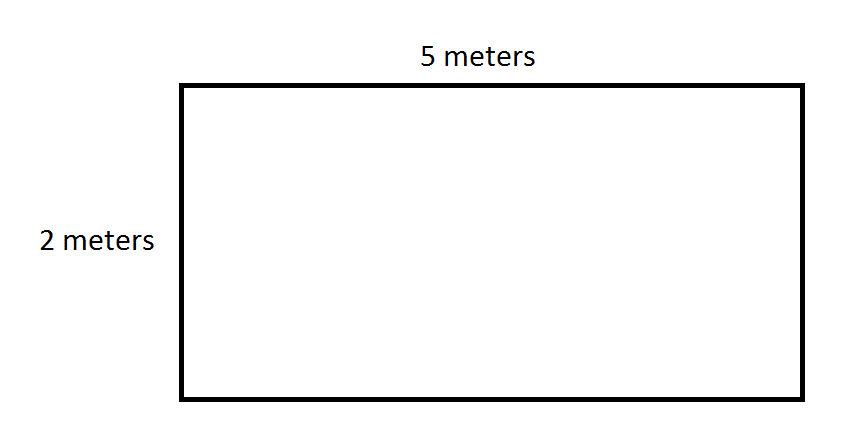
Give the perimeter of the rectangle in millimeters.
Give the perimeter of the rectangle in millimeters.
Tap to reveal answer
Use the following formula for the perimeter, substituting the two side lengths,  :
:


Since there are 1,000 millimeters in 1 meter, multiply the answer by 1,000:

Use the following formula for the perimeter, substituting the two side lengths,
Since there are 1,000 millimeters in 1 meter, multiply the answer by 1,000:
← Didn't Know|Knew It →
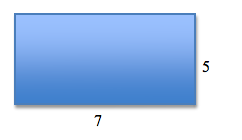
What is the perimeter of the above rectangle?
What is the perimeter of the above rectangle?
Tap to reveal answer
To find the perimeter of this rectangle, add all four sides together. Even though we are not given the length of all four sides, we know that opposite sides of a rectangle are always equal!

To find the perimeter of this rectangle, add all four sides together. Even though we are not given the length of all four sides, we know that opposite sides of a rectangle are always equal!
← Didn't Know|Knew It →
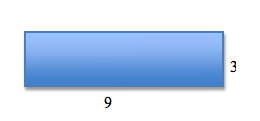
What is the perimeter of the rectangle?
What is the perimeter of the rectangle?
Tap to reveal answer
To find the perimeter of a rectangle, add all four sides together.

To find the perimeter of a rectangle, add all four sides together.
← Didn't Know|Knew It →
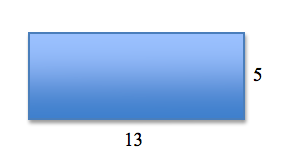
What is the perimeter of the rectangle?
What is the perimeter of the rectangle?
Tap to reveal answer
To find the perimeter of this rectangle, add all four sides together. Even though we are not given the length of all four sides, we know that opposites sides of a rectangle are always equal.

To find the perimeter of this rectangle, add all four sides together. Even though we are not given the length of all four sides, we know that opposites sides of a rectangle are always equal.
← Didn't Know|Knew It →
A rectangle has sides of lengths  and
and  . What is its perimeter?
A rectangle has sides of lengths
Tap to reveal answer
Since a rectangle has two sets of equal sides, the perimeter is the sum of twice each of the two sides given.  and
and  .
.  , which is the answer.
Since a rectangle has two sets of equal sides, the perimeter is the sum of twice each of the two sides given.
← Didn't Know|Knew It →
If a rectangle has a perimeter of  units, and one of its sides is of length
  , what are the lengths of its other three sides?
If a rectangle has a perimeter of
Tap to reveal answer
Since rectangles have two sets of equal sides, and one side is of length  , there must be another side of length
  . Since we know the total perimeter of the rectangle, we can get the length of the two remaining sides by subtracting the two known side lengths from the total perimeter.
  , and since the rectangle must have another set of equal sides, we must split
  into two equal parts. Therefore, the last two sides must be
  and
and  . This means the rectangle's other three sides must be
  ,
,  , and
, and  .
.
Since rectangles have two sets of equal sides, and one side is of length
← Didn't Know|Knew It →

What is the perimeter of the above rectangle?
What is the perimeter of the above rectangle?
Tap to reveal answer
To find the perimeter of the rectangle, add all four sides together. Even though we are not given the length of all four sides, we know that opposite sides are always equal.

To find the perimeter of the rectangle, add all four sides together. Even though we are not given the length of all four sides, we know that opposite sides are always equal.
← Didn't Know|Knew It →

What is the perimeter of the blue rectangle?
What is the perimeter of the blue rectangle?
Tap to reveal answer
To find the perimeter of the rectangle, add all four sides together. Even though we are not given the length of all four sides, we know that opposite sides are always equal.

To find the perimeter of the rectangle, add all four sides together. Even though we are not given the length of all four sides, we know that opposite sides are always equal.
← Didn't Know|Knew It →
Madison would like to buy a rug to cover the whole floor in her new room. Her room is in the shape of a rectangle and has a perimeter of  feet. She measured and one side of her room is
  feet long. Which of the following rug dimensions would best fit Madison's room?
Madison would like to buy a rug to cover the whole floor in her new room. Her room is in the shape of a rectangle and has a perimeter of
Tap to reveal answer
The perimeter is the measurements of all four sides of a square or rectangle. We can use the following formula to solve the problem:

We already know that one side is 15 ft and that the total perimeter is 76 ft, so we can plug those numbers into the formula.


We can subtract 30 from both sides of the equation.

Now we are left with:

We can divide both sides by 2 to find the width of the room.


Therefore, the lengths of the other two sides of the room are 23 ft.
To check to see if our answer is correct we can add the four sides of the room:

This equals 76! (The perimeter of the room in the problem.)
Madison should buy a rug that is 15 ft. by 23 ft.
The perimeter is the measurements of all four sides of a square or rectangle. We can use the following formula to solve the problem:
We already know that one side is 15 ft and that the total perimeter is 76 ft, so we can plug those numbers into the formula.
We can subtract 30 from both sides of the equation.
Now we are left with:
We can divide both sides by 2 to find the width of the room.
Therefore, the lengths of the other two sides of the room are 23 ft.
To check to see if our answer is correct we can add the four sides of the room:
This equals 76! (The perimeter of the room in the problem.)
Madison should buy a rug that is 15 ft. by 23 ft.
← Didn't Know|Knew It →