Solving Nonlinear Functions
Help Questions
PSAT Math › Solving Nonlinear Functions
Let $f(x)=|2x-5|$. What is the value of $f(1)$?
$3$
$-3$
$7$
$-7$
Explanation
This question asks us to evaluate an absolute value function at a specific point. To find f(1) where f(x) = |2x-5|, we substitute x = 1: f(1) = |2(1)-5| = |2-5| = |-3| = 3. The absolute value operation takes the distance from zero, so |-3| = 3. A common error is to forget to apply the absolute value after evaluating the expression inside, which would give -3 instead of 3. Always complete all operations inside the absolute value bars first, then take the absolute value of the result.
If $f(x)=2^{x+1}$, what is $f(3)$? Be careful: the exponent is $x+1$, not just $x$.
$12$
$16$
$32$
$8$
Explanation
The question asks for $f(3)$ where $f(x)=2^{x+1}$. This is exponential, nonlinear with base 2. Substitute: $2^{3+1}=2^4=16$. The exponent is $x+1$, not $x$. A common error is forgetting +1, getting 8 like B. Another is miscalculating $2^3=8$. Apply the exponent correctly to avoid confusing with base changes.
A coordinate plane shows a function that is always positive, passes through $(0,2)$, and has horizontal asymptote $y=0$. It also passes through $(-1,4)$. Which equation matches?
$y=\dfrac{2}{x}$
$y=2\left(\tfrac12\right)^x$
$y=|x|+2$
$y=2\cdot 2^x$
Explanation
The question requires the equation for a positive function through (0,2) with y=0 asymptote and through (-1,4). This is an exponential decay function, nonlinear approaching zero asymptotically. Points give: at x=0, a=2; at x=-1, 2*(1/b)=4, b=1/2, so $y=2*(1/2)^x$. Matches points and asymptote. Choice A fits; reciprocal lacks exponential shape. Common error: Choosing growth for increasing at negative x. Strategy: Use points from both sides of y-intercept to find base in exponentials.
For the rational function $r(x)=\dfrac{2x-1}{x-4}$, what is $r(6)$? Substitute carefully and simplify the fraction.
$\tfrac{1}{11}$
$\tfrac{11}{10}$
$\tfrac{10}{11}$
$\tfrac{11}{2}$
Explanation
The question asks for r(6) where $r(x) = \frac{2x - 1}{x - 4}$. This is a rational function, nonlinear and evaluated by substitution. Plug in x=6: $\frac{12 - 1}{6 - 4} = \frac{11}{2}$. Simplify the fraction after substituting. A common error is mis-substituting like getting $\frac{1}{11}$. Another is confusing numerator and denominator. For rationals, substitute carefully and simplify to avoid arithmetic errors.
The function $g(x)=\dfrac{x}{x+5}$ is nonlinear. What is $g(-5)$? Identify what happens when the denominator becomes 0.
Undefined
$-1$
$0$
$1$
Explanation
The question requires finding $g(-5)$ for $g(x) = \dfrac{x}{x+5}$, noting it's nonlinear. This is a rational function, nonlinear with a possible asymptote. At $x=-5$, denominator $-5 + 5 = 0$, so undefined. Division by zero makes it undefined, not a real number. Matches choice C. A common error is attempting to compute it as $-5/0$ = some value. Strategy: Check denominator for zero before evaluating rational functions to identify undefined points.
The function $f(x)=\dfrac{x^2-1}{x-1}$ is undefined for one real value of $x$. Which value must be excluded from the domain? (Do not simplify first when deciding where the denominator is 0.)
$0$
$-1$
$1$
$2$
Explanation
The question seeks the real value where $f(x) = \frac{x^2 - 1}{x - 1}$ is undefined, without simplifying the expression first. This is a rational function, nonlinear because of the variable denominator leading to asymptotes or holes. To find undefined points, set the denominator to zero: $x - 1 = 0$, so $x=1$. Even though simplifying gives $x + 1$ (defined everywhere), the original is undefined at $x=1$ as instructed. This corresponds to choice C. A common mistake is simplifying before checking the denominator, missing the restriction. Strategy: For rational functions, always identify denominator zeros first to determine domain exclusions before any algebraic simplification.
A bacteria culture starts with 200 cells and doubles every 3 hours. The number of cells after $t$ hours is modeled by a nonlinear function. Which equation represents the number of cells after $t$ hours? Be careful to use multiplicative growth rather than adding a constant amount each hour.
$N(t)=200\cdot(t/3)^2$
$N(t)=2\cdot 200^{t/3}$
$N(t)=200+2t$
$N(t)=200\cdot 2^{t/3}$
Explanation
The question asks for the equation modeling the number of bacteria cells after t hours, starting with 200 cells and doubling every 3 hours. This is an exponential growth function, a type of nonlinear function where the quantity multiplies by a constant factor over time. To find the model, recognize that doubling every 3 hours means the growth factor is 2 raised to the power of t/3, so N(t) = 200 * $2^{t/3}$. Verify by checking at t=3: N(3) = 200 * $2^1$ = 400, which is double the initial amount. A key error is choosing linear growth like choice A, which adds a constant instead of multiplying, failing to capture exponential doubling. Another mistake is swapping the base and initial value as in choice C, which grows too rapidly. For growth problems, distinguish exponential from linear by checking if changes are multiplicative rather than additive.
A store’s online sales follow $S(t)=150\cdot 1.2^t$, where $t$ is weeks. Which best describes the growth rate? Interpret $1.2$ as a weekly multiplier.
20% increase/week
1.2% increase/week
20% decrease/week
120% increase/week
Explanation
This question asks for the best description of the growth rate in the given exponential sales model. The function is an exponential growth function since the base 1.2 is greater than 1, distinguishing it from decay functions where the base is between 0 and 1. To find the growth rate, interpret the base 1.2 as a multiplier, meaning sales increase by a factor of 1.2 each week, which corresponds to a 20% increase because 1.2 = 1 + 0.2. Subtracting 1 from the base and converting to a percentage gives the rate directly. A common error is confusing the multiplier with the percentage increase, such as thinking 1.2 means 120% increase, which would actually be a multiplier of 2.2. When dealing with exponential models, always express the growth rate as (base - 1) × 100% for percentage interpretation.
A function satisfies $f(0)=7$ and for each increase of 1 in $x$, the output is multiplied by 4. Which equation defines $f(x)$? Choose the exponential function with initial value 7.
$f(x)=7\cdot x^4$
$f(x)=7+4x$
$f(x)=7\cdot 4^x$
$f(x)=4\cdot 7^x$
Explanation
This question asks for the equation defining f(x) given f(0)=7 and multiplication by 4 for each unit increase in x. The function is exponential growth, as the output multiplies by a constant factor, unlike linear addition or polynomial powers. Starting with f(0)=7, then f(1)=74, $f(2)=74^2$, so generally $f(x)=7*4^x$. Choice B has the base and initial swapped. A common error is selecting a linear model like 7+4x, which adds instead of multiplies. For recursive descriptions, convert to explicit exponential form by identifying the initial value and growth factor.
A coordinate plane shows the graph of $y=|x-1|-2$. Which statement correctly identifies a key feature of this function?
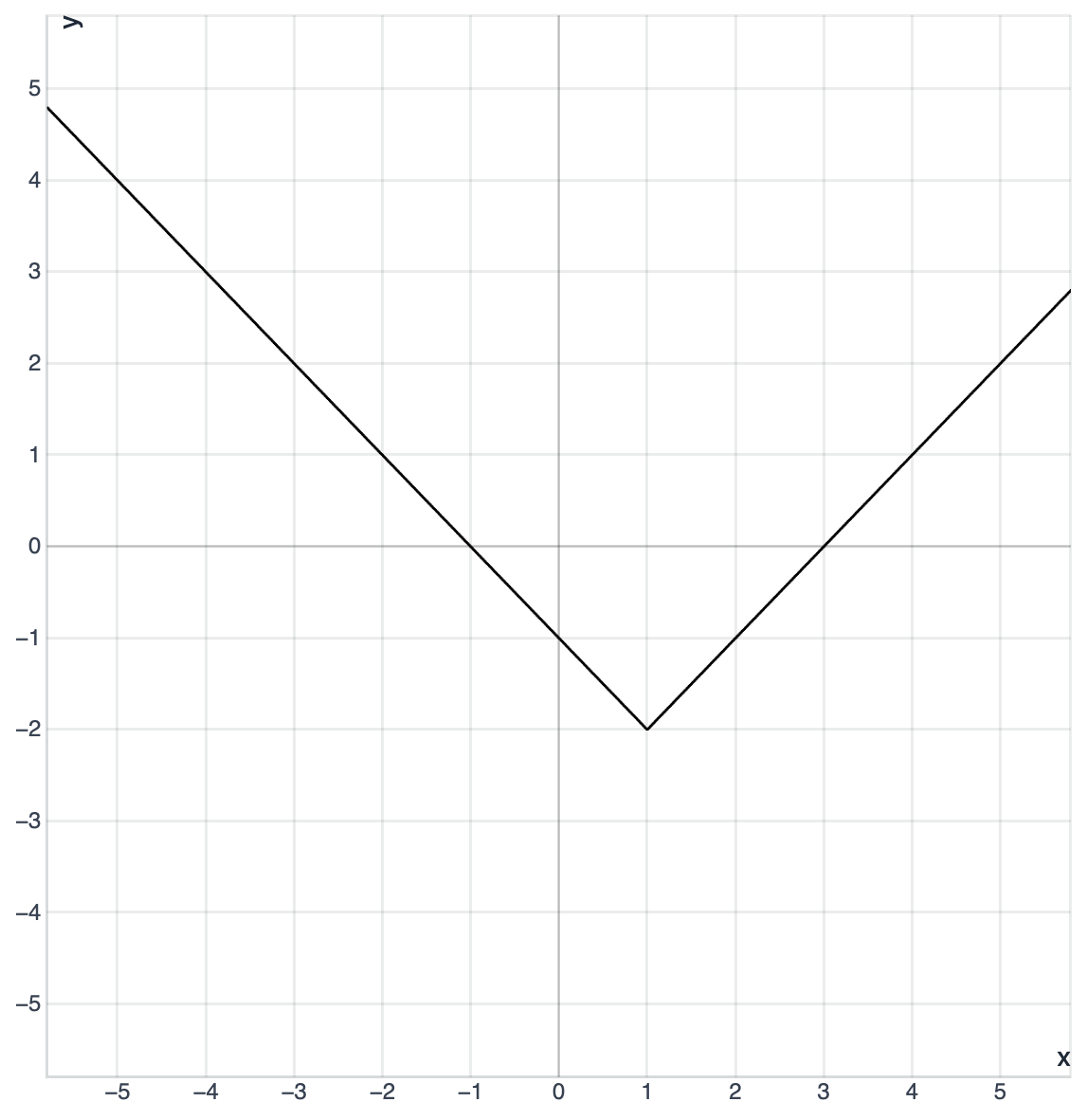
Vertex at $(1,-2)$
Vertex at $(-2,1)$
Vertex at $(1,2)$
Vertex at $(-1,2)$
Explanation
This question asks about the vertex of an absolute value function. The function y = |x-1|-2 is in the form y = |x-h|+k, where (h,k) represents the vertex. From the given equation, we can identify h = 1 (note the sign: x-1 means we shift right by 1) and k = -2. Therefore, the vertex is at (1,-2), which is the point where the V-shaped graph changes direction. A common error is to misinterpret the signs, thinking x-1 means the vertex is at x = -1. Remember that |x-h| shifts the graph h units to the right when h is positive.