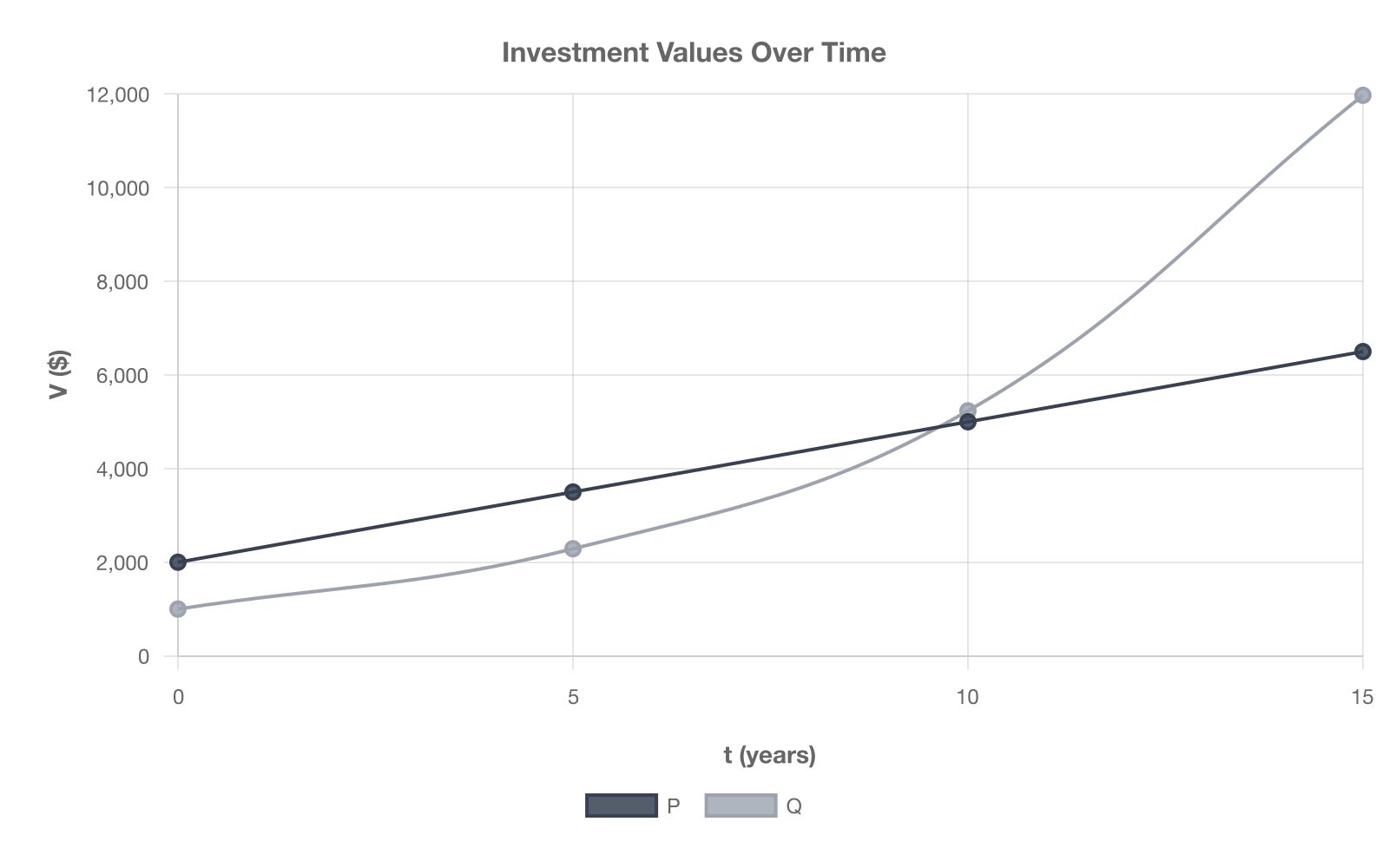
Linear & Exponential Growth - PSAT Math
Card 1 of 30
What is the recursive form for exponential growth with initial value $a$ and growth factor $r$?
Tap to reveal answer
$f(0)=a,\ f(n)=r,f(n-1)$. Each term equals the previous term times factor $r$.
← Didn't Know|Knew It →
Which function has the greater value at $x=5$: $y=3x+2$ or $y=2^x$?
Tap to reveal answer
$y=2^x$. At $x=5$: linear gives $17$, exponential gives $32$.
← Didn't Know|Knew It →
Identify the model type: constant additive change each step (linear or exponential)?
Tap to reveal answer
Linear. Adding the same amount each step creates linear growth.
← Didn't Know|Knew It →
Identify the model type: constant multiplicative change each step (linear or exponential)?
Tap to reveal answer
Exponential. Multiplying by the same factor each step creates exponential growth.
← Didn't Know|Knew It →
What is the $y$-intercept of the line $y=-3x+7$?
Tap to reveal answer
$7$. The y-intercept is the constant term when in slope-intercept form.
← Didn't Know|Knew It →
What is the slope of the line $4x-2y=10$?
Tap to reveal answer
$2$. Rewrite as $y=2x-5$; coefficient of $x$ is the slope.
← Didn't Know|Knew It →
What is the slope-intercept form of a linear function with slope $m$ and intercept $b$?
Tap to reveal answer
$y=mx+b$. Standard form where $m$ is slope and $b$ is y-intercept.
← Didn't Know|Knew It →
What is the meaning of slope $m$ in $y=mx+b$ in a real-world context?
Tap to reveal answer
Constant rate of change per $1$ unit of $x$. Slope tells how much $y$ changes when $x$ increases by 1.
← Didn't Know|Knew It →
What condition on $b$ in $y=a\cdot b^x$ gives exponential decay?
Tap to reveal answer
$0<b<1$. Values multiply by less than 1 each step.
← Didn't Know|Knew It →
What is the common ratio for the exponential sequence $2,6,18,54,\dots$?
Tap to reveal answer
$r=3$. Each term is 3 times the previous: $\frac{6}{2}=\frac{18}{6}=3$.
← Didn't Know|Knew It →
What does the slope $m$ represent in $y=mx+b$?
Tap to reveal answer
$m=\frac{\Delta y}{\Delta x}$ (constant rate of change). Slope measures vertical change per unit horizontal change.
← Didn't Know|Knew It →
What is the linear growth model for initial value $a$ and change $d$ per step?
Tap to reveal answer
$f(n)=a+dn$. Adds constant $d$ for each unit increase in $n$.
← Didn't Know|Knew It →
What is the slope between $(x_1,y_1)$ and $(x_2,y_2)$?
Tap to reveal answer
$m=\frac{y_2-y_1}{x_2-x_1}$. Calculate rise over run between two points.
← Didn't Know|Knew It →
Find the slope of the line through $(2,3)$ and $(6,11)$.
Tap to reveal answer
$2$. Use $m=\frac{11-3}{6-2}=\frac{8}{4}=2$.
← Didn't Know|Knew It →
Identify whether $g(n)=12\cdot 3^n$ is linear or exponential.
Tap to reveal answer
Exponential. Has form $a\cdot r^n$ with constant ratio between terms.
← Didn't Know|Knew It →
What is the equation for linear growth with initial value $a$ and rate $d$ per step?
Tap to reveal answer
$f(x)=a+dx$. Linear growth adds constant amount $d$ per unit increase in $x$.
← Didn't Know|Knew It →
What does the slope $m$ represent in $y=mx+b$?
Tap to reveal answer
$m=\frac{\Delta y}{\Delta x}$ (constant rate of change). Change in $y$ over change in $x$ stays constant.
← Didn't Know|Knew It →
What is the explicit form for an arithmetic sequence with first term $a_1$ and difference $d$?
Tap to reveal answer
$a_n=a_1+(n-1)d$. Direct formula for $n$th term using first term and common difference.
← Didn't Know|Knew It →
What is the recursive form for a linear sequence with first term $a_1$ and common difference $d$?
Tap to reveal answer
$a_n=a_{n-1}+d$ with $a_1$ given. Each term equals previous term plus constant difference.
← Didn't Know|Knew It →
What is the recursive form for a geometric sequence with first term $a_1$ and ratio $r$?
Tap to reveal answer
$a_n=ra_{n-1}$ with $a_1$ given. Each term equals previous term times constant ratio.
← Didn't Know|Knew It →
Find $f(3)$ for the exponential function $f(x)=2\cdot 5^x$.
Tap to reveal answer
$250$. Calculate $f(3)=2\cdot 5^3=2\cdot 125=250$.
← Didn't Know|Knew It →
Find $f(5)$ for the linear function $f(x)=12-3x$.
Tap to reveal answer
$-3$. Substitute: $f(5)=12-3(5)=12-15=-3$.
← Didn't Know|Knew It →
What is the slope of $3x+2y=10$?
Tap to reveal answer
$-\frac{3}{2}$. Rewrite as $y=-\frac{3}{2}x+5$; slope is coefficient of $x$.
← Didn't Know|Knew It →
What is the $y$-intercept of the line $y=4x-7$?
Tap to reveal answer
$-7$. The constant term when $x=0$.
← Didn't Know|Knew It →
What is the slope of the line through $(2,5)$ and $(6,13)$?
Tap to reveal answer
$m=2$. Use $m=\frac{13-5}{6-2}=\frac{8}{4}=2$.
← Didn't Know|Knew It →
Identify the model type: constant ratio between outputs for equal $x$-steps.
Tap to reveal answer
Exponential. Equal steps produce equal ratios in exponential models.
← Didn't Know|Knew It →
Identify the model type: constant difference between outputs for equal $x$-steps.
Tap to reveal answer
Linear. Equal steps produce equal differences in linear models.
← Didn't Know|Knew It →
What is the exponential factor $b$ if a quantity increases by $p%$ each step?
Tap to reveal answer
$b=1+\frac{p}{100}$. Add percent as decimal to 1 to get growth factor.
← Didn't Know|Knew It →
What is the percent change per step if an exponential model has factor $b$ each step?
Tap to reveal answer
$\text{percent change}=(b-1)\times 100%$. Convert growth factor to percent by subtracting 1 and multiplying by 100.
← Didn't Know|Knew It →
What is the explicit form for a geometric sequence with first term $a_1$ and ratio $r$?
Tap to reveal answer
$a_n=a_1\cdot r^{n-1}$. Direct formula for $n$th term using first term and common ratio.
← Didn't Know|Knew It →