Relations and Functions - Pre-Calculus
Card 0 of 176
Which of the following expressions is not a function?
Which of the following expressions is not a function?
Tap to see back →
Recall that an expression is only a function if it passes the vertical line test. Test this by graphing each function and looking for one which fails the vertical line test. (The vertical line test consists of drawing a vertical line through the graph of an expression. If the vertical line crosses the graph of the expression more than once, the expression is not a function.)
Functions can only have one y value for every x value. The only choice that reflects this is:

Recall that an expression is only a function if it passes the vertical line test. Test this by graphing each function and looking for one which fails the vertical line test. (The vertical line test consists of drawing a vertical line through the graph of an expression. If the vertical line crosses the graph of the expression more than once, the expression is not a function.)
Functions can only have one y value for every x value. The only choice that reflects this is:
Suppose we have the relation  on the set of real numbers
  whenever
  . Which of the following is true.
Suppose we have the relation
Tap to see back →
The relation is not a function because  and
and  hold. If it were a function,
  would hold only for one
  . But we know it holds for
  because
  and
and  . Thus, the relation
  on the set of real numbers
  is not a function.
The relation is not a function because
Consider a family consisting of a two parents, Juan and Oksana, and their daughters Adriana and Laksmi. A relation  is true whenever
  is the child of
  . Which of the following is not true?
Consider a family consisting of a two parents, Juan and Oksana, and their daughters Adriana and Laksmi. A relation
Tap to see back →
The statement
"Even if the two parents had only one daughter, the relation would not be a function."
is not true because if they had only one daughter, say Adriana, then the only relations that would exist would be (Juan, Adriana) and (Oksana,Adriana), which defines a function.
The statement
"Even if the two parents had only one daughter, the relation would not be a function."
is not true because if they had only one daughter, say Adriana, then the only relations that would exist would be (Juan, Adriana) and (Oksana,Adriana), which defines a function.
Which of the following relations is not a function?
Which of the following relations is not a function?
Tap to see back →
The definition of a function requires that for each input (i.e. each value of  ), there is only one output (i.e. one value of
  ). For
  , each value of
  corresponds to two values of
  (for example, when
  , both
  and
and  are correct solutions). Therefore, this relation cannot be a function.
The definition of a function requires that for each input (i.e. each value of
Given the set of ordered pairs, determine if the relation is a function


Given the set of ordered pairs, determine if the relation is a function
Tap to see back →
A relation is a function if no single x-value corresponds to more than one y-value.
Because the mapping from  goes to
  and
and 
the relation is NOT a function.
A relation is a function if no single x-value corresponds to more than one y-value.
Because the mapping from
the relation is NOT a function.
What equation is perpendicular to  and passes throgh
  ?
?
What equation is perpendicular to
Tap to see back →
First find the reciprocal of the slope of the given function.


The perpendicular function is:
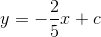
Now we must find the constant,  , by using the given point that the perpendicular crosses.
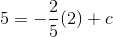
solve for  :
:

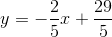
First find the reciprocal of the slope of the given function.
The perpendicular function is:
Now we must find the constant,
solve for
Is the following relation of ordered pairs a function?

Is the following relation of ordered pairs a function?
Tap to see back →
A set of ordered pairs is a function if it passes the vertical line test.
Because there are no more than one corresponding  value for any given
  value, the relation of ordered pairs IS a function.
A set of ordered pairs is a function if it passes the vertical line test.
Because there are no more than one corresponding
Find the range of the following function:

Find the range of the following function:
Tap to see back →
Every element of the domain has as image 7.This means that the function is constant . Therefore,
the range of f is :{7}.
Every element of the domain has as image 7.This means that the function is constant . Therefore,
the range of f is :{7}.
What is the range of  :
:

What is the range of
Tap to see back →
We know that  . So
. So  .
.
Therefore:
 .
.
This gives:
 .
.
Therefore the range is:

We know that
Therefore:
This gives:
Therefore the range is:
Find the range of f(x) given below:

Find the range of f(x) given below:
Tap to see back →
Note that: we can write f(x) as :
 .
.
Since,

Therefore,

So the range is 
Note that: we can write f(x) as :
Since,
Therefore,
So the range is
What is the range of  :
:

What is the range of
Tap to see back →
We have  .
.
Adding 7 to both sides we have:
 .
.
Therefore  .
.
This means that the range of f is 
We have
Adding 7 to both sides we have:
Therefore
This means that the range of f is
Find the domain of the following function:

Find the domain of the following function:
Tap to see back →
The part inside the square root must be positive. This means that we must be  . Thus
 . Adding -121 to both sides gives
  . Finally multiplying both sides by (-1) give:
 with x reals. This gives the answer.
Note: When we divide by a negative we need to flip our sign.
The part inside the square root must be positive. This means that we must be
Note: When we divide by a negative we need to flip our sign.
What is the domain of the function given by:

What is the domain of the function given by:
Tap to see back →
cos(x) is definded for all reals. cos(x) is always between -1 and 1. Thus  . The value inside the square is always positive. Therefore the domain is the set of all real numbers.
cos(x) is definded for all reals. cos(x) is always between -1 and 1. Thus
Find the domain of

Find the domain of
Tap to see back →
Since 
for all real numbers, the denominator is never 0 .Therefore the domain is the set
of all real numbers.
Since
for all real numbers, the denominator is never 0 .Therefore the domain is the set
of all real numbers.
Information about Nernst Equation:
http://physiologyweb.com/calculators/nernst\_potential\_calculator.html
The Nernst equation is very important in physiology, useful for measuring an ion's potential across cellular membranes. Suppose we are finding an ion's potential of a potassium ion at body temperature. Then the equation becomes:

Where  is the ion's electrical potential in miniVolts and
  is a ratio of concentration.
What is the domain and range of  ?
?
Information about Nernst Equation:
http://physiologyweb.com/calculators/nernst\_potential\_calculator.html
The Nernst equation is very important in physiology, useful for measuring an ion's potential across cellular membranes. Suppose we are finding an ion's potential of a potassium ion at body temperature. Then the equation becomes:
Where
What is the domain and range of
Tap to see back →
Apart from the multiplication by  , this function is very similar to the function
The logarithmic function has domain x>0, meaning for every value x>0, the function  has an output (and for x = 0 or below, there are no values for log x)
The range indicates all the values that can be outputs of the  . When you draw the graph of y = log(x), you can see that the function extends from -infinity (near x = 0), and then extends out infinitely in the positive x direction.
Therefore the Domain: 
and the is Range: 
Apart from the multiplication by
The logarithmic function has domain x>0, meaning for every value x>0, the function
The range indicates all the values that can be outputs of the
Therefore the Domain:
and the is Range:
Find the domain and range of the given function.

Find the domain and range of the given function.
Tap to see back →
The domain is the set of x-values for which the function is defined.
The range is the set of y-values for which the function is defined.
Because the values for x can be any number in the reals,
and the values for y are never negative,
Domain: All real numbers
Range: 
The domain is the set of x-values for which the function is defined.
The range is the set of y-values for which the function is defined.
Because the values for x can be any number in the reals,
and the values for y are never negative,
Domain: All real numbers
Range:
Find the domain and range of the function.

Find the domain and range of the function.
Tap to see back →
The domain is the set of x-values for which the function is defined.
The range is the set of y-values for which the function is defined.
Because the values for x are never negative,
and the values for y are never negative,
Domain: 
Range: 
The domain is the set of x-values for which the function is defined.
The range is the set of y-values for which the function is defined.
Because the values for x are never negative,
and the values for y are never negative,
Domain:
Range:
What is the domain of 
What is the domain of
Tap to see back →
As long as the number under the square root sign is greater than or equal to  , then the corresponding x-value is in the domain. So to figure out our domain, it is easiest to look at the equation and determine what is NOT in the domain. We do this by solving
  and we get
  . We now look at values greater than and less than
  , and we can see that when
  , the number under the square root will be negative. When
  , the number will be greater than or equal to
  . Therefore, our domain is anything greater than or equal to 6, or
  .
.
As long as the number under the square root sign is greater than or equal to
What is the range of 
What is the range of
Tap to see back →
Because the only term in the equation containing an  is squared, we know that its value will range from
  (when
(when  ) to
) to  (as
(as  approaches
  ). When
  is large, a constant such as
  does not matter, but when
  is at its smallest, it does. We can see that when
  ,
,  will be at its minimum of
  . This number gets bracket notation because there is an
  value such that
  .
.
Because the only term in the equation containing an
Find the domain of the function:

Find the domain of the function:
Tap to see back →
The square cannot house any negative term or can the denominator be zero. So the lower limit is  since
since  cannot be
  , but any value greater than it is ok. And the upper limit is infinity.
The square cannot house any negative term or can the denominator be zero. So the lower limit is