Cartesian Coordinate System - Pre-Calculus
Card 0 of 32
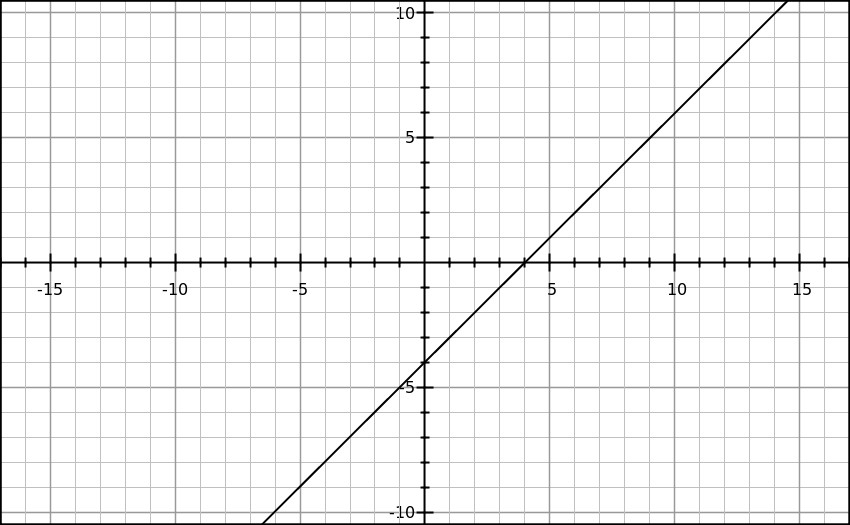
Given  , which graph is the correct one?
Given
Tap to see back →
First, solve for  :
:  .
.
Then, graph the  at
at  .
.
Since the slope of the line is  , you can graph the point
  as well.
There is only one graph that fits these requirements.
First, solve for
Then, graph the
Since the slope of the line is
There is only one graph that fits these requirements.
Which of the following does not lie on the line given by the equation below?

Which of the following does not lie on the line given by the equation below?
Tap to see back →
To determine if a point lies on a line, plug in the x-value and y-value to see if the equation is satisfied. We can do this for each choice to check.
For example:
 :
: 
Since both sides are equivalent, this point does lie on the line.
We can continue to do this for each of the points until one point does not work out.

Thus, this point does not lie on the line. Thus, this must be the solution.
To determine if a point lies on a line, plug in the x-value and y-value to see if the equation is satisfied. We can do this for each choice to check.
For example:
Since both sides are equivalent, this point does lie on the line.
We can continue to do this for each of the points until one point does not work out.
Thus, this point does not lie on the line. Thus, this must be the solution.
The point  is in which quadrant?
The point
Tap to see back →
In order to determine in which quadrant the point lies, we must remember the order of the quadrants. The first quadrant is that where x and y are both positive, to the upper right of the origin. To move sequentially to the final quadrant, we go counterclockwise from the first quadrant, which means the second is where x is negative and y is positive, the third is where x and y are both negative, and the fourth is where x is positive and y is negative. We can see from our point (-3,-8) that x and y are both negative, which means the point lies in the third quadrant.
In order to determine in which quadrant the point lies, we must remember the order of the quadrants. The first quadrant is that where x and y are both positive, to the upper right of the origin. To move sequentially to the final quadrant, we go counterclockwise from the first quadrant, which means the second is where x is negative and y is positive, the third is where x and y are both negative, and the fourth is where x is positive and y is negative. We can see from our point (-3,-8) that x and y are both negative, which means the point lies in the third quadrant.
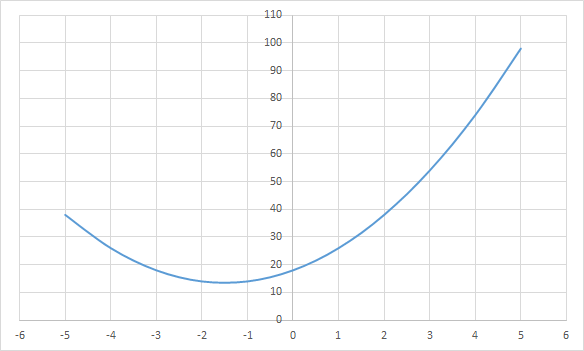
Which of the following coordinates does NOT fit on the graph of the corresponding function?

Which of the following coordinates does NOT fit on the graph of the corresponding function?
Tap to see back →
When looking at the graph, it is clear that when  ,
,  has a value less than
  . If we were to plug in the value of
  , our equation would come out as such:


Therefore, at  , we get a
  , providing the coordinate
  .
.
When looking at the graph, it is clear that when
Therefore, at
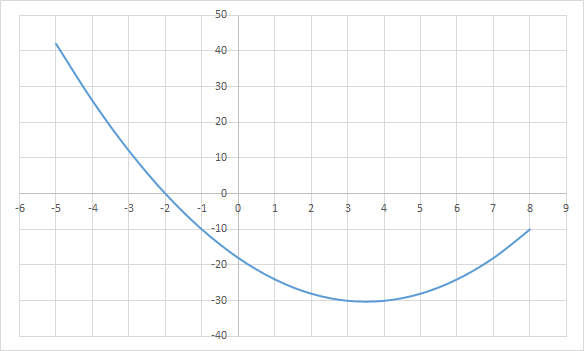
Which of the following  coordinates does NOT correspond with the given function and graph?

Which of the following
Tap to see back →
When looking at the graph, it is clear that when  ,
,  has a value greater than
  . When we plug in both
  and
and  values into the function, it is clear that these values do not work for the function:



When looking at the graph, it is clear that when
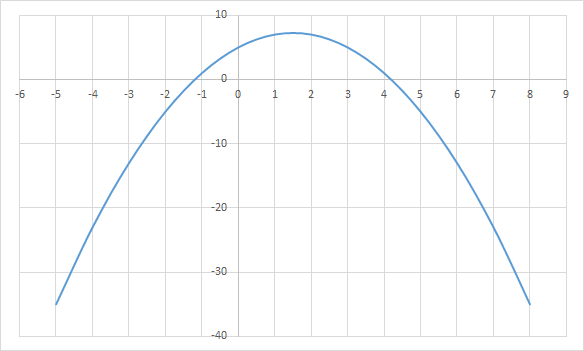
Which of the following  coordinates does NOT correspond with the given function and graph?

Which of the following
Tap to see back →
If we are to plug  into our function, the values would not work and both sides of the equation would not be equal:



Therefore, we know that these coordinates do not lie on the graph of the function.
If we are to plug
Therefore, we know that these coordinates do not lie on the graph of the function.
Which of the following  coordinates does NOT correspond with the given function and graph?

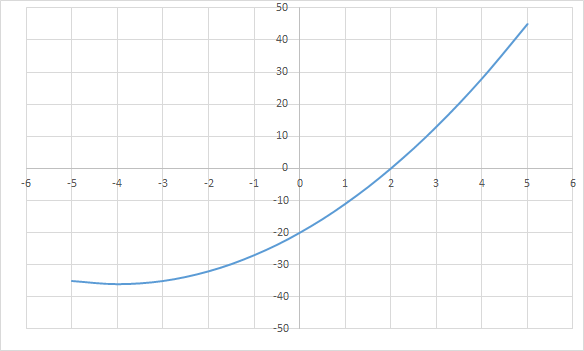
Which of the following
Tap to see back →
If we were to plug in the coordinate  into the function, we will find that it does not equate properly:



Since these values do not equate properly when plugged into the function, we now know that  does not fit on the provided graph.
If we were to plug in the coordinate
Since these values do not equate properly when plugged into the function, we now know that
 and
and  are located on the circle, with
  forming its diameter. What is the area of the circle.
Tap to see back →
Use the distance formula to find the length of  .
.
 .
.
Since the length of  is that of the diameter, the radius of the circle is
  .
.
Thus, the area of the circle is
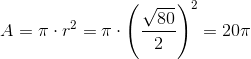 .
.
Use the distance formula to find the length of
Since the length of
Thus, the area of the circle is
Given , which graph is the correct one?
Given
Tap to see back →
First, solve for : .
Then, graph the at .
Since the slope of the line is , you can graph the point as well.
There is only one graph that fits these requirements.
First, solve for
Then, graph the
Since the slope of the line is
There is only one graph that fits these requirements.
Which of the following does not lie on the line given by the equation below?
Which of the following does not lie on the line given by the equation below?
Tap to see back →
To determine if a point lies on a line, plug in the x-value and y-value to see if the equation is satisfied. We can do this for each choice to check.
For example:
:
Since both sides are equivalent, this point does lie on the line.
We can continue to do this for each of the points until one point does not work out.
Thus, this point does not lie on the line. Thus, this must be the solution.
To determine if a point lies on a line, plug in the x-value and y-value to see if the equation is satisfied. We can do this for each choice to check.
For example:
Since both sides are equivalent, this point does lie on the line.
We can continue to do this for each of the points until one point does not work out.
Thus, this point does not lie on the line. Thus, this must be the solution.
The point is in which quadrant?
The point
Tap to see back →
In order to determine in which quadrant the point lies, we must remember the order of the quadrants. The first quadrant is that where x and y are both positive, to the upper right of the origin. To move sequentially to the final quadrant, we go counterclockwise from the first quadrant, which means the second is where x is negative and y is positive, the third is where x and y are both negative, and the fourth is where x is positive and y is negative. We can see from our point (-3,-8) that x and y are both negative, which means the point lies in the third quadrant.
In order to determine in which quadrant the point lies, we must remember the order of the quadrants. The first quadrant is that where x and y are both positive, to the upper right of the origin. To move sequentially to the final quadrant, we go counterclockwise from the first quadrant, which means the second is where x is negative and y is positive, the third is where x and y are both negative, and the fourth is where x is positive and y is negative. We can see from our point (-3,-8) that x and y are both negative, which means the point lies in the third quadrant.
Which of the following coordinates does NOT fit on the graph of the corresponding function?
Which of the following coordinates does NOT fit on the graph of the corresponding function?
Tap to see back →
When looking at the graph, it is clear that when , has a value less than . If we were to plug in the value of , our equation would come out as such:
Therefore, at , we get a , providing the coordinate .
When looking at the graph, it is clear that when
Therefore, at
Which of the following coordinates does NOT correspond with the given function and graph?
Which of the following
Tap to see back →
When looking at the graph, it is clear that when , has a value greater than . When we plug in both and values into the function, it is clear that these values do not work for the function:
When looking at the graph, it is clear that when
Which of the following coordinates does NOT correspond with the given function and graph?
Which of the following
Tap to see back →
If we are to plug into our function, the values would not work and both sides of the equation would not be equal:
Therefore, we know that these coordinates do not lie on the graph of the function.
If we are to plug
Therefore, we know that these coordinates do not lie on the graph of the function.
Which of the following coordinates does NOT correspond with the given function and graph?
Which of the following
Tap to see back →
If we were to plug in the coordinate into the function, we will find that it does not equate properly:
Since these values do not equate properly when plugged into the function, we now know that does not fit on the provided graph.
If we were to plug in the coordinate
Since these values do not equate properly when plugged into the function, we now know that
and are located on the circle, with forming its diameter. What is the area of the circle.
Tap to see back →
Use the distance formula to find the length of .
.
Since the length of is that of the diameter, the radius of the circle is .
Thus, the area of the circle is
.
Use the distance formula to find the length of
Since the length of
Thus, the area of the circle is
Given , which graph is the correct one?
Given
Tap to see back →
First, solve for : .
Then, graph the at .
Since the slope of the line is , you can graph the point as well.
There is only one graph that fits these requirements.
First, solve for
Then, graph the
Since the slope of the line is
There is only one graph that fits these requirements.
Which of the following does not lie on the line given by the equation below?
Which of the following does not lie on the line given by the equation below?
Tap to see back →
To determine if a point lies on a line, plug in the x-value and y-value to see if the equation is satisfied. We can do this for each choice to check.
For example:
:
Since both sides are equivalent, this point does lie on the line.
We can continue to do this for each of the points until one point does not work out.
Thus, this point does not lie on the line. Thus, this must be the solution.
To determine if a point lies on a line, plug in the x-value and y-value to see if the equation is satisfied. We can do this for each choice to check.
For example:
Since both sides are equivalent, this point does lie on the line.
We can continue to do this for each of the points until one point does not work out.
Thus, this point does not lie on the line. Thus, this must be the solution.
The point is in which quadrant?
The point
Tap to see back →
In order to determine in which quadrant the point lies, we must remember the order of the quadrants. The first quadrant is that where x and y are both positive, to the upper right of the origin. To move sequentially to the final quadrant, we go counterclockwise from the first quadrant, which means the second is where x is negative and y is positive, the third is where x and y are both negative, and the fourth is where x is positive and y is negative. We can see from our point (-3,-8) that x and y are both negative, which means the point lies in the third quadrant.
In order to determine in which quadrant the point lies, we must remember the order of the quadrants. The first quadrant is that where x and y are both positive, to the upper right of the origin. To move sequentially to the final quadrant, we go counterclockwise from the first quadrant, which means the second is where x is negative and y is positive, the third is where x and y are both negative, and the fourth is where x is positive and y is negative. We can see from our point (-3,-8) that x and y are both negative, which means the point lies in the third quadrant.
Which of the following coordinates does NOT fit on the graph of the corresponding function?
Which of the following coordinates does NOT fit on the graph of the corresponding function?
Tap to see back →
When looking at the graph, it is clear that when , has a value less than . If we were to plug in the value of , our equation would come out as such:
Therefore, at , we get a , providing the coordinate .
When looking at the graph, it is clear that when
Therefore, at