Electrostatics - Physics
Card 0 of 48
When the magnitude of two interacting charges is increased by a factor of 2, the electrical forces between these charges is .
When the magnitude of two interacting charges is increased by a factor of 2, the electrical forces between these charges is .
Tap to see back →
In Coloumb's law, an increase in both interacting charges will cause an increase in the magnitude of the electrical force between them. Specifically if the magnitude of both interacting charges is doubled, this will quadruple the electrical force.
In Coloumb's law, an increase in both interacting charges will cause an increase in the magnitude of the electrical force between them. Specifically if the magnitude of both interacting charges is doubled, this will quadruple the electrical force.
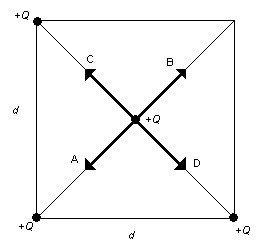
Three equal charges are at three of the corners of a square of side d. A fourth charge of equal magnitude is at the center of the square as shown in Figure above. Which of the arrows shown represents the net force acting on the charge at the center of the square?
Three equal charges are at three of the corners of a square of side d. A fourth charge of equal magnitude is at the center of the square as shown in Figure above. Which of the arrows shown represents the net force acting on the charge at the center of the square?
Tap to see back →
Because of the principles of superposition, each electric force that acts from the charges at the corners on to the charge at the center can be broken into components. Since all the charges are positive, all the forces will be repulsive. The forces acting from the top left and bottom right corners will cancel, leaving only the repulsive force coming from the bottom left corner.
Because of the principles of superposition, each electric force that acts from the charges at the corners on to the charge at the center can be broken into components. Since all the charges are positive, all the forces will be repulsive. The forces acting from the top left and bottom right corners will cancel, leaving only the repulsive force coming from the bottom left corner.
An electron traveling along the +x-axis enters an electric field that is directed vertically down, i.e., along the negative y-axis. What will be the direction of the electric force acting on the electron after entering the electric field?
An electron traveling along the +x-axis enters an electric field that is directed vertically down, i.e., along the negative y-axis. What will be the direction of the electric force acting on the electron after entering the electric field?
Tap to see back →
Positive charges in an electric field will experience an electric force that is in the same direction as the electric field. If the charge is negative, the force will be in the opposite direction of the electric field. Since we are talking about an electron moving in an electric field that points in the negative y-direction, the electron will feel a force that points in the positive y-direction, or upwards.
Positive charges in an electric field will experience an electric force that is in the same direction as the electric field. If the charge is negative, the force will be in the opposite direction of the electric field. Since we are talking about an electron moving in an electric field that points in the negative y-direction, the electron will feel a force that points in the positive y-direction, or upwards.
A charged rod carrying a negative charge is brought near two spheres that are in contact with each other but insulated from the ground. If the two spheres are then separated, what kind of charge will be on the spheres?
A charged rod carrying a negative charge is brought near two spheres that are in contact with each other but insulated from the ground. If the two spheres are then separated, what kind of charge will be on the spheres?
Tap to see back →
When the negatively charged rod is brought near one of the two spheres, the presents of the negative charge will induce a flow of charge in the spheres such that regions farthest away from the charged rod will become most negative and regions near the rod will become most positive. This is called charge by induction.
When the negatively charged rod is brought near one of the two spheres, the presents of the negative charge will induce a flow of charge in the spheres such that regions farthest away from the charged rod will become most negative and regions near the rod will become most positive. This is called charge by induction.
By what method will a positively charged rod produce a negative charge on a conducting sphere that is placed on an insulating surface?
By what method will a positively charged rod produce a negative charge on a conducting sphere that is placed on an insulating surface?
Tap to see back →
Charge by induction happens when a charged object is brought in the vicinity of a neutral object. The presents of the charged object will cause the free charges in the neutral object to shift such that the neutral object becomes polarized. When the charged object is positive, this will induce a negative charge on a neutral object.
Charge by induction happens when a charged object is brought in the vicinity of a neutral object. The presents of the charged object will cause the free charges in the neutral object to shift such that the neutral object becomes polarized. When the charged object is positive, this will induce a negative charge on a neutral object.
A charged particle traveling along the +x axis enters an electric field directed vertically upward along the +y-axis. If the charged particle experiences a force downward because of this field, what is the sign of the charge on this particle?
A charged particle traveling along the +x axis enters an electric field directed vertically upward along the +y-axis. If the charged particle experiences a force downward because of this field, what is the sign of the charge on this particle?
Tap to see back →
Positive charges in an electric field will experience an electric force that is in the same direction as the electric field. If the charge is negative, the force will be in the opposite direction of the electric field. Since the charged particle experiences a force which is opposite to the electric field, the sign of the charge must be negative.
Positive charges in an electric field will experience an electric force that is in the same direction as the electric field. If the charge is negative, the force will be in the opposite direction of the electric field. Since the charged particle experiences a force which is opposite to the electric field, the sign of the charge must be negative.
A conductor is placed in an electric field under electrostatic conditions. Which of the following statements is correct for this situation?
A conductor is placed in an electric field under electrostatic conditions. Which of the following statements is correct for this situation?
Tap to see back →
A conductor is defined as a object free to move charges. In particular, valence electrons, which are the outer most electron in each atom and the most free to move, travel inside the conductor until the net electric field inside the conductor is zero. These electrons will move until this condition has been met. Because of the presents of charged particles at the surface and the condition that they are no longer moving, any electric field at the surface must be perpendicular to that surface.
A conductor is defined as a object free to move charges. In particular, valence electrons, which are the outer most electron in each atom and the most free to move, travel inside the conductor until the net electric field inside the conductor is zero. These electrons will move until this condition has been met. Because of the presents of charged particles at the surface and the condition that they are no longer moving, any electric field at the surface must be perpendicular to that surface.
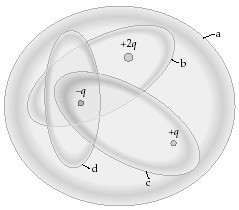
The figure shows four Gaussian surfaces surrounding a distribution of charges. Which Gaussian surfaces have an electric flux of  through them?
The figure shows four Gaussian surfaces surrounding a distribution of charges. Which Gaussian surfaces have an electric flux of
Tap to see back →
Gauss' laws states that the the electric flux through a Gaussian surface will be proportional to the net total charge inside the Gaussian surface. By inspection of the figure, we see that Gaussian surface B is the correct answer.
Gauss' laws states that the the electric flux through a Gaussian surface will be proportional to the net total charge inside the Gaussian surface. By inspection of the figure, we see that Gaussian surface B is the correct answer.
The Figure shows four Gaussian surfaces surrounding a distribution of charges. Which Gaussian surfaces have no electric flux through them
The Figure shows four Gaussian surfaces surrounding a distribution of charges. Which Gaussian surfaces have no electric flux through them
Tap to see back →
According to Gaussian law, the electric flux will be zero when the net electric charge inside the Gaussian surface is zero. By inspection, we see this is Gaussian surface C.
According to Gaussian law, the electric flux will be zero when the net electric charge inside the Gaussian surface is zero. By inspection, we see this is Gaussian surface C.
Gaussian surfaces A and B enclose the same positive charge +Q. The area of Gaussian surface A is three times larger than that of Gaussian surface B. The flux of electric field through Gaussian surface A is .
Gaussian surfaces A and B enclose the same positive charge +Q. The area of Gaussian surface A is three times larger than that of Gaussian surface B. The flux of electric field through Gaussian surface A is .
Tap to see back →
According to Gauss's law, the total electric flux is equal to the net total electric charge inside the a Gaussian surface. If the Gaussian surface is three times larger, the electric flux will be the same if both Gaussian surfaces contain the same amount of total electric charge.
According to Gauss's law, the total electric flux is equal to the net total electric charge inside the a Gaussian surface. If the Gaussian surface is three times larger, the electric flux will be the same if both Gaussian surfaces contain the same amount of total electric charge.
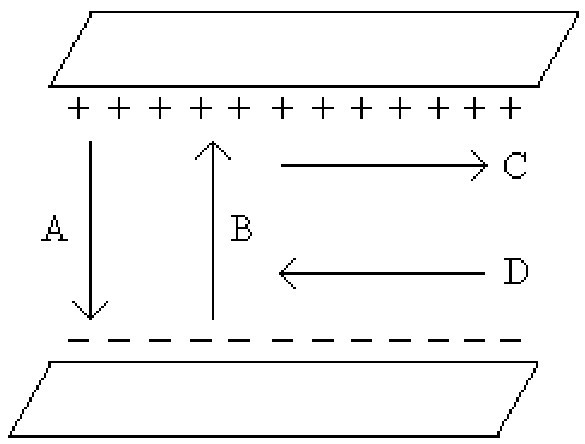
Which of the arrows shown in the figure represents the correct direction of the electric field between the two metal plates?
Which of the arrows shown in the figure represents the correct direction of the electric field between the two metal plates?
Tap to see back →
The direction of electric field describes the trajectory of a positive test charge. Since a positive test charge would want to move away from the positive metal plate and towards the negative metal plate, the direction would be A.
The direction of electric field describes the trajectory of a positive test charge. Since a positive test charge would want to move away from the positive metal plate and towards the negative metal plate, the direction would be A.
What is the main difference between electrical and gravitational forces?
What is the main difference between electrical and gravitational forces?
Tap to see back →
Electric forces can be attractive or repulsive because charges may be positive or negative. In the case for gravitational forces, there are only attractive forces because mass is always positive.
Electric forces can be attractive or repulsive because charges may be positive or negative. In the case for gravitational forces, there are only attractive forces because mass is always positive.
When the magnitude of two interacting charges is increased by a factor of 2, the electrical forces between these charges is .
When the magnitude of two interacting charges is increased by a factor of 2, the electrical forces between these charges is .
Tap to see back →
In Coloumb's law, an increase in both interacting charges will cause an increase in the magnitude of the electrical force between them. Specifically if the magnitude of both interacting charges is doubled, this will quadruple the electrical force.
In Coloumb's law, an increase in both interacting charges will cause an increase in the magnitude of the electrical force between them. Specifically if the magnitude of both interacting charges is doubled, this will quadruple the electrical force.
Three equal charges are at three of the corners of a square of side d. A fourth charge of equal magnitude is at the center of the square as shown in Figure above. Which of the arrows shown represents the net force acting on the charge at the center of the square?
Three equal charges are at three of the corners of a square of side d. A fourth charge of equal magnitude is at the center of the square as shown in Figure above. Which of the arrows shown represents the net force acting on the charge at the center of the square?
Tap to see back →
Because of the principles of superposition, each electric force that acts from the charges at the corners on to the charge at the center can be broken into components. Since all the charges are positive, all the forces will be repulsive. The forces acting from the top left and bottom right corners will cancel, leaving only the repulsive force coming from the bottom left corner.
Because of the principles of superposition, each electric force that acts from the charges at the corners on to the charge at the center can be broken into components. Since all the charges are positive, all the forces will be repulsive. The forces acting from the top left and bottom right corners will cancel, leaving only the repulsive force coming from the bottom left corner.
An electron traveling along the +x-axis enters an electric field that is directed vertically down, i.e., along the negative y-axis. What will be the direction of the electric force acting on the electron after entering the electric field?
An electron traveling along the +x-axis enters an electric field that is directed vertically down, i.e., along the negative y-axis. What will be the direction of the electric force acting on the electron after entering the electric field?
Tap to see back →
Positive charges in an electric field will experience an electric force that is in the same direction as the electric field. If the charge is negative, the force will be in the opposite direction of the electric field. Since we are talking about an electron moving in an electric field that points in the negative y-direction, the electron will feel a force that points in the positive y-direction, or upwards.
Positive charges in an electric field will experience an electric force that is in the same direction as the electric field. If the charge is negative, the force will be in the opposite direction of the electric field. Since we are talking about an electron moving in an electric field that points in the negative y-direction, the electron will feel a force that points in the positive y-direction, or upwards.
A charged rod carrying a negative charge is brought near two spheres that are in contact with each other but insulated from the ground. If the two spheres are then separated, what kind of charge will be on the spheres?
A charged rod carrying a negative charge is brought near two spheres that are in contact with each other but insulated from the ground. If the two spheres are then separated, what kind of charge will be on the spheres?
Tap to see back →
When the negatively charged rod is brought near one of the two spheres, the presents of the negative charge will induce a flow of charge in the spheres such that regions farthest away from the charged rod will become most negative and regions near the rod will become most positive. This is called charge by induction.
When the negatively charged rod is brought near one of the two spheres, the presents of the negative charge will induce a flow of charge in the spheres such that regions farthest away from the charged rod will become most negative and regions near the rod will become most positive. This is called charge by induction.
By what method will a positively charged rod produce a negative charge on a conducting sphere that is placed on an insulating surface?
By what method will a positively charged rod produce a negative charge on a conducting sphere that is placed on an insulating surface?
Tap to see back →
Charge by induction happens when a charged object is brought in the vicinity of a neutral object. The presents of the charged object will cause the free charges in the neutral object to shift such that the neutral object becomes polarized. When the charged object is positive, this will induce a negative charge on a neutral object.
Charge by induction happens when a charged object is brought in the vicinity of a neutral object. The presents of the charged object will cause the free charges in the neutral object to shift such that the neutral object becomes polarized. When the charged object is positive, this will induce a negative charge on a neutral object.
A charged particle traveling along the +x axis enters an electric field directed vertically upward along the +y-axis. If the charged particle experiences a force downward because of this field, what is the sign of the charge on this particle?
A charged particle traveling along the +x axis enters an electric field directed vertically upward along the +y-axis. If the charged particle experiences a force downward because of this field, what is the sign of the charge on this particle?
Tap to see back →
Positive charges in an electric field will experience an electric force that is in the same direction as the electric field. If the charge is negative, the force will be in the opposite direction of the electric field. Since the charged particle experiences a force which is opposite to the electric field, the sign of the charge must be negative.
Positive charges in an electric field will experience an electric force that is in the same direction as the electric field. If the charge is negative, the force will be in the opposite direction of the electric field. Since the charged particle experiences a force which is opposite to the electric field, the sign of the charge must be negative.
A conductor is placed in an electric field under electrostatic conditions. Which of the following statements is correct for this situation?
A conductor is placed in an electric field under electrostatic conditions. Which of the following statements is correct for this situation?
Tap to see back →
A conductor is defined as a object free to move charges. In particular, valence electrons, which are the outer most electron in each atom and the most free to move, travel inside the conductor until the net electric field inside the conductor is zero. These electrons will move until this condition has been met. Because of the presents of charged particles at the surface and the condition that they are no longer moving, any electric field at the surface must be perpendicular to that surface.
A conductor is defined as a object free to move charges. In particular, valence electrons, which are the outer most electron in each atom and the most free to move, travel inside the conductor until the net electric field inside the conductor is zero. These electrons will move until this condition has been met. Because of the presents of charged particles at the surface and the condition that they are no longer moving, any electric field at the surface must be perpendicular to that surface.
The figure shows four Gaussian surfaces surrounding a distribution of charges. Which Gaussian surfaces have an electric flux of through them?
The figure shows four Gaussian surfaces surrounding a distribution of charges. Which Gaussian surfaces have an electric flux of
Tap to see back →
Gauss' laws states that the the electric flux through a Gaussian surface will be proportional to the net total charge inside the Gaussian surface. By inspection of the figure, we see that Gaussian surface B is the correct answer.
Gauss' laws states that the the electric flux through a Gaussian surface will be proportional to the net total charge inside the Gaussian surface. By inspection of the figure, we see that Gaussian surface B is the correct answer.