Factoring Polynomials
Help Questions
Math › Factoring Polynomials
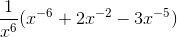
Factor:




Explanation
For each term in this expression, we will notice that each shares a variable of 

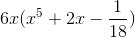
There are no more common factors, and this is the reduced form.
The answer is:

Solve for 


Explanation
First, factor the numerator, which should be 

Second, cancel the "like" terms - 

Third, solve for 


Factor the following polynomical expression completely, using the "factor-by-grouping" method.


Explanation
Let's split the four terms into two groups, and find the GCF of each group.
First group:

Second group:

The GCF of the first group is 


The GCF of the second group is 


We can rewrite the original expression,

as,

The common factor for BOTH of these terms is 
Dividing both sides by 

Factor the following polynomial: 





Explanation
Because the 



Find the factors of 


There are four factors of 



Factor the following polynomial expression completely, using the "factor-by-grouping" method.


Explanation
Separate the four terms into two groups, and then find the GCF of each group.
First group:

Second group:

The GCF of the first group is 


The GCF of the second group is 


We can rewrite the original expression,

as,

We can factor this as:

Solve for
Explanation
First, factor the numerator, which should be
Second, cancel the "like" terms -
Third, solve for
Factor:
Explanation
For each term in this expression, we will notice that each shares a variable of
There are no more common factors, and this is the reduced form.
The answer is:
Find the greatest common factor (GCF) of the following polynomial expression.


Explanation
To find the greatest common factor of a polynomial expression, we need to find all of the factors each term has in common. The easiest way to do this is to first look at the "coefficients", the "real numbers" to the left of the variable.
The first term has "20," the second term has "30," and the third term has "10."
The biggest common factor of these three numbers is "10".
Next, we look at the variable, x.
The first term has x^3, or three x's, the second term has x, or one x, and the third has x^2, or two x's.
The biggest common factor is "x", because while the first and third terms have more x's, the second term only has one x, so we can't pull out any more.
The greatest common factor is 10x, and when you divide each of the three terms by 10x, you get:

Factor the following expression:


not factorable

Explanation
We are going to use factoring by grouping to factor this expression.
The expression:

has the form:

In factoring by grouping, we want to split that B value into two smaller values a and b so we end up with this expression:

The rules are:

and

For our problem A=6 B=-13 C=6
So we have:


Another way of saying this is that we are looking for factors of 36 that add up to -13
The values that work are:

Plugging those values in:

Now let's group and factor out from both groups:


Finally let's factor out a (2x-3) from both terms: and we get our answer:

Find the greatest common factor (GCF) of the following polynomial expression.
Explanation
To find the greatest common factor of a polynomial expression, we need to find all of the factors each term has in common. The easiest way to do this is to first look at the "coefficients", the "real numbers" to the left of the variable.
The first term has "20," the second term has "30," and the third term has "10."
The biggest common factor of these three numbers is "10".
Next, we look at the variable, x.
The first term has x^3, or three x's, the second term has x, or one x, and the third has x^2, or two x's.
The biggest common factor is "x", because while the first and third terms have more x's, the second term only has one x, so we can't pull out any more.
The greatest common factor is 10x, and when you divide each of the three terms by 10x, you get: