Angles - Math
Card 1 of 60
Solve for  .
.

(Figure not drawn to scale).
Solve for
(Figure not drawn to scale).
Tap to reveal answer
The angles are supplementary, therefore, the sum of the angles must equal  .
.


The angles are supplementary, therefore, the sum of the angles must equal
← Didn't Know|Knew It →
Are  and
and  supplementary angles?
Are
Tap to reveal answer
Since supplementary angles must add up to  , the given angles are indeed supplementary.
Since supplementary angles must add up to
← Didn't Know|Knew It →
Are  and
and  complementary angles?
Are
Tap to reveal answer
Complementary angles add up to  . Therefore, these angles are complementary.
Complementary angles add up to
← Didn't Know|Knew It →
Which of the following angles is supplementary to  ?
?
Which of the following angles is supplementary to
Tap to reveal answer
When two angles are supplementary, they add up to  .
.
For this problem, we can set up an equation and solve for the supplementary angle:


When two angles are supplementary, they add up to
For this problem, we can set up an equation and solve for the supplementary angle:
← Didn't Know|Knew It →
What angle is complementary to  ?
?
What angle is complementary to
Tap to reveal answer
Two complementary angles add up to  .
.
Therefore,  .
.


Two complementary angles add up to
Therefore,
← Didn't Know|Knew It →
What angle is supplementary to  ?
?
What angle is supplementary to
Tap to reveal answer
Supplementary angles add up to  . That means:


Supplementary angles add up to
← Didn't Know|Knew It →
Which of the following angles is complementary to  ?
?
Which of the following angles is complementary to
Tap to reveal answer
Two complementary angles add up to  .
.


Two complementary angles add up to
← Didn't Know|Knew It →
What angle is supplementary to  ?
?
What angle is supplementary to
Tap to reveal answer
When two angles are supplementary, they add up to  .
.

Solve for  :
:


When two angles are supplementary, they add up to
Solve for
← Didn't Know|Knew It →
Find a coterminal angle for  .
.
Find a coterminal angle for
Tap to reveal answer
Coterminal angles are angles that, when drawn in the standard position, share a terminal side. You can find these angles by adding or subtracting 360 to the given angle. Thus, the only angle measurement that works from the answers given is  .
.
Coterminal angles are angles that, when drawn in the standard position, share a terminal side. You can find these angles by adding or subtracting 360 to the given angle. Thus, the only angle measurement that works from the answers given is
← Didn't Know|Knew It →
Which of the following angles is coterminal with  ?
?
Which of the following angles is coterminal with
Tap to reveal answer
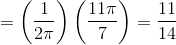
For an angle to be coterminal with  , that angle must be of the form
  for some integer
  - or, equivalently, the difference of the angle measures multiplied by
  must be an integer. We apply this test to all five choices.
 :
:
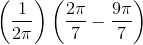

 :
:
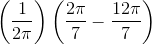
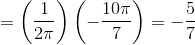
 :
:
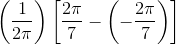
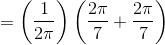
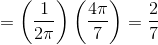
 :
:
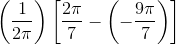
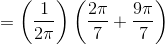
 :
:
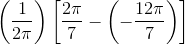
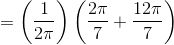

 is the correct choice, since only that choice passes our test.
For an angle to be coterminal with
← Didn't Know|Knew It →
Which of the following angles is coterminal with  ?
?
Which of the following angles is coterminal with
Tap to reveal answer
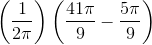
For an angle to be coterminal with  , that angle must be of the form
  for some integer
  - or, equivalently, the difference of the angle measures multiplied by
  must be an integer. We apply this test to all four choices.
 :
:

 :
:
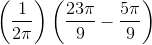

 :
:
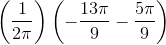

 :
:
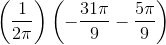

All four choices pass the test, so all four angles are coterminal with  .
.
For an angle to be coterminal with
All four choices pass the test, so all four angles are coterminal with
← Didn't Know|Knew It →
Which of the following choices represents a pair of coterminal angles?
Which of the following choices represents a pair of coterminal angles?
Tap to reveal answer
For two angles to be coterminal, they must differ by  for some integer
  - or, equivalently, the difference of the angle measures multiplied by
  must be an integer. We apply this test to all five choices.
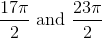 :
:

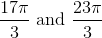 :
:

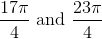 :
:

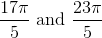 :
:

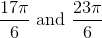 :
:

The only angles that pass the test - and are therefore coterminal - are 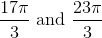 .
.
For two angles to be coterminal, they must differ by
The only angles that pass the test - and are therefore coterminal - are
← Didn't Know|Knew It →


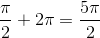
Tap to reveal answer

 .
.
← Didn't Know|Knew It →
What angle is supplementary to ?
What angle is supplementary to
Tap to reveal answer
Supplementary angles add up to . That means:
Supplementary angles add up to
← Didn't Know|Knew It →
Solve for .
(Figure not drawn to scale).
Solve for
(Figure not drawn to scale).
Tap to reveal answer
The angles are supplementary, therefore, the sum of the angles must equal .
The angles are supplementary, therefore, the sum of the angles must equal
← Didn't Know|Knew It →
Are and supplementary angles?
Are
Tap to reveal answer
Since supplementary angles must add up to , the given angles are indeed supplementary.
Since supplementary angles must add up to
← Didn't Know|Knew It →
Are and complementary angles?
Are
Tap to reveal answer
Complementary angles add up to . Therefore, these angles are complementary.
Complementary angles add up to
← Didn't Know|Knew It →
Which of the following angles is supplementary to ?
Which of the following angles is supplementary to
Tap to reveal answer
When two angles are supplementary, they add up to .
For this problem, we can set up an equation and solve for the supplementary angle:
When two angles are supplementary, they add up to
For this problem, we can set up an equation and solve for the supplementary angle:
← Didn't Know|Knew It →
What angle is complementary to ?
What angle is complementary to
Tap to reveal answer
Two complementary angles add up to .
Therefore, .
Two complementary angles add up to
Therefore,
← Didn't Know|Knew It →
Which of the following angles is complementary to ?
Which of the following angles is complementary to
Tap to reveal answer
Two complementary angles add up to .
Two complementary angles add up to
← Didn't Know|Knew It →