Kites - Math
Card 1 of 92
What is the area of the following kite?

What is the area of the following kite?
Tap to reveal answer
The formula for the area of a kite:
 ,
,
where  represents the length of one diagonal and
  represents the length of the other diagonal.
Plugging in our values, we get:


The formula for the area of a kite:
where
Plugging in our values, we get:
← Didn't Know|Knew It →
Which of the following shapes is a kite?

Which of the following shapes is a kite?
Tap to reveal answer
A kite is a four-sided shape with straight sides that has two pairs of sides. Each pair of adjacent sides are equal in length. A square is also considered a kite.
A kite is a four-sided shape with straight sides that has two pairs of sides. Each pair of adjacent sides are equal in length. A square is also considered a kite.
← Didn't Know|Knew It →
Two congruent equilateral triangles with sides of length  are connected so that they share a side. Each triangle has a height of
  . Express the area of the shape in terms of
  .
.
Two congruent equilateral triangles with sides of length
Tap to reveal answer
The shape being described is a rhombus with side lengths 1. Since they are equilateral triangles connected by one side, that side becomes the lesser diagonal, so  .
.
The greater diagonal is twice the height of the equaliteral triangles,  .
.
The area of a rhombus is half the product of the diagonals, so:

The shape being described is a rhombus with side lengths 1. Since they are equilateral triangles connected by one side, that side becomes the lesser diagonal, so
The greater diagonal is twice the height of the equaliteral triangles,
The area of a rhombus is half the product of the diagonals, so:
← Didn't Know|Knew It →
The diagonal lengths of a kite are  and
and  . What is the area?
The diagonal lengths of a kite are
Tap to reveal answer
The area of a kite is given below. Substitute the given diagonals to find the area.

The area of a kite is given below. Substitute the given diagonals to find the area.
← Didn't Know|Knew It →
Find the area of a kite if the length of the diagonals are  and
and  .
.
Find the area of a kite if the length of the diagonals are
Tap to reveal answer
Substitute the given diagonals into the area formula for kites. Solve and simplify.

Substitute the given diagonals into the area formula for kites. Solve and simplify.
← Didn't Know|Knew It →
Find the area of a kite if the diagonal dimensions are  and
and  .
.
Find the area of a kite if the diagonal dimensions are
Tap to reveal answer
The area of the kite is given below. The FOIL method will need to be used to simplify the binomial.


The area of the kite is given below. The FOIL method will need to be used to simplify the binomial.
← Didn't Know|Knew It →
Find the area of a kite if one diagonal is  long, and the other diagonal is
  long.
long.
Find the area of a kite if one diagonal is
Tap to reveal answer
The formula for the area of a kite is

Plug in the values for each of the diagonals and solve.

The formula for the area of a kite is
Plug in the values for each of the diagonals and solve.
← Didn't Know|Knew It →
The diagonals of a kite are  and
and  . Find the area.
The diagonals of a kite are
Tap to reveal answer
The formula for the area for a kite is
 , where
  and
and  are the lengths of the kite's two diagonals. We are given the length of these diagonals in the problem, so we can substitute them into the formula and solve for the area:

The formula for the area for a kite is
← Didn't Know|Knew It →
The diagonals of a kite are  and
and  . Express the kite's area in simplified form.
The diagonals of a kite are
Tap to reveal answer
Write the formula for the area of a kite.

Substitute the diagonals and reduce.

Multiply the parenthetical elements together by distributing the  :
:


You can consider the outermost fraction with  in the denominator as multiplying everything in the numerator by
  :
:


Change the added  to
to  to create a common denominator and add the fractions to arrive at the correct answer:

Write the formula for the area of a kite.
Substitute the diagonals and reduce.
Multiply the parenthetical elements together by distributing the
You can consider the outermost fraction with
Change the added
← Didn't Know|Knew It →
If the diagonals of a kite are  and
and  , express the area in simplified form.
If the diagonals of a kite are
Tap to reveal answer
Write the formula for the area of a kite:

Substitute the given diagonals:

Distribute the  :
:

Create a common denominator for the two fractions in the numerator:


You can consider the outermost division by  as multiplying everything in the numerator by
  :
:

Multiply across to arrive at the correct answer:

Write the formula for the area of a kite:
Substitute the given diagonals:
Distribute the
Create a common denominator for the two fractions in the numerator:
You can consider the outermost division by
Multiply across to arrive at the correct answer:
← Didn't Know|Knew It →
Find the area of a kite with the diagonal lengths of  and
and  .
.
Find the area of a kite with the diagonal lengths of
Tap to reveal answer
Write the formula to find the area of a kite. Substitute the diagonals and solve.

Write the formula to find the area of a kite. Substitute the diagonals and solve.
← Didn't Know|Knew It →
Find the area of a kite with diagonal lengths of  and
and  .
.
Find the area of a kite with diagonal lengths of
Tap to reveal answer
Write the formula for the area of a kite.

Plug in the given diagonals.
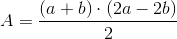
Pull out a common factor of two in  and simplify.
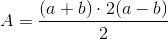

Use the FOIL method to simplify.


Write the formula for the area of a kite.
Plug in the given diagonals.
Pull out a common factor of two in
Use the FOIL method to simplify.
← Didn't Know|Knew It →
Show algebraically how the formula of the area of a kite is developed.
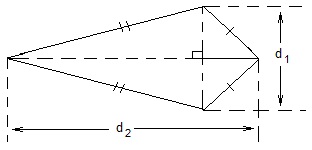
Show algebraically how the formula of the area of a kite is developed.
Tap to reveal answer
-
The given kite is divded into two congruent triangles.
-
Each triangle has a height  and a base
  .
.
-
The area  of each triangle is
  .
.
-
The areas of the two triangles are added together,


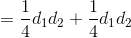

-
The given kite is divded into two congruent triangles.
-
Each triangle has a height
-
The area
-
The areas of the two triangles are added together,
← Didn't Know|Knew It →
Find the area of a kite, if the diagonals of the kite are  .
.
Find the area of a kite, if the diagonals of the kite are
Tap to reveal answer
You find the area of a kite by using the lengths of the diagonals.

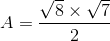 , which is equal to
  .
.
You can reduce this to,
 for the final answer.
You find the area of a kite by using the lengths of the diagonals.
You can reduce this to,
← Didn't Know|Knew It →
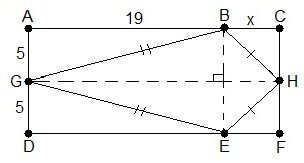
The rectangle area  is 220. What is the area
  of the inscribed
kite  ?
?
The rectangle area
kite
Tap to reveal answer
-
The measures of the kite diagonals  and
and  have to be found.
-
Using the circumscribed rectangle,  , and
, and  .
.
-
 has to be found to find
  .
.
-
The rectangle area  .
.
-
 .
.
-
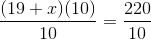
From step 1) and step 2), using substitution,  .
.
-
Solving the equation for x,


-

-
Kite area 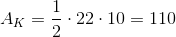
-
The measures of the kite diagonals
-
Using the circumscribed rectangle,
-
-
The rectangle area
-
-
From step 1) and step 2), using substitution,
-
Solving the equation for x,
-
-
Kite area
← Didn't Know|Knew It →
If a kite has lengths of  and
and  , what is the perimeter?
If a kite has lengths of
Tap to reveal answer
Write the formula to find the perimeter of a kite.

Substitute the lengths and solve.

Write the formula to find the perimeter of a kite.
Substitute the lengths and solve.
← Didn't Know|Knew It →
If a kite has lengths of  and
and  , what is the perimeter?
If a kite has lengths of
Tap to reveal answer
Write the formula for the perimeter of a kite.

Substitute the lengths and solve.

Write the formula for the perimeter of a kite.
Substitute the lengths and solve.
← Didn't Know|Knew It →
What is the perimeter of a kite if the lengths were  and
and  ?
?
What is the perimeter of a kite if the lengths were
Tap to reveal answer
Write the formula to find the perimeter of a kite.

Substitute the lengths and simplify.

Write the formula to find the perimeter of a kite.
Substitute the lengths and simplify.
← Didn't Know|Knew It →
What is the perimeter of a kite if the lengths were and ?
What is the perimeter of a kite if the lengths were
Tap to reveal answer
Write the formula to find the perimeter of a kite.
Substitute the lengths and simplify.
Write the formula to find the perimeter of a kite.
Substitute the lengths and simplify.
← Didn't Know|Knew It →
If a kite has lengths of and , what is the perimeter?
If a kite has lengths of
Tap to reveal answer
Write the formula to find the perimeter of a kite.
Substitute the lengths and solve.
Write the formula to find the perimeter of a kite.
Substitute the lengths and solve.
← Didn't Know|Knew It →