Solving Quadratic Equations - Math
Card 1 of 732
Solve the quadratic equation using any method:

Solve the quadratic equation using any method:
Tap to reveal answer
Use the quadratic formula to solve:
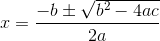


Use the quadratic formula to solve:
← Didn't Know|Knew It →
Find the zeros.

Find the zeros.
Tap to reveal answer
Factor the equation to  . Set both equal to zero and you get
  and
and  . Remember, the zeros of an equation are wherever the function crosses the
  -axis.
Factor the equation to
← Didn't Know|Knew It →
Find the zeros.

Find the zeros.
Tap to reveal answer
Factor out an  from the equation so that you have
  "x(x-10)") . Set
. Set  and
and  equal to
  . Your roots are
  and
and  .
.
Factor out an
← Didn't Know|Knew It →
Find the zeros.

Find the zeros.
Tap to reveal answer
Set  equal to zero and you get
  . Set
. Set  equal to zero as well and you get
  and
and  because when you take a square root, your answer will be positive and negative.
Set
← Didn't Know|Knew It →
Find the zeros.

Find the zeros.
Tap to reveal answer
Factor out a  from the entire equation. After that, you get
  . Factor the expression to
  . Set both of those equal to zero and your answers are
  and
and  .
.
Factor out a
← Didn't Know|Knew It →
Find the zeros.

Find the zeros.
Tap to reveal answer
This expression is the difference of perfect squares. Therefore, it factors to . Set both of those equal to zero and your answers are
  and
and  .
.
This expression is the difference of perfect squares. Therefore, it factors to
← Didn't Know|Knew It →
Find the zeros.

Find the zeros.
Tap to reveal answer
Factor the equation to  . Set both equal to
  and you get
  and
and  .
.
Factor the equation to
← Didn't Know|Knew It →
Find the zeros.

Find the zeros.
Tap to reveal answer
Factor a  out of the quation to get

which can be further factored to
 .
.
Set the last two expressions equal to zero and you get  and
and  .
.
Factor a
which can be further factored to
Set the last two expressions equal to zero and you get
← Didn't Know|Knew It →
Find the zeros.

Find the zeros.
Tap to reveal answer
Set each expression equal to zero and you get 0 and 6.
Set each expression equal to zero and you get 0 and 6.
← Didn't Know|Knew It →
Find the zeros.

Find the zeros.
Tap to reveal answer
Set both expressions equal to  . The first factor yields
  . The second factor gives you
  .
.
Set both expressions equal to
← Didn't Know|Knew It →
Find the zeros.

Find the zeros.
Tap to reveal answer
Set both expressions to  and you get
  and
and  .
.
Set both expressions to
← Didn't Know|Knew It →
Solve the following equation by factoring.

Solve the following equation by factoring.
Tap to reveal answer
We can factor by determining the terms that will multiply to –8 and add to +7.

Our factors are +8 and –1.

Now we can set each factor equal to zero and solve for the root.


We can factor by determining the terms that will multiply to –8 and add to +7.
Our factors are +8 and –1.
Now we can set each factor equal to zero and solve for the root.
← Didn't Know|Knew It →
Solve the following equation by factoring.

Solve the following equation by factoring.
Tap to reveal answer
We know that one  term has a coefficient of 2 and that our factors must multiply to –10.

Our factors are +2 and –5.

Now we can set each factor equal to zero and solve for the root.


We know that one
Our factors are +2 and –5.
Now we can set each factor equal to zero and solve for the root.
← Didn't Know|Knew It →
Solve the following equation by factoring.

Solve the following equation by factoring.
Tap to reveal answer
First, we can factor an  term out of all of the values.

We can factor remaining polynomial by determining the terms that will multiply to +4 and add to +4.

Our factors are +2 and +2.

Now we can set each factor equal to zero and solve for the root.


First, we can factor an
We can factor remaining polynomial by determining the terms that will multiply to +4 and add to +4.
Our factors are +2 and +2.
Now we can set each factor equal to zero and solve for the root.
← Didn't Know|Knew It →
Find the sum of the solutions to:

Find the sum of the solutions to:
Tap to reveal answer
Multiply both sides of the equation by  , to get

This can be factored into the form

So we must solve

and

to get the solutions.
The solutions are:

and their sum is  .
.
Multiply both sides of the equation by
This can be factored into the form
So we must solve
and
to get the solutions.
The solutions are:
and their sum is
← Didn't Know|Knew It →
Solve 
Solve
Tap to reveal answer
Factor the problem and set each factor equal to zero.
 becomes
  so
so 
Factor the problem and set each factor equal to zero.
← Didn't Know|Knew It →
Solve  .
.
Solve
Tap to reveal answer
Factor the quadratic equation and set each factor equal to zero:
 becomes
  so the correct answer is
  .
.
Factor the quadratic equation and set each factor equal to zero:
← Didn't Know|Knew It →

Tap to reveal answer


← Didn't Know|Knew It →
Solve  .
.
Solve
Tap to reveal answer
To find the roots of this equation, you can factor it to

Set each of those expressions equal to zero and then solve for  . The roots are
  and
and  .
.
To find the roots of this equation, you can factor it to
Set each of those expressions equal to zero and then solve for
← Didn't Know|Knew It →
What are the roots of  ?
?
What are the roots of
Tap to reveal answer
To find the roots, we need to find the values that would make  . Since there are two parts to
  , we will have two roots: one where
  , and one where
  .
.
Solve each one individually:


Therefore, our roots will be  .
.
To find the roots, we need to find the values that would make
Solve each one individually:
Therefore, our roots will be
← Didn't Know|Knew It →