Circles - Math
Card 1 of 2896
Find the length of the radius of a circle given the circumference is  .
.
Find the length of the radius of a circle given the circumference is
Tap to reveal answer
To solve, simply use the formula for the circumference of a circle and solve for r. Thus,


To solve, simply use the formula for the circumference of a circle and solve for r. Thus,
← Didn't Know|Knew It →
Find the radius of a circle given the circumference is  .
.
Find the radius of a circle given the circumference is
Tap to reveal answer
To solve, simply use the formula for the circumference of a circle and solve for r. Thus,


To solve, simply use the formula for the circumference of a circle and solve for r. Thus,
← Didn't Know|Knew It →
Find the length of the radius of a circle given the diameter is 3.
Find the length of the radius of a circle given the diameter is 3.
Tap to reveal answer
To solve, simply use the formula for the diameter and solve for r. Thus,

Therefore, when solved for r,

Plug in d and:

To solve, simply use the formula for the diameter and solve for r. Thus,
Therefore, when solved for r,
Plug in d and:
← Didn't Know|Knew It →
The specifications of an official NBA basketball are that it must be 29.5 inches in circumference and weigh 22 ounces. What is the approximate radius of the basketball?
The specifications of an official NBA basketball are that it must be 29.5 inches in circumference and weigh 22 ounces. What is the approximate radius of the basketball?
Tap to reveal answer
To Find your answer, we would use the formula: C=2πr. We are given that C = 29.5. Thus we can plug in to get \[29.5\]=2πr and then multiply 2π to get 29.5=(6.28)r. Lastly, we divide both sides by 6.28 to get 4.70=r. (The information given of 22 ounces is useless)
To Find your answer, we would use the formula: C=2πr. We are given that C = 29.5. Thus we can plug in to get \[29.5\]=2πr and then multiply 2π to get 29.5=(6.28)r. Lastly, we divide both sides by 6.28 to get 4.70=r. (The information given of 22 ounces is useless)
← Didn't Know|Knew It →
A circle with center (8, **–**5) is tangent to the y-axis in the standard (x,y) coordinate plane. What is the radius of this circle?
A circle with center (8, **–**5) is tangent to the y-axis in the standard (x,y) coordinate plane. What is the radius of this circle?
Tap to reveal answer
For the circle to be tangent to the y-axis, it must have its outer edge on the axis. The center is 8 units from the edge.
For the circle to be tangent to the y-axis, it must have its outer edge on the axis. The center is 8 units from the edge.
← Didn't Know|Knew It →
A circle has an area of  . What is the radius of the circle, in inches?
A circle has an area of
Tap to reveal answer
We know that the formula for the area of a circle is πr_2. Therefore, we must set 49_π equal to this formula to solve for the radius of the circle.
49_π_ = _πr_2
49 = _r_2
7 = r
We know that the formula for the area of a circle is πr_2. Therefore, we must set 49_π equal to this formula to solve for the radius of the circle.
49_π_ = _πr_2
49 = _r_2
7 = r
← Didn't Know|Knew It →
Find the length of the radius given the circumference is 16
Find the length of the radius given the circumference is 16
Tap to reveal answer
To solve, simply use the formula of the circumference and solve for r. Thus,


To solve, simply use the formula of the circumference and solve for r. Thus,
← Didn't Know|Knew It →
A circle has an area of 36π inches. What is the radius of the circle, in inches?
A circle has an area of 36π inches. What is the radius of the circle, in inches?
Tap to reveal answer
We know that the formula for the area of a circle is π_r_2. Therefore, we must set 36π equal to this formula to solve for the radius of the circle.
36π = π_r_2
36 = _r_2
6 = r
We know that the formula for the area of a circle is π_r_2. Therefore, we must set 36π equal to this formula to solve for the radius of the circle.
36π = π_r_2
36 = _r_2
6 = r
← Didn't Know|Knew It →
Circle X is divided into 3 sections: A, B, and C. The 3 sections are equal in area. If the area of section C is 12π, what is the radius of the circle?

Circle X
Circle X is divided into 3 sections: A, B, and C. The 3 sections are equal in area. If the area of section C is 12π, what is the radius of the circle?
Circle X
Tap to reveal answer
Find the total area of the circle, then use the area formula to find the radius.
Area of section A = section B = section C
Area of circle X = A + B + C = 12π+ 12π + 12π = 36π
Area of circle = where r is the radius of the circle
36π = πr2
36 = r2
√36 = r
6 = r
Find the total area of the circle, then use the area formula to find the radius.
Area of section A = section B = section C
Area of circle X = A + B + C = 12π+ 12π + 12π = 36π
Area of circle = where r is the radius of the circle
36π = πr2
36 = r2
√36 = r
6 = r
← Didn't Know|Knew It →
The area of a circle is one square yard. Give its radius in inches, to the nearest tenth of an inch.
The area of a circle is one square yard. Give its radius in inches, to the nearest tenth of an inch.
Tap to reveal answer
The area of a circle is

Substitute 1 for  :
:


This is the radius in yards. The radius in inches is 36 times this.
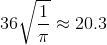
20.3 inches is the radius.
The area of a circle is
Substitute 1 for
This is the radius in yards. The radius in inches is 36 times this.
20.3 inches is the radius.
← Didn't Know|Knew It →
The circle shown below has an area equal to  . What is the length of the radius,
  , of this circle?
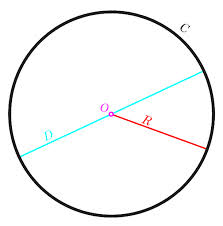
The circle shown below has an area equal to
Tap to reveal answer
The formula for the area of a circle is  . We can fill in what we know, the area, and then solve for the radius,
  .
.

Divide each side of the equation by  :
:

Take the square root of each side:


The formula for the area of a circle is
Divide each side of the equation by
Take the square root of each side:
← Didn't Know|Knew It →
A circle has a circumference of  inches. What is the radius of the circle?
A circle has a circumference of
Tap to reveal answer
The circumference of a circle is given by  , where
  is the circumference and
  is the radius.
Plug in the given circumference for  and solve for
  :
:


The circumference of a circle is given by
Plug in the given circumference for
← Didn't Know|Knew It →

What is the name of the segment in red?
What is the name of the segment in red?
Tap to reveal answer
The radius is the distance from the center of a circle to any point on it's perimeter.
The radius is the distance from the center of a circle to any point on it's perimeter.
← Didn't Know|Knew It →
What is the name of the segment in brown?
What is the name of the segment in brown?
Tap to reveal answer
A chord is a line segment which joins two points on a curve. A chord does not go through the center of a circle.
A chord is a line segment which joins two points on a curve. A chord does not go through the center of a circle.
← Didn't Know|Knew It →
The diameter of a circle is 16 centimeters. What is the circle's radius in centimeters?
The diameter of a circle is 16 centimeters. What is the circle's radius in centimeters?
Tap to reveal answer
The radius is half of the diameter. To find the radius, simply divide the diameter by 2.

The radius is half of the diameter. To find the radius, simply divide the diameter by 2.
← Didn't Know|Knew It →
Find the radius of a circle inscribed in a square that has a diagonal of  .
.
Find the radius of a circle inscribed in a square that has a diagonal of
Tap to reveal answer

Notice that the diagonal of the square is also the hypotenuse of a right isosceles triangle whose legs are also the sides of the square. You should also notice that the diameter of the circle has the same length as that of a side of the square.
In order to find the radius of the circle, we need to first use the Pythagorean theorem to find the length of the side of the square.


Now, substitute in the value of the diagonal to find the length of a side of the square.

Simplify.

Now keep in mind the following relationship between the diameter and the side of the square:

Recall the relationship between the diameter and the radius.

Substitute in the value of the radius by plugging in the value of the diameter.

Solve.

Notice that the diagonal of the square is also the hypotenuse of a right isosceles triangle whose legs are also the sides of the square. You should also notice that the diameter of the circle has the same length as that of a side of the square.
In order to find the radius of the circle, we need to first use the Pythagorean theorem to find the length of the side of the square.
Now, substitute in the value of the diagonal to find the length of a side of the square.
Simplify.
Now keep in mind the following relationship between the diameter and the side of the square:
Recall the relationship between the diameter and the radius.
Substitute in the value of the radius by plugging in the value of the diameter.
Solve.
← Didn't Know|Knew It →
Find the radius of a circle inscribed in a square that has a diagonal of  .
.
Find the radius of a circle inscribed in a square that has a diagonal of
Tap to reveal answer
Notice that the diagonal of the square is also the hypotenuse of a right isosceles triangle whose legs are also the sides of the square. You should also notice that the diameter of the circle has the same length as that of a side of the square.
In order to find the radius of the circle, we need to first use the Pythagorean theorem to find the length of the side of the square.
Now, substitute in the value of the diagonal to find the length of a side of the square.

Simplify.

Now keep in mind the following relationship between the diameter and the side of the square:

Recall the relationship between the diameter and the radius.

Substitute in the value of the radius by plugging in the value of the diameter.

Solve.

Notice that the diagonal of the square is also the hypotenuse of a right isosceles triangle whose legs are also the sides of the square. You should also notice that the diameter of the circle has the same length as that of a side of the square.
In order to find the radius of the circle, we need to first use the Pythagorean theorem to find the length of the side of the square.
Now, substitute in the value of the diagonal to find the length of a side of the square.
Simplify.
Now keep in mind the following relationship between the diameter and the side of the square:
Recall the relationship between the diameter and the radius.
Substitute in the value of the radius by plugging in the value of the diameter.
Solve.
← Didn't Know|Knew It →
Find the radius of a circle inscribed in a square that has a diagonal of  .
.
Find the radius of a circle inscribed in a square that has a diagonal of
Tap to reveal answer
Notice that the diagonal of the square is also the hypotenuse of a right isosceles triangle whose legs are also the sides of the square. You should also notice that the diameter of the circle has the same length as that of a side of the square.
In order to find the radius of the circle, we need to first use the Pythagorean theorem to find the length of the side of the square.
Now, substitute in the value of the diagonal to find the length of a side of the square.

Simplify.

Now keep in mind the following relationship between the diameter and the side of the square:

Recall the relationship between the diameter and the radius.

Substitute in the value of the radius by plugging in the value of the diameter.

Solve.

Notice that the diagonal of the square is also the hypotenuse of a right isosceles triangle whose legs are also the sides of the square. You should also notice that the diameter of the circle has the same length as that of a side of the square.
In order to find the radius of the circle, we need to first use the Pythagorean theorem to find the length of the side of the square.
Now, substitute in the value of the diagonal to find the length of a side of the square.
Simplify.
Now keep in mind the following relationship between the diameter and the side of the square:
Recall the relationship between the diameter and the radius.
Substitute in the value of the radius by plugging in the value of the diameter.
Solve.
← Didn't Know|Knew It →
Find the radius of a circle inscribed in a square with a diagonal of  .
.
Find the radius of a circle inscribed in a square with a diagonal of
Tap to reveal answer
Notice that the diagonal of the square is also the hypotenuse of a right isosceles triangle whose legs are also the sides of the square. You should also notice that the diameter of the circle has the same length as that of a side of the square.
In order to find the radius of the circle, we need to first use the Pythagorean theorem to find the length of the side of the square.
Now, substitute in the value of the diagonal to find the length of a side of the square.

Simplify.

Now keep in mind the following relationship between the diameter and the side of the square:

Recall the relationship between the diameter and the radius.

Substitute in the value of the radius by plugging in the value of the diameter.

Solve.

Notice that the diagonal of the square is also the hypotenuse of a right isosceles triangle whose legs are also the sides of the square. You should also notice that the diameter of the circle has the same length as that of a side of the square.
In order to find the radius of the circle, we need to first use the Pythagorean theorem to find the length of the side of the square.
Now, substitute in the value of the diagonal to find the length of a side of the square.
Simplify.
Now keep in mind the following relationship between the diameter and the side of the square:
Recall the relationship between the diameter and the radius.
Substitute in the value of the radius by plugging in the value of the diameter.
Solve.
← Didn't Know|Knew It →
Find the length of the radius of a circle inscribed in a square with a diagonal of  .
.
Find the length of the radius of a circle inscribed in a square with a diagonal of
Tap to reveal answer
Notice that the diagonal of the square is also the hypotenuse of a right isosceles triangle whose legs are also the sides of the square. You should also notice that the diameter of the circle has the same length as that of a side of the square.
In order to find the radius of the circle, we need to first use the Pythagorean theorem to find the length of the side of the square.
Now, substitute in the value of the diagonal to find the length of a side of the square.

Simplify.

Now keep in mind the following relationship between the diameter and the side of the square:

Recall the relationship between the diameter and the radius.

Substitute in the value of the radius by plugging in the value of the diameter.

Solve.

Notice that the diagonal of the square is also the hypotenuse of a right isosceles triangle whose legs are also the sides of the square. You should also notice that the diameter of the circle has the same length as that of a side of the square.
In order to find the radius of the circle, we need to first use the Pythagorean theorem to find the length of the side of the square.
Now, substitute in the value of the diagonal to find the length of a side of the square.
Simplify.
Now keep in mind the following relationship between the diameter and the side of the square:
Recall the relationship between the diameter and the radius.
Substitute in the value of the radius by plugging in the value of the diameter.
Solve.
← Didn't Know|Knew It →