Simplifying Logarithms - Math
Card 1 of 64
Rewrite the following logarithmic expression in expanded form (i.e. as a sum and/or difference):

Rewrite the following logarithmic expression in expanded form (i.e. as a sum and/or difference):
Tap to reveal answer
By logarithmic properties:
 ;
;

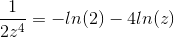
Combining these three terms gives the correct answer:

By logarithmic properties:
Combining these three terms gives the correct answer:
← Didn't Know|Knew It →
Many textbooks use the following convention for logarithms:



Solve:

Many textbooks use the following convention for logarithms:
Solve:
Tap to reveal answer
Remembering the rules for logarithms, we know that 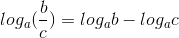 .
.
This tells us that  .
.
This becomes  , which is
  .
.
Remembering the rules for logarithms, we know that
This tells us that
This becomes
← Didn't Know|Knew It →
Find the value of the Logarithmic Expression.

Find the value of the Logarithmic Expression.
Tap to reveal answer
Use the change of base formula to solve this equation.


Use the change of base formula to solve this equation.
← Didn't Know|Knew It →
Which of the following is equivalent to
 ?
?
Which of the following is equivalent to
Tap to reveal answer
Recall that log implies base  if not indicated.Then, we break up
  . Thus, we have
  .
.
Our log rules indicate that
 .
.
So we are really interested in,
 .
.
Since we are interested in log base  , we can solve
  without a calculator.
We know that  , and thus by the definition of log we have that
  .
.
Therefore, we have  .
.
Recall that log implies base
Our log rules indicate that
So we are really interested in,
Since we are interested in log base
We know that
Therefore, we have
← Didn't Know|Knew It →
What is another way of expressing the following?

What is another way of expressing the following?
Tap to reveal answer
Use the rule


Use the rule
← Didn't Know|Knew It →
Expand this logarithm: 
Expand this logarithm:
Tap to reveal answer
In order to solve this problem you must understand the product property of logarithms  and the power property of logarithms
  . Note that these apply to logs of all bases not just base 10.

log of multiple terms is the log of each individual one:

now use the power property to move the exponent over:

In order to solve this problem you must understand the product property of logarithms
log of multiple terms is the log of each individual one:
now use the power property to move the exponent over:
← Didn't Know|Knew It →
Which of the following is equivalent to  ?
?
Which of the following is equivalent to
Tap to reveal answer
We can rewrite the terms of the inner quantity. Change the negative exponent into a fraction.


This means that:
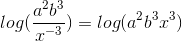
Split up these logarithms by addition.

According to the log rules, the powers can be transferred in front of the logs as coefficients.
The answer is: 
We can rewrite the terms of the inner quantity. Change the negative exponent into a fraction.
This means that:
Split up these logarithms by addition.
According to the log rules, the powers can be transferred in front of the logs as coefficients.
The answer is:
← Didn't Know|Knew It →
Evaluate by hand 
Evaluate by hand
Tap to reveal answer
Using the logarithm rules, exponents within logarithms can be removed and simply multiplied by the remaining logarithm. This expression can be simplified as 
Using the logarithm rules, exponents within logarithms can be removed and simply multiplied by the remaining logarithm. This expression can be simplified as
← Didn't Know|Knew It →
Solve for 

Solve for
Tap to reveal answer

Use the power reducing theorem:

 and
and 


Use the power reducing theorem:
← Didn't Know|Knew It →
Which of the following expressions is equivalent to  ?
?
Which of the following expressions is equivalent to
Tap to reveal answer
According to the rule for exponents of logarithms, . As a direct application of this,
 .
.
According to the rule for exponents of logarithms,
← Didn't Know|Knew It →
Simplify the expression below.

Simplify the expression below.
Tap to reveal answer
Based on the definition of exponents,  .
.
Then, we use the following rule of logarithms:

Thus,  .
.
Based on the definition of exponents,
Then, we use the following rule of logarithms:
Thus,
← Didn't Know|Knew It →
Simplify the expression using logarithmic identities.

Simplify the expression using logarithmic identities.
Tap to reveal answer
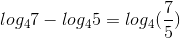
The logarithm of a fraction is equal to the logarithm of the numerator minus the logarithm of the denominator.

If we encounter two logarithms with the same base, we can likely combine them. In this case, we can use the reverse of the above identity.


The logarithm of a fraction is equal to the logarithm of the numerator minus the logarithm of the denominator.
If we encounter two logarithms with the same base, we can likely combine them. In this case, we can use the reverse of the above identity.
← Didn't Know|Knew It →
Which of the following represents a simplified form of  ?
?
Which of the following represents a simplified form of
Tap to reveal answer
The rule for the addition of logarithms is as follows:
 .
.
As an application of this, .
.
The rule for the addition of logarithms is as follows:
As an application of this,
← Didn't Know|Knew It →
Simplify  .
.
Simplify
Tap to reveal answer
Using properties of logs we get:


Using properties of logs we get:
← Didn't Know|Knew It →
Simplify the following expression:

Simplify the following expression:
Tap to reveal answer
Recall the log rule:

In this particular case,  and
and  . Thus, our answer is
  .
.
Recall the log rule:
In this particular case,
← Didn't Know|Knew It →
Use the properties of logarithms to solve the following equation:

Use the properties of logarithms to solve the following equation:
Tap to reveal answer
Since the bases of the logs are the same and the logarithms are added, the arguments can be multiplied together. We then simplify the right side of the equation:


The logarithm can be converted to exponential form:



Factor the equation:


Although there are two solutions to the equation, logarithms cannot be negative. Therefore, the only real solution is  .
.
Since the bases of the logs are the same and the logarithms are added, the arguments can be multiplied together. We then simplify the right side of the equation:
The logarithm can be converted to exponential form:
Factor the equation:
Although there are two solutions to the equation, logarithms cannot be negative. Therefore, the only real solution is
← Didn't Know|Knew It →
Rewrite the following logarithmic expression in expanded form (i.e. as a sum and/or difference):
Rewrite the following logarithmic expression in expanded form (i.e. as a sum and/or difference):
Tap to reveal answer
By logarithmic properties:
;
Combining these three terms gives the correct answer:
By logarithmic properties:
Combining these three terms gives the correct answer:
← Didn't Know|Knew It →
Many textbooks use the following convention for logarithms:
Solve:
Many textbooks use the following convention for logarithms:
Solve:
Tap to reveal answer
Remembering the rules for logarithms, we know that .
This tells us that .
This becomes , which is .
Remembering the rules for logarithms, we know that
This tells us that
This becomes
← Didn't Know|Knew It →
Find the value of the Logarithmic Expression.
Find the value of the Logarithmic Expression.
Tap to reveal answer
Use the change of base formula to solve this equation.
Use the change of base formula to solve this equation.
← Didn't Know|Knew It →
Which of the following is equivalent to
?
Which of the following is equivalent to
Tap to reveal answer
Recall that log implies base if not indicated.Then, we break up . Thus, we have .
Our log rules indicate that
.
So we are really interested in,
.
Since we are interested in log base , we can solve without a calculator.
We know that , and thus by the definition of log we have that .
Therefore, we have .
Recall that log implies base
Our log rules indicate that
So we are really interested in,
Since we are interested in log base
We know that
Therefore, we have
← Didn't Know|Knew It →