Rational Expressions - Math
Card 1 of 48
Solve:
If  varies directly as
  , and
, and  when
when  , find
  when
when  .
.
Solve:
If
Tap to reveal answer
The formula for a direct variation is:

Plugging in our values, we get:


The formula for a direct variation is:
Plugging in our values, we get:
← Didn't Know|Knew It →
If two boxes have the same depth and capacity, the length is inversely proportional to the width. One box is  long and
  wide. A second box (same depth and capacity) is
  long. How wide is it?
If two boxes have the same depth and capacity, the length is inversely proportional to the width. One box is
Tap to reveal answer
The formula for an indirect variation is:

Plugging in our values, we get:
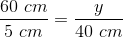


The formula for an indirect variation is:
Plugging in our values, we get:
← Didn't Know|Knew It →
Simplify 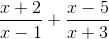
Simplify
Tap to reveal answer
This is a more complicated form of 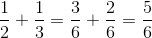
Find the least common denominator (LCD) and convert each fraction to the LCD, then add the numerators. Simplify as needed.

which is equivalent to 
Simplify to get 
This is a more complicated form of
Find the least common denominator (LCD) and convert each fraction to the LCD, then add the numerators. Simplify as needed.
which is equivalent to
Simplify to get
← Didn't Know|Knew It →
Divide and simplify the following rational expression:

Divide and simplify the following rational expression:
Tap to reveal answer
Multiply by the reciprocal of the second expression:

Factor the expressions:

Remove common terms:


Multiply by the reciprocal of the second expression:
Factor the expressions:
Remove common terms:
← Didn't Know|Knew It →
Divide and simplify the following rational expression:

Divide and simplify the following rational expression:
Tap to reveal answer
Multiply by the inverse of the denominator:

Factor:

Remove like terms:


Multiply by the inverse of the denominator:
Factor:
Remove like terms:
← Didn't Know|Knew It →
Add and simplify the following rational expression:
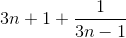
Add and simplify the following rational expression:
Tap to reveal answer
Begin by multiplying the left term by  :
:

Simplify:
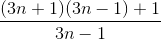


Begin by multiplying the left term by
Simplify:
← Didn't Know|Knew It →
Simplify the following rational expression:

Simplify the following rational expression:
Tap to reveal answer
Begin by combining the terms in the denominator:

Multiply by the reciprocal of the denominator:
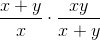
Remove like terms:
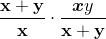

Begin by combining the terms in the denominator:
Multiply by the reciprocal of the denominator:
Remove like terms:
← Didn't Know|Knew It →
Simplify the following rational expression:

Simplify the following rational expression:
Tap to reveal answer
Create a common denominator of  in both the numerator and denominator:

Multiply by the reciprocal of the denominator:

Simplify:
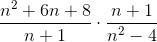

Remove common terms:


Create a common denominator of
Multiply by the reciprocal of the denominator:
Simplify:
Remove common terms:
← Didn't Know|Knew It →
Multiply and simplify the following rational expression:
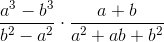
Multiply and simplify the following rational expression:
Tap to reveal answer
Factor the expression:
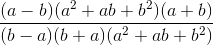
Remove like terms:

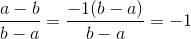
Factor the expression:
Remove like terms:
← Didn't Know|Knew It →
Solve:
If varies directly as , and when , find when .
Solve:
If
Tap to reveal answer
The formula for a direct variation is:
Plugging in our values, we get:
The formula for a direct variation is:
Plugging in our values, we get:
← Didn't Know|Knew It →
If two boxes have the same depth and capacity, the length is inversely proportional to the width. One box is long and wide. A second box (same depth and capacity) is long. How wide is it?
If two boxes have the same depth and capacity, the length is inversely proportional to the width. One box is
Tap to reveal answer
The formula for an indirect variation is:
Plugging in our values, we get:
The formula for an indirect variation is:
Plugging in our values, we get:
← Didn't Know|Knew It →
If 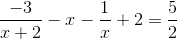 , then what is the largest real value of x?
If
Tap to reveal answer
We are asked to solve the equation 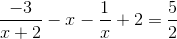 .
.
Often, when solving equations involving rational expressions, it helps to elminate fractions by multiplying both sides of the equation by the denominators of each term intervolved.
In the context of this problem, we can first multiply both sides of the equation by x+2 to eliminate the denominator of the first term.

Be sure to distribute the x+2 to each term on the left side of the equation.


Next, multiply both sides of the equation by x to elminate the term with an x in the denominator.



Then, multiply both sides of the equation by 2.






In order to solve this polynomial equation, we can use the Rational Root Theorem. According to this theorem, if there is a rational root to a polynomial equation, then that root must be in the form p/q, where p is a factor of the constant, and q is the factor of the coefficient of the highest term.
In the context of this problem, p will be a factor of 4 (which is the constant), and q will be a factor of 2 (which is the coefficient of the highest term).
The factors of 4 are  . The factors of 2 are
  .
.
This means that if there is a rational root for the equation, then the numerator must be either  , and the denominator must be one of
  . In other words, the possible rational roots are
 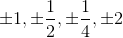 , because these are all the possible ratios we can make with a numerator of
  and a denominator of one of
  .
.
At this point, we have narrowed down the rational roots of the equation  to the following eight choices:
 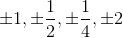 .
.
Notice, that if we were to let  , then the polynomial
  would evaluate to 4. Also, if we were to let
  , then the polynomial would evaluate to -3. Because the value of the polynomial switches from a postive value of 4 when x = 0 to a negative value of -3 when x = -1, there must be a root somewhere between
  and
and  .
.
Let's see what happens when  , because -1/2 is between 0 and -1.
We will put -1/2 into the polynomial to see if it evaluates to zero.


Thus  is indeed a root to the equation.
However, the question asks us to find the largest real root; this means that there could be other roots larger than  . We will need to continue solving the equation to see what other roots are possible.
We can make use of the Factor Theorem of polynomials, which states that if  is a root of a polynomial equation, where a is constant, then x-a must be a factor of the polynomial.
This means that for our polynomial,  is a factor. We can divide the polynomial
  by
by  using long division.

This means that 
In order to find the remaining roots of the equation, we now need to solve the quadratic equation  .
.
First, divide both sides of the equation by two.

Perhaps the most straightforward way to solve this is to use the quadratic formula:
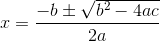
When we evaluate this, we will be forced to take the square root of  . Because this will result in an imaginary number,
  has no real solutions.
Thus, returning to our original polynomial equation  , it turns out that -1/2 is indeed the only root of the equation.
The question asks us to find the largest real value of x that solves the equation. Because -1/2 is the only real value that solves the equation, the answer must be -1/2.
We are asked to solve the equation
Often, when solving equations involving rational expressions, it helps to elminate fractions by multiplying both sides of the equation by the denominators of each term intervolved.
In the context of this problem, we can first multiply both sides of the equation by x+2 to eliminate the denominator of the first term.
Be sure to distribute the x+2 to each term on the left side of the equation.
Next, multiply both sides of the equation by x to elminate the term with an x in the denominator.
Then, multiply both sides of the equation by 2.
In order to solve this polynomial equation, we can use the Rational Root Theorem. According to this theorem, if there is a rational root to a polynomial equation, then that root must be in the form p/q, where p is a factor of the constant, and q is the factor of the coefficient of the highest term.
In the context of this problem, p will be a factor of 4 (which is the constant), and q will be a factor of 2 (which is the coefficient of the highest term).
The factors of 4 are
This means that if there is a rational root for the equation, then the numerator must be either
At this point, we have narrowed down the rational roots of the equation
Notice, that if we were to let
Let's see what happens when
We will put -1/2 into the polynomial to see if it evaluates to zero.
Thus
However, the question asks us to find the largest real root; this means that there could be other roots larger than
We can make use of the Factor Theorem of polynomials, which states that if
This means that for our polynomial,
This means that
In order to find the remaining roots of the equation, we now need to solve the quadratic equation
First, divide both sides of the equation by two.
Perhaps the most straightforward way to solve this is to use the quadratic formula:
When we evaluate this, we will be forced to take the square root of
Thus, returning to our original polynomial equation
The question asks us to find the largest real value of x that solves the equation. Because -1/2 is the only real value that solves the equation, the answer must be -1/2.
← Didn't Know|Knew It →
Solve the following rational expression:
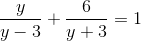
Solve the following rational expression:
Tap to reveal answer
Multiply the equation by  :
:




Multiply the equation by
← Didn't Know|Knew It →
Solve the following rational equation:

Solve the following rational equation:
Tap to reveal answer
Multiply the equation by  :
:
Simplify:




Multiply the equation by
Simplify:
← Didn't Know|Knew It →
Simplify
Simplify
Tap to reveal answer
This is a more complicated form of
Find the least common denominator (LCD) and convert each fraction to the LCD, then add the numerators. Simplify as needed.
which is equivalent to
Simplify to get
This is a more complicated form of
Find the least common denominator (LCD) and convert each fraction to the LCD, then add the numerators. Simplify as needed.
which is equivalent to
Simplify to get
← Didn't Know|Knew It →
Divide and simplify the following rational expression:
Divide and simplify the following rational expression:
Tap to reveal answer
Multiply by the reciprocal of the second expression:
Factor the expressions:
Remove common terms:
Multiply by the reciprocal of the second expression:
Factor the expressions:
Remove common terms:
← Didn't Know|Knew It →
Divide and simplify the following rational expression:
Divide and simplify the following rational expression:
Tap to reveal answer
Multiply by the inverse of the denominator:
Factor:
Remove like terms:
Multiply by the inverse of the denominator:
Factor:
Remove like terms:
← Didn't Know|Knew It →
Add and simplify the following rational expression:
Add and simplify the following rational expression:
Tap to reveal answer
Begin by multiplying the left term by :
Simplify:
Begin by multiplying the left term by
Simplify:
← Didn't Know|Knew It →
Simplify the following rational expression:
Simplify the following rational expression:
Tap to reveal answer
Begin by combining the terms in the denominator:
Multiply by the reciprocal of the denominator:
Remove like terms:
Begin by combining the terms in the denominator:
Multiply by the reciprocal of the denominator:
Remove like terms:
← Didn't Know|Knew It →
Simplify the following rational expression:
Simplify the following rational expression:
Tap to reveal answer
Create a common denominator of in both the numerator and denominator:
Multiply by the reciprocal of the denominator:
Simplify:
Remove common terms:
Create a common denominator of
Multiply by the reciprocal of the denominator:
Simplify:
Remove common terms:
← Didn't Know|Knew It →