Solid Geometry - Math
Card 1 of 2252
If a cylinder has a radius, r, of 2 inches and a height, h, of 5 inches, what is the total surface area of the cylinder?
If a cylinder has a radius, r, of 2 inches and a height, h, of 5 inches, what is the total surface area of the cylinder?
Tap to reveal answer
The total surface area will be equal to the area of the two bases added to the area of the outer surface of the cylinder. If "unwrapped" the area of the outer surface is simply a rectangle with the height of the cylinder and a base equal to the circumference of the cylinder base. We can use these relationships to find a formula for the total area of the cylinder.


Use the given radius and height to solve for the final area.
$2pi(2)^{2}$ + 2pi (2)(5)
8pi + 20pi
28pi
The total surface area will be equal to the area of the two bases added to the area of the outer surface of the cylinder. If "unwrapped" the area of the outer surface is simply a rectangle with the height of the cylinder and a base equal to the circumference of the cylinder base. We can use these relationships to find a formula for the total area of the cylinder.
Use the given radius and height to solve for the final area.
$2pi(2)^{2}$ + 2pi (2)(5)
8pi + 20pi
28pi
← Didn't Know|Knew It →
The volume of a cylinder is  , what is its height?
The volume of a cylinder is
Tap to reveal answer
Because both the radius and height are unspecified, any real number could be it's height as long as an matching radius is also chosen. There is no restriction on the height or radius being rational.
Because both the radius and height are unspecified, any real number could be it's height as long as an matching radius is also chosen. There is no restriction on the height or radius being rational.
← Didn't Know|Knew It →
What is the volume of a hollow cylinder with an outer diameter of  , an inner diameter of
  and a length of
  ?
?
What is the volume of a hollow cylinder with an outer diameter of
Tap to reveal answer
The general formula for the volume of a hollow cylinder is given by  where
where  is the outer radius,
  is the inner radius, and
  is the length.
The question gives diameters and we need to convert them to radii by cutting the diameters in half. Remember,  . So the equation to solve becomes:
 or
or 
The general formula for the volume of a hollow cylinder is given by
The question gives diameters and we need to convert them to radii by cutting the diameters in half. Remember,
← Didn't Know|Knew It →
Find the volume of the following right cylinder: 
Find the volume of the following right cylinder:
Tap to reveal answer
The correct answer is  .
.
The formula for volume of a cylinder is

 and
and 
The correct answer is
The formula for volume of a cylinder is
← Didn't Know|Knew It →
Given a cylinder with radius of 5cm and height of 10cm, what is the volume of the cylinder?
Given a cylinder with radius of 5cm and height of 10cm, what is the volume of the cylinder?
Tap to reveal answer
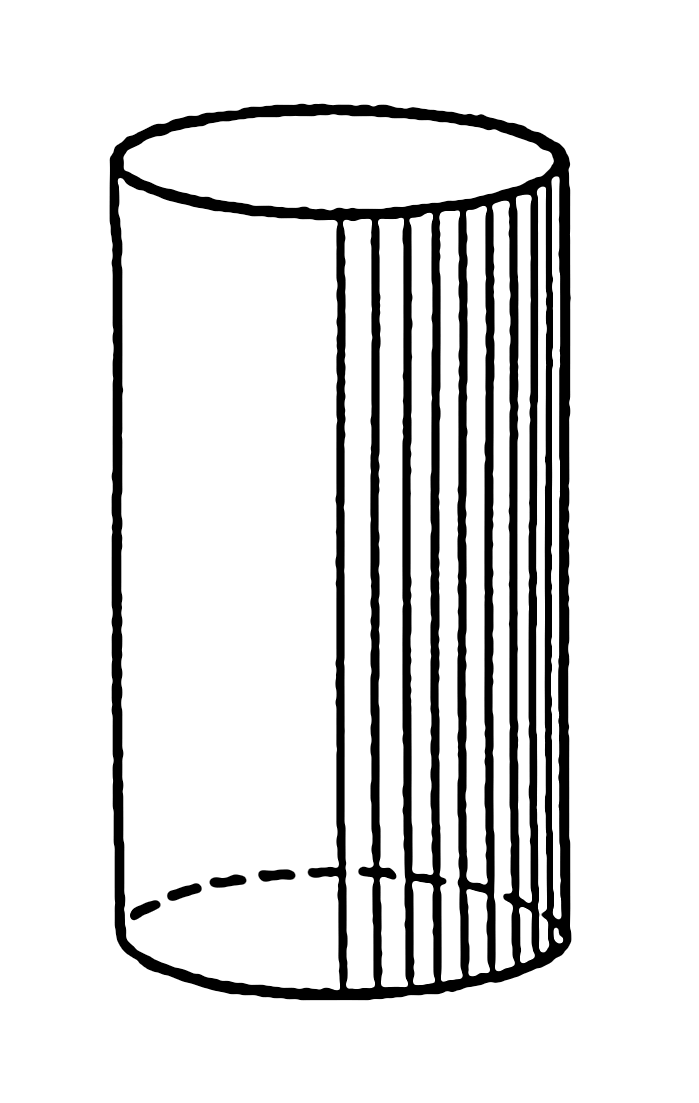
The volume of a cylinder is given by 
Notice how the formula for the volume is defined as the area of a circle times the lateral height of the cylinder. It is as if we are taking little paper circles and stacking them one-by-one until we fill up the entire container.
Plugging in the numbers we get:


The volume of a cylinder is given by
Notice how the formula for the volume is defined as the area of a circle times the lateral height of the cylinder. It is as if we are taking little paper circles and stacking them one-by-one until we fill up the entire container.
Plugging in the numbers we get:
← Didn't Know|Knew It →
A right cylinder has a diameter of  and a height of
  . What is the volume of this cylinder?
A right cylinder has a diameter of
Tap to reveal answer
The formula to find the volume of a cylinder is:  , where
  is the radius of the cylinder and
  is the height of the cylinder.
A good point to start in this kind of a formula-based problem is to ask "What information do I have?" and "What information is missing that I need?"
In this case, the problem provides us with the height of the cylinder and its diameter. We have the  component of the equation, but we're missing the
  component. Can we find out
  ? The answer is yes! Radius is half of diameter. So in this case, because the diameter is
  , the radius must be
  .
.
Now that we have  and
and  , we are ready to solve for the volume after substituting in those values.


The formula to find the volume of a cylinder is:
A good point to start in this kind of a formula-based problem is to ask "What information do I have?" and "What information is missing that I need?"
In this case, the problem provides us with the height of the cylinder and its diameter. We have the
Now that we have
← Didn't Know|Knew It →
You have just bought a farm that includes a storage silo. You want to find the volume for the 20 foot tall silo in the shape of a cylinder. You measure the circumference of the silo, it is listed below.

Leave answer in terms of  .
.
You have just bought a farm that includes a storage silo. You want to find the volume for the 20 foot tall silo in the shape of a cylinder. You measure the circumference of the silo, it is listed below.
Leave answer in terms of
Tap to reveal answer
To find the volume of a cylinder we need to find the area of the base and then multiply that by the height. The base is in the shape of a circle so the formula is given below:

To find the radius of the base, we use what was found from the measurement for circumference of the base. We set the formula for circumference equal to the measured circumference given in the problem.

From this we can solve to find that the radius =5. Which we can plug into the original Volume formula. With the given height of 20 ft.

Simplifying will give us the volume of the cylinder.

To find the volume of a cylinder we need to find the area of the base and then multiply that by the height. The base is in the shape of a circle so the formula is given below:
To find the radius of the base, we use what was found from the measurement for circumference of the base. We set the formula for circumference equal to the measured circumference given in the problem.
From this we can solve to find that the radius =5. Which we can plug into the original Volume formula. With the given height of 20 ft.
Simplifying will give us the volume of the cylinder.
← Didn't Know|Knew It →
A can of tomato soup has a diameter of 3.5 inches and a height of 8 inches. What is the volume of the can of soup?
A can of tomato soup has a diameter of 3.5 inches and a height of 8 inches. What is the volume of the can of soup?
Tap to reveal answer
To find the volume of a soup can, or a cylinder, we use the formula for volume:

The base of our cylinder is a circle and to find the area of the circle we use:

Now we can use the formula for the area of our circular base:

All we need to do now is multiply the base by the hieght of our cylinder!

To find the volume of a soup can, or a cylinder, we use the formula for volume:
The base of our cylinder is a circle and to find the area of the circle we use:
Now we can use the formula for the area of our circular base:
All we need to do now is multiply the base by the hieght of our cylinder!
← Didn't Know|Knew It →
You are painting a water tank black. You are trying to find the surface area of the tank so you measure the height and diameter of the tank. The height is 2.5 meters, and diameter is 4 meters. What is the total surface area of the tank?
You are painting a water tank black. You are trying to find the surface area of the tank so you measure the height and diameter of the tank. The height is 2.5 meters, and diameter is 4 meters. What is the total surface area of the tank?
Tap to reveal answer
To find the surface area of a cylinder we need to find the area of the circular top and bottom and the area of the rectangular (but rounded) side, then add them together. Lets start by finding the area of the circular ends to the cylinder, remember that we measured the diameter (d) and we need the radius (r) to find the area of a circle, the radius is half of the diameter:
 (area of one circle)
Don't forget that we have two circles on the cylinder that have this area:
 (area for both circles)
Now we just need to find the area of rectangular side of the cylinder. To do this we will take the hieght of the cylinder, 2.5 m, and multiply by the circumference (C) of the circle (the width of the rectangular side of the cylinder).

So now that we know the circumference we can multiply by the cylinder height to find the area of the rectangular side:
 (area for rectangular side)
Now just add to find the total surface area:

and that is our total surface area for the cylinder!
To find the surface area of a cylinder we need to find the area of the circular top and bottom and the area of the rectangular (but rounded) side, then add them together. Lets start by finding the area of the circular ends to the cylinder, remember that we measured the diameter (d) and we need the radius (r) to find the area of a circle, the radius is half of the diameter:
Don't forget that we have two circles on the cylinder that have this area:
Now we just need to find the area of rectangular side of the cylinder. To do this we will take the hieght of the cylinder, 2.5 m, and multiply by the circumference (C) of the circle (the width of the rectangular side of the cylinder).
So now that we know the circumference we can multiply by the cylinder height to find the area of the rectangular side:
Now just add to find the total surface area:
and that is our total surface area for the cylinder!
← Didn't Know|Knew It →
Find the volume of a cylinder that has a radius of  and a height of
  .
.
Find the volume of a cylinder that has a radius of
Tap to reveal answer
Recall how to find the volume of a cylinder:

Since the base of a cylinder is a circle, we can write the following equation:

Substitute in the given values to find the volume.

Solve.

Recall how to find the volume of a cylinder:
Since the base of a cylinder is a circle, we can write the following equation:
Substitute in the given values to find the volume.
Solve.
← Didn't Know|Knew It →
Find the volume of the figure.

Find the volume of the figure.
Tap to reveal answer

In order to find the volume of the figure, we will first need to find the volume of both cylinders.
Recall how to find the volume of the cylinder:

Now, use the given radius and height to find the volume of the larger cylinder.

Next, use the given radius and height to find the volume of the smaller cylinder.

Subtract the volume of the smaller cylinder from the volume of the larger one to find the volume of the figure.

Make sure to round to  places after the decimal.
In order to find the volume of the figure, we will first need to find the volume of both cylinders.
Recall how to find the volume of the cylinder:
Now, use the given radius and height to find the volume of the larger cylinder.
Next, use the given radius and height to find the volume of the smaller cylinder.
Subtract the volume of the smaller cylinder from the volume of the larger one to find the volume of the figure.
Make sure to round to
← Didn't Know|Knew It →
Find the volume of a cylinder that has a radius of  and a height of
  .
.
Find the volume of a cylinder that has a radius of
Tap to reveal answer
Recall how to find the volume of a cylinder:
Since the base of a cylinder is a circle, we can write the following equation:
Substitute in the given values to find the volume.

Solve.

Recall how to find the volume of a cylinder:
Since the base of a cylinder is a circle, we can write the following equation:
Substitute in the given values to find the volume.
Solve.
← Didn't Know|Knew It →
Find the volume of a cylinder that has a radius of  and a height of
  .
.
Find the volume of a cylinder that has a radius of
Tap to reveal answer
Recall how to find the volume of a cylinder:
Since the base of a cylinder is a circle, we can write the following equation:
Substitute in the given values to find the volume.

Solve.

Recall how to find the volume of a cylinder:
Since the base of a cylinder is a circle, we can write the following equation:
Substitute in the given values to find the volume.
Solve.
← Didn't Know|Knew It →
Find the volume of a cylinder that has a radius of  and a height of
  .
.
Find the volume of a cylinder that has a radius of
Tap to reveal answer
Recall how to find the volume of a cylinder:
Since the base of a cylinder is a circle, we can write the following equation:
Substitute in the given values to find the volume.

Solve.

Recall how to find the volume of a cylinder:
Since the base of a cylinder is a circle, we can write the following equation:
Substitute in the given values to find the volume.
Solve.
← Didn't Know|Knew It →
Find the volume of a cylinder that has a radius of  and a height of
  .
.
Find the volume of a cylinder that has a radius of
Tap to reveal answer
Recall how to find the volume of a cylinder:
Since the base of a cylinder is a circle, we can write the following equation:
Substitute in the given values to find the volume.

Solve.

Recall how to find the volume of a cylinder:
Since the base of a cylinder is a circle, we can write the following equation:
Substitute in the given values to find the volume.
Solve.
← Didn't Know|Knew It →
Find the volume of a cylinder that has a radius of  and a height of
  .
.
Find the volume of a cylinder that has a radius of
Tap to reveal answer
Recall how to find the volume of a cylinder:
Since the base of a cylinder is a circle, we can write the following equation:
Substitute in the given values to find the volume.

Solve.

Recall how to find the volume of a cylinder:
Since the base of a cylinder is a circle, we can write the following equation:
Substitute in the given values to find the volume.
Solve.
← Didn't Know|Knew It →
Find the volume of a cylinder that has a radius of  and a height of
  .
.
Find the volume of a cylinder that has a radius of
Tap to reveal answer
Recall how to find the volume of a cylinder:
Since the base of a cylinder is a circle, we can write the following equation:
Substitute in the given values to find the volume.

Solve.

Recall how to find the volume of a cylinder:
Since the base of a cylinder is a circle, we can write the following equation:
Substitute in the given values to find the volume.
Solve.
← Didn't Know|Knew It →
Find the volume of a cylinder that has a radius of  and a height of
  .
.
Find the volume of a cylinder that has a radius of
Tap to reveal answer
Recall how to find the volume of a cylinder:
Since the base of a cylinder is a circle, we can write the following equation:
Substitute in the given values to find the volume.

Solve.

Recall how to find the volume of a cylinder:
Since the base of a cylinder is a circle, we can write the following equation:
Substitute in the given values to find the volume.
Solve.
← Didn't Know|Knew It →
Find the volume of a cylinder that has a radius of  and a height of
  .
.
Find the volume of a cylinder that has a radius of
Tap to reveal answer
Recall how to find the volume of a cylinder:
Since the base of a cylinder is a circle, we can write the following equation:
Substitute in the given values to find the volume.

Solve.

Recall how to find the volume of a cylinder:
Since the base of a cylinder is a circle, we can write the following equation:
Substitute in the given values to find the volume.
Solve.
← Didn't Know|Knew It →
Find the volume of a cylinder that has a radius of  and a height of
  .
.
Find the volume of a cylinder that has a radius of
Tap to reveal answer
Recall how to find the volume of a cylinder:
Since the base of a cylinder is a circle, we can write the following equation:
Substitute in the given values to find the volume.

Solve.

Recall how to find the volume of a cylinder:
Since the base of a cylinder is a circle, we can write the following equation:
Substitute in the given values to find the volume.
Solve.
← Didn't Know|Knew It →