Number Theory - Math
Card 1 of 28
Which of the following is NOT a real number?
Which of the following is NOT a real number?
Tap to reveal answer
We are looking for a number that is not real.
 ,
,  , and
, and  are irrational numbers, but they are still real.
Then,  is equivalent to
  by the rules of complex numbers. Thus, it is also real.
That leaves us with:  which in fact is imaginary (since no real number multiplied by itself yields a negative number) and simplifies to
  .
.
We are looking for a number that is not real.
Then,
That leaves us with:
← Didn't Know|Knew It →
Without using a calculator, which of the following is the best estimate for  ?
?
Without using a calculator, which of the following is the best estimate for
Tap to reveal answer
We know that  and
and  .
.



Because 90 falls is approximately halfway between 81 and 100, the square root of 90 is approximately halfway between 9 and 10, or 9.5.
We know that
Because 90 falls is approximately halfway between 81 and 100, the square root of 90 is approximately halfway between 9 and 10, or 9.5.
← Didn't Know|Knew It →
Which of the following are considered real numbers?
Which of the following are considered real numbers?
Tap to reveal answer
Real numbers can be found anywhere on a continuous number line ranging from negative infinity to positive infinity; therefore, all of the numbers are real numbers.
Real numbers can be found anywhere on a continuous number line ranging from negative infinity to positive infinity; therefore, all of the numbers are real numbers.
← Didn't Know|Knew It →
Place in order from smallest to largest:
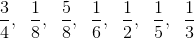
Place in order from smallest to largest:
Tap to reveal answer
To place in order, first we must find a common denominator and convert all fractions to that denominator.
 have a common denominator of
  .
.
 have a common denominator of
  .
.
 have a common denominator of
  .
.
Therefore we can use common denominators to make all of the fractions look similar. Then the ordering becomes trivial.

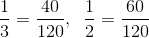
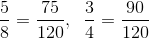
To place in order, first we must find a common denominator and convert all fractions to that denominator.
Therefore we can use common denominators to make all of the fractions look similar. Then the ordering becomes trivial.
← Didn't Know|Knew It →
What number is  of
of  ?
?
What number is
Tap to reveal answer
For percent problems there are verbal cues:
"IS" means equals and "OF" means multiplication.
Then the equation to solve becomes:

For percent problems there are verbal cues:
"IS" means equals and "OF" means multiplication.
Then the equation to solve becomes:
← Didn't Know|Knew It →
Find the distance between  and
and  on a number line.
Find the distance between
Tap to reveal answer
To find the distance on a number line:




To find the distance on a number line:
← Didn't Know|Knew It →
If a card is drawn randomly from a regular shuffled 52 card deck, what is the probability that the card is either a spade or a 3?
If a card is drawn randomly from a regular shuffled 52 card deck, what is the probability that the card is either a spade or a 3?
Tap to reveal answer
How many cards in the deck are either a spade or a 3?
There are thirteen spades, including a 3 of spades.
There are four 3's, including a 3 of spades.
Since we are counting the same card (3 of spades) twice, there are actually

 distinct cards that fit the criteria of being either a spade or a 3.
Since any of the 52 cards is equally likely to be drawn, the probability that it is a spade or a 3, is


How many cards in the deck are either a spade or a 3?
There are thirteen spades, including a 3 of spades.
There are four 3's, including a 3 of spades.
Since we are counting the same card (3 of spades) twice, there are actually
Since any of the 52 cards is equally likely to be drawn, the probability that it is a spade or a 3, is
← Didn't Know|Knew It →
Without using a calculator, which of the following is the best estimate for ?
Without using a calculator, which of the following is the best estimate for
Tap to reveal answer
We know that and .
Because 90 falls is approximately halfway between 81 and 100, the square root of 90 is approximately halfway between 9 and 10, or 9.5.
We know that
Because 90 falls is approximately halfway between 81 and 100, the square root of 90 is approximately halfway between 9 and 10, or 9.5.
← Didn't Know|Knew It →
Which of the following are considered real numbers?
Which of the following are considered real numbers?
Tap to reveal answer
Real numbers can be found anywhere on a continuous number line ranging from negative infinity to positive infinity; therefore, all of the numbers are real numbers.
Real numbers can be found anywhere on a continuous number line ranging from negative infinity to positive infinity; therefore, all of the numbers are real numbers.
← Didn't Know|Knew It →
Place in order from smallest to largest:
Place in order from smallest to largest:
Tap to reveal answer
To place in order, first we must find a common denominator and convert all fractions to that denominator.
have a common denominator of .
have a common denominator of .
have a common denominator of .
Therefore we can use common denominators to make all of the fractions look similar. Then the ordering becomes trivial.
To place in order, first we must find a common denominator and convert all fractions to that denominator.
Therefore we can use common denominators to make all of the fractions look similar. Then the ordering becomes trivial.
← Didn't Know|Knew It →
What number is of ?
What number is
Tap to reveal answer
For percent problems there are verbal cues:
"IS" means equals and "OF" means multiplication.
Then the equation to solve becomes:
For percent problems there are verbal cues:
"IS" means equals and "OF" means multiplication.
Then the equation to solve becomes:
← Didn't Know|Knew It →
Which of the following is NOT a real number?
Which of the following is NOT a real number?
Tap to reveal answer
We are looking for a number that is not real.
, , and are irrational numbers, but they are still real.
Then, is equivalent to by the rules of complex numbers. Thus, it is also real.
That leaves us with: which in fact is imaginary (since no real number multiplied by itself yields a negative number) and simplifies to .
We are looking for a number that is not real.
Then,
That leaves us with:
← Didn't Know|Knew It →
If a card is drawn randomly from a regular shuffled 52 card deck, what is the probability that the card is either a spade or a 3?
If a card is drawn randomly from a regular shuffled 52 card deck, what is the probability that the card is either a spade or a 3?
Tap to reveal answer
How many cards in the deck are either a spade or a 3?
There are thirteen spades, including a 3 of spades.
There are four 3's, including a 3 of spades.
Since we are counting the same card (3 of spades) twice, there are actually
distinct cards that fit the criteria of being either a spade or a 3.
Since any of the 52 cards is equally likely to be drawn, the probability that it is a spade or a 3, is
How many cards in the deck are either a spade or a 3?
There are thirteen spades, including a 3 of spades.
There are four 3's, including a 3 of spades.
Since we are counting the same card (3 of spades) twice, there are actually
Since any of the 52 cards is equally likely to be drawn, the probability that it is a spade or a 3, is
← Didn't Know|Knew It →
Find the distance between and on a number line.
Find the distance between
Tap to reveal answer
To find the distance on a number line:
To find the distance on a number line:
← Didn't Know|Knew It →
Find the distance between and on a number line.
Find the distance between
Tap to reveal answer
To find the distance on a number line:
To find the distance on a number line:
← Didn't Know|Knew It →
Without using a calculator, which of the following is the best estimate for ?
Without using a calculator, which of the following is the best estimate for
Tap to reveal answer
We know that and .
Because 90 falls is approximately halfway between 81 and 100, the square root of 90 is approximately halfway between 9 and 10, or 9.5.
We know that
Because 90 falls is approximately halfway between 81 and 100, the square root of 90 is approximately halfway between 9 and 10, or 9.5.
← Didn't Know|Knew It →
Which of the following are considered real numbers?
Which of the following are considered real numbers?
Tap to reveal answer
Real numbers can be found anywhere on a continuous number line ranging from negative infinity to positive infinity; therefore, all of the numbers are real numbers.
Real numbers can be found anywhere on a continuous number line ranging from negative infinity to positive infinity; therefore, all of the numbers are real numbers.
← Didn't Know|Knew It →
Place in order from smallest to largest:
Place in order from smallest to largest:
Tap to reveal answer
To place in order, first we must find a common denominator and convert all fractions to that denominator.
have a common denominator of .
have a common denominator of .
have a common denominator of .
Therefore we can use common denominators to make all of the fractions look similar. Then the ordering becomes trivial.
To place in order, first we must find a common denominator and convert all fractions to that denominator.
Therefore we can use common denominators to make all of the fractions look similar. Then the ordering becomes trivial.
← Didn't Know|Knew It →
What number is of ?
What number is
Tap to reveal answer
For percent problems there are verbal cues:
"IS" means equals and "OF" means multiplication.
Then the equation to solve becomes:
For percent problems there are verbal cues:
"IS" means equals and "OF" means multiplication.
Then the equation to solve becomes:
← Didn't Know|Knew It →
Which of the following is NOT a real number?
Which of the following is NOT a real number?
Tap to reveal answer
We are looking for a number that is not real.
, , and are irrational numbers, but they are still real.
Then, is equivalent to by the rules of complex numbers. Thus, it is also real.
That leaves us with: which in fact is imaginary (since no real number multiplied by itself yields a negative number) and simplifies to .
We are looking for a number that is not real.
Then,
That leaves us with:
← Didn't Know|Knew It →