Word Problems - HSPT Math
Card 1 of 508
Steve can paint his greenhouse in four hours working alone; his ten-year-old son can paint the greenhouse alone in nine hours. Working together, how long, to the nearest minute, would it take them?
Steve can paint his greenhouse in four hours working alone; his ten-year-old son can paint the greenhouse alone in nine hours. Working together, how long, to the nearest minute, would it take them?
Tap to reveal answer
Think of these work rates as "greenhouses per hour", not "hours per greenhouse". Then Steve's work rate is one fourth of a greenhouse per hour, and his son's is one ninth of a greenhouse per hour. Now, multiply each rate by the time  to get the portion of the greenhouse each paints, and add the products up to get one greenhouse. The work equation becomes:

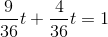

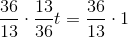

or 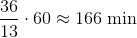
This is two hours and forty-six minutes.
Think of these work rates as "greenhouses per hour", not "hours per greenhouse". Then Steve's work rate is one fourth of a greenhouse per hour, and his son's is one ninth of a greenhouse per hour. Now, multiply each rate by the time
or
This is two hours and forty-six minutes.
← Didn't Know|Knew It →
Bob gets paid  an hour for the regular hours he works and
  an hour for any overtime hours he works. All hours over 40 in a week are considered overtime. If Bob works 44 hours this week, how much did he make?
Bob gets paid
Tap to reveal answer
You first calculate how much he makes for normal hours, which is the number of hours works multiplied by the wage. So for normal hours,  . For overtime, it is
  . Add the amount made in overtime and the normal hours and you get
  .
.
You first calculate how much he makes for normal hours, which is the number of hours works multiplied by the wage. So for normal hours,
← Didn't Know|Knew It →
Julie sells cars. She has a monthly salary of $1000 and a commission of $500 for each car sold. How much money will she make this month if she sells 7 cars?
Julie sells cars. She has a monthly salary of $1000 and a commission of $500 for each car sold. How much money will she make this month if she sells 7 cars?
Tap to reveal answer
To find out how much Julie makes from selling the cars, we first multiply the 7 cars she sells by the $500 that she receives for each car. This gives us $3,500. We now add the $1,000 that she gets for her monthly salary for a total of $4,500.
To find out how much Julie makes from selling the cars, we first multiply the 7 cars she sells by the $500 that she receives for each car. This gives us $3,500. We now add the $1,000 that she gets for her monthly salary for a total of $4,500.
← Didn't Know|Knew It →
Machine A can produce 4 books in 2 days. Machine B can produce 20 books in 4 days. How many books can machines A and B, working together, produce in 40 days?
Machine A can produce 4 books in 2 days. Machine B can produce 20 books in 4 days. How many books can machines A and B, working together, produce in 40 days?
Tap to reveal answer
Through simplification, we can see that machine A produces 2 books a day and that machine B produces 5 books a day. If we multily each by 40 days and add them together, we find that together they can produce 280 books in 40 days:

Through simplification, we can see that machine A produces 2 books a day and that machine B produces 5 books a day. If we multily each by 40 days and add them together, we find that together they can produce 280 books in 40 days:
← Didn't Know|Knew It →
John sells cloths. His monthly salary is  dollars plus a commission of
  dollars for each cloth sold. If he sells
  cloths this month, how much money does he make in dollars?
John sells cloths. His monthly salary is
Tap to reveal answer
In order to find how much he makes from selling the cloths, we first multiply the number of cloths sold by  dollars.
 dollars
Now we add his monthly salary:
 dollars
In order to find how much he makes from selling the cloths, we first multiply the number of cloths sold by
Now we add his monthly salary:
← Didn't Know|Knew It →
Tom works in a mall and sells shoes. His monthly salary is  dollars plus a commission of
  dollars for every pair of shoes that he sells. How many pairs of shoes must he sell to earn
  dollars per month.
Tom works in a mall and sells shoes. His monthly salary is
Tap to reveal answer
Let  number of pairs of shoes.
Then we can set up the following equation:

Now we solve the equation for  :
:

Let
Then we can set up the following equation:
Now we solve the equation for
← Didn't Know|Knew It →
John and Tom are farmers. John can produce  of an organic product in six months. Tom can produce
  of the organic product in one year. How many pounds of organic product can they produce in three years together? (Assume that they can work and produce the organic product all year round.)
John and Tom are farmers. John can produce
Tap to reveal answer
John can produce  in six month. Therefore we can set up a proportion:

Tom can produce  in one year. Then we can set up another proportion:


John can produce
Tom can produce
← Didn't Know|Knew It →
A bakery has a machine that can make two hundred loaves of bread in one hour, and a machine that can make three hundred loaves of bread in one hour. How many hours will it take for the two machines together to make 10,000 loaves of bread?
A bakery has a machine that can make two hundred loaves of bread in one hour, and a machine that can make three hundred loaves of bread in one hour. How many hours will it take for the two machines together to make 10,000 loaves of bread?
Tap to reveal answer
In one hour, the two machines can make a total of

loaves of bread.
Divide 10,000 loaves by 500 loaves per hour:
 .
.
In one hour, the two machines can make a total of
loaves of bread.
Divide 10,000 loaves by 500 loaves per hour:
← Didn't Know|Knew It →
A candymaker has two machines. One can turn out one hundred pieces of divinity in one hour; the other, an older machine, can do the same in one hour and twenty minutes. Working together and starting at the same time, how many hours would it take for them to make 10,000 pieces of divinity?
Choose the closest answer.
A candymaker has two machines. One can turn out one hundred pieces of divinity in one hour; the other, an older machine, can do the same in one hour and twenty minutes. Working together and starting at the same time, how many hours would it take for them to make 10,000 pieces of divinity?
Choose the closest answer.
Tap to reveal answer
The newer machine can make 100 pieces of divinity per hour. The older machine makes 100 pieces in one hour twenty minutes, or, equivalently, one and one third hours, which is
 pieces per hour.
Together, the machines make  pieces per hour.
Divide 10,000 pieces by 175 pieces per hour:
 .
.
The candy can be made in a little over 57 hours. The closest choice is therefore 60 hours.
The newer machine can make 100 pieces of divinity per hour. The older machine makes 100 pieces in one hour twenty minutes, or, equivalently, one and one third hours, which is
Together, the machines make
Divide 10,000 pieces by 175 pieces per hour:
The candy can be made in a little over 57 hours. The closest choice is therefore 60 hours.
← Didn't Know|Knew It →
A candymaker specializes in making "turtles" (pecan caramel candies). She has two machines - a newer machine, which can make one hundred turtles in seventy minutes, and an older machine, which can make one hundred turtles in ninety minutes.
She wants to make one hundred boxes of turtles, each of which holds forty turtles. How many hours would it take for both machines, working together, to produce enough turtles to fill those boxes?
Choose the closest answer.
A candymaker specializes in making "turtles" (pecan caramel candies). She has two machines - a newer machine, which can make one hundred turtles in seventy minutes, and an older machine, which can make one hundred turtles in ninety minutes.
She wants to make one hundred boxes of turtles, each of which holds forty turtles. How many hours would it take for both machines, working together, to produce enough turtles to fill those boxes?
Choose the closest answer.
Tap to reveal answer
The newer machine makes one hundred turtles in seventy minutes, or, on the average,
 turtles in one minute.
Similarly, the older machine makes, on the average,
 turtles in one minute.
Together, they make an average of

turtles per minute.
The candymaker wants one hundred boxes, each with forty turtles, so she wants
 turtles. Divide this by
  turtles per minute to get
 minutes;
multiply this by  to get the number of hours:

The process takes just over 26 hours; the response closest to the correct time is 25 hours.
The newer machine makes one hundred turtles in seventy minutes, or, on the average,
Similarly, the older machine makes, on the average,
Together, they make an average of
turtles per minute.
The candymaker wants one hundred boxes, each with forty turtles, so she wants
multiply this by
The process takes just over 26 hours; the response closest to the correct time is 25 hours.
← Didn't Know|Knew It →
A machine can make one hundred caramel creams in twenty five minutes.
The owner of the machine wants to fill an order of two hundred boxes of caramel creams; eighty of the boxes are to be large boxes, which contain fifty candies each, and the rest are to be small boxes, which contain thirty candies each. How many hours will it take to make enough candies to fill all two hundred boxes?
Select the closest answer.
A machine can make one hundred caramel creams in twenty five minutes.
The owner of the machine wants to fill an order of two hundred boxes of caramel creams; eighty of the boxes are to be large boxes, which contain fifty candies each, and the rest are to be small boxes, which contain thirty candies each. How many hours will it take to make enough candies to fill all two hundred boxes?
Select the closest answer.
Tap to reveal answer
80 boxes contain 50 candies each; 120 boxes contain 30 candies each. Therefore, there will be a total of

candies in the boxes.
It takes 25 minutes to produce 100 candies. It takes

minutes to produce 7,600 candies. Divide by 60 to convert to hours:

This is 31 hours and 40 minutes. The closest response to this is 30 hours.
80 boxes contain 50 candies each; 120 boxes contain 30 candies each. Therefore, there will be a total of
candies in the boxes.
It takes 25 minutes to produce 100 candies. It takes
minutes to produce 7,600 candies. Divide by 60 to convert to hours:
This is 31 hours and 40 minutes. The closest response to this is 30 hours.
← Didn't Know|Knew It →
Phillip can paint his father's greenhouse in six hours, working alone. His brother Greg can perform the same task in  hours. If the two work together, how many hours, in terms of
  , does it take them to complete the task?
Phillip can paint his father's greenhouse in six hours, working alone. His brother Greg can perform the same task in
Tap to reveal answer
Phillip can paint the greenhouse in six hours, so he can paint  of the greenhouse in one hour. Likewise, Greg can paint the greenhouse in
  hours, so he can paint
  of the greenhouse in one hour.
Working together, they can paint

of the greenhouse in one hour. Take the reciprocal of this; it takes them

hours to paint the enitre greenhouse, working together.
Phillip can paint the greenhouse in six hours, so he can paint
Working together, they can paint
of the greenhouse in one hour. Take the reciprocal of this; it takes them
hours to paint the enitre greenhouse, working together.
← Didn't Know|Knew It →
Kelly can paint her father's shed in five hours, working alone. Working together, she and her sister Sharon can complete the task in  hours. In terms of
  , how many hours would it take for Sharon to complete this task?
Kelly can paint her father's shed in five hours, working alone. Working together, she and her sister Sharon can complete the task in
Tap to reveal answer
Let  be the number of hours it would take Sharon to paint the shed alone. Kelly alone can paint the shed in
  hours, so she can paint
  of a shed per hour. Similarly, Sharon alone can paint
  shed per hour, so, working together, they can paint

shed per hour.
Since it takes them five hours to paint the shed together, they can paint  shed per hour, so


Take the reciprocal of both expressions:
 , the correct choice.
Let
shed per hour.
Since it takes them five hours to paint the shed together, they can paint
Take the reciprocal of both expressions:
← Didn't Know|Knew It →
What information in the following word problem is not relevant to the questions?
Jess has a square garden with a length of 5 feet in which there are four kinds of flowers. There are ten tulips, three roses, four petunias, and three lilies. What is the probability of picking a tulip?
What information in the following word problem is not relevant to the questions?
Jess has a square garden with a length of 5 feet in which there are four kinds of flowers. There are ten tulips, three roses, four petunias, and three lilies. What is the probability of picking a tulip?
Tap to reveal answer
For this problem, first identify what the question is asking for.
"What is the probability of picking a tulip?"
Next, identify what is given.
Shape of the garden: Square
Length of the garden: 5 feet
# of tulips: 10
# of roses: 3
# of petunias: 4
# of lilies: 3
Now, identify what is needed to solve the question.
Since you are looking for the probability of picking a flower, you only need the number of the different kinds of flowers and the total number of flowers to get that answer.

From here, find which information that is given is not being used to solve the question.
The side length and of the garden and the shape of the garden would not help find that probability.
For this problem, first identify what the question is asking for.
"What is the probability of picking a tulip?"
Next, identify what is given.
Shape of the garden: Square
Length of the garden: 5 feet
# of tulips: 10
# of roses: 3
# of petunias: 4
# of lilies: 3
Now, identify what is needed to solve the question.
Since you are looking for the probability of picking a flower, you only need the number of the different kinds of flowers and the total number of flowers to get that answer.
From here, find which information that is given is not being used to solve the question.
The side length and of the garden and the shape of the garden would not help find that probability.
← Didn't Know|Knew It →
f pigeons land on a telephone wire. Then, g+2 pigeons fly away. Find an expression for the number of pigeons remaining.
f pigeons land on a telephone wire. Then, g+2 pigeons fly away. Find an expression for the number of pigeons remaining.
Tap to reveal answer
There are f - g - 2 pigeons remaining on the wire. We start with f pigeons, then subtract (g + 2) pigeons. f - (g + 2) = f - g - 2.
There are f - g - 2 pigeons remaining on the wire. We start with f pigeons, then subtract (g + 2) pigeons. f - (g + 2) = f - g - 2.
← Didn't Know|Knew It →
The sum of the number of pennies and nickels equals 70 and the total dollar amount of the change equals $1.50. How many nickels and pennies are there?
The sum of the number of pennies and nickels equals 70 and the total dollar amount of the change equals $1.50. How many nickels and pennies are there?
Tap to reveal answer
Assume there are x pennies. Hence the number of nickels is 70-x.
Now you have to set up an equation for the dollar value of the pennies and nickels which will be x+5(70-x)=150.
Now solving for x results in x=50 (number of pennies). Hence the number of nickels will be 70-50=20.
Assume there are x pennies. Hence the number of nickels is 70-x.
Now you have to set up an equation for the dollar value of the pennies and nickels which will be x+5(70-x)=150.
Now solving for x results in x=50 (number of pennies). Hence the number of nickels will be 70-50=20.
← Didn't Know|Knew It →
What is the prime factorization of 48?
What is the prime factorization of 48?
Tap to reveal answer
We can find the prime factorization of a number by dividing 48 into smaller numbers.
48=2times 24
2 is prime
24=2times 12
2 is prime
12=2times 6
2 is prime
6=2times 3
Both 2 and 3 are prime.
So we have four 2's and one 3. Multiply these numbers to get 48.
We can find the prime factorization of a number by dividing 48 into smaller numbers.
48=2times 24
2 is prime
24=2times 12
2 is prime
12=2times 6
2 is prime
6=2times 3
Both 2 and 3 are prime.
So we have four 2's and one 3. Multiply these numbers to get 48.
← Didn't Know|Knew It →
What is the least common multiple of 6 and 8?
What is the least common multiple of 6 and 8?
Tap to reveal answer
One easy way to find the least common multiple is to take the largest of the numbers given to you, and find its multiples.
8: 8, 16, 24, 32, 40, 48...
Now start with 8, and see if any of these numbers is divisible by 6. The first number that is divisible by 6 is the least common multiple of 6 and 8.
8: No
16: No
24: Yes
24 is the least common multiple of 6 and 8.
One easy way to find the least common multiple is to take the largest of the numbers given to you, and find its multiples.
8: 8, 16, 24, 32, 40, 48...
Now start with 8, and see if any of these numbers is divisible by 6. The first number that is divisible by 6 is the least common multiple of 6 and 8.
8: No
16: No
24: Yes
24 is the least common multiple of 6 and 8.
← Didn't Know|Knew It →
How many whole numbers are between $\frac{16}{5}$ and $\frac{50}{7}$?
How many whole numbers are between $\frac{16}{5}$ and $\frac{50}{7}$?
Tap to reveal answer
Convert each fraction to a mixed number.
$\frac{16}{5}$=3$\frac{1}{5}$
$\frac{50}{7}$=7$\frac{1}{7}$
So how many whole numbers are between 3$\frac{1}{5}$ and 7$\frac{1}{7}$?
4, 5, 6, and 7 would fall between these two numbers. 3 would not. So there are 4 total whole numbers between them.
Convert each fraction to a mixed number.
$\frac{16}{5}$=3$\frac{1}{5}$
$\frac{50}{7}$=7$\frac{1}{7}$
So how many whole numbers are between 3$\frac{1}{5}$ and 7$\frac{1}{7}$?
4, 5, 6, and 7 would fall between these two numbers. 3 would not. So there are 4 total whole numbers between them.
← Didn't Know|Knew It →
Sarah borrowed 48 books in the last six months. She returned half of them and then borrowed 9 more. How many books does she have now?
Sarah borrowed 48 books in the last six months. She returned half of them and then borrowed 9 more. How many books does she have now?
Tap to reveal answer
If Sarah borrowed 48 books and returned half of them, she now has

If she then borrowed 9 more, she added 9 to the 24 she had so now she has 33.
If Sarah borrowed 48 books and returned half of them, she now has
If she then borrowed 9 more, she added 9 to the 24 she had so now she has 33.
← Didn't Know|Knew It →