Other Lines - GRE Quantitative Reasoning
Card 0 of 328
Consider the lines described by the following two equations:
4y = 3x2
3y = 4x2
Find the vertical distance between the two lines at the points where x = 6.
Consider the lines described by the following two equations:
4y = 3x2
3y = 4x2
Find the vertical distance between the two lines at the points where x = 6.
Tap to see back →
Since the vertical coordinates of each point are given by y, solve each equation for y and plug in 6 for x, as follows:

Taking the difference of the resulting y -values give the vertical distance between the points (6,27) and (6,48), which is 21.
Since the vertical coordinates of each point are given by y, solve each equation for y and plug in 6 for x, as follows:
Taking the difference of the resulting y -values give the vertical distance between the points (6,27) and (6,48), which is 21.
Solve the following system of equations:
–2x + 3y = 10
2x + 5y = 6
Solve the following system of equations:
–2x + 3y = 10
2x + 5y = 6
Tap to see back →
Since we have –2x and +2x in the equations, it makes sense to add the equations together to give 8y = 16 yielding y = 2. Then we substitute y = 2 into one of the original equations to get x = –2. So the solution to the system of equations is (–2, 2)
Since we have –2x and +2x in the equations, it makes sense to add the equations together to give 8y = 16 yielding y = 2. Then we substitute y = 2 into one of the original equations to get x = –2. So the solution to the system of equations is (–2, 2)
Find the point where the line y = .25(x – 20) + 12 crosses the x-axis.
Find the point where the line y = .25(x – 20) + 12 crosses the x-axis.
Tap to see back →
When the line crosses the x-axis, the y-coordinate is 0. Substitute 0 into the equation for y and solve for x.
.25(x – 20) + 12 = 0
.25_x_ – 5 = –12
.25_x_ = –7
x = –28
The answer is the point (–28,0).
When the line crosses the x-axis, the y-coordinate is 0. Substitute 0 into the equation for y and solve for x.
.25(x – 20) + 12 = 0
.25_x_ – 5 = –12
.25_x_ = –7
x = –28
The answer is the point (–28,0).
If the coordinates (3, 14) and (_–_5, 15) are on the same line, what is the equation of the line?
If the coordinates (3, 14) and (_–_5, 15) are on the same line, what is the equation of the line?
Tap to see back →
First solve for the slope of the line, m using y=mx+b
m = (y2 – y1) / (x2 – x1)
= (15 – 14) / (_–_5 _–_3)
= (1 )/( _–_8)
=_–_1/8
y = –(1/8)x + b
Now, choose one of the coordinates and solve for b:
14 = –(1/8)3 + b
14 = _–_3/8 + b
b = 14 + (3/8)
b = 14.375
y = –(1/8)x + 14.375
First solve for the slope of the line, m using y=mx+b
m = (y2 – y1) / (x2 – x1)
= (15 – 14) / (_–_5 _–_3)
= (1 )/( _–_8)
=_–_1/8
y = –(1/8)x + b
Now, choose one of the coordinates and solve for b:
14 = –(1/8)3 + b
14 = _–_3/8 + b
b = 14 + (3/8)
b = 14.375
y = –(1/8)x + 14.375
What is the equation of the line passing through (–1,5) and the upper-right corner of a square with a center at the origin and a perimeter of 22?
What is the equation of the line passing through (–1,5) and the upper-right corner of a square with a center at the origin and a perimeter of 22?
Tap to see back →
If the square has a perimeter of 22, each side is 22/4 or 5.5. This means that the upper-right corner is (2.75, 2.75)—remember that each side will be "split in half" by the x and y axes.
Using the two points we have, we can ascertain our line's equation by using the point-slope formula. Let us first get our slope:
m = rise/run = (2.75 – 5)/(2.75 + 1) = –2.25/3.75 = –(9/4)/(15/4) = –9/15 = –3/5.
The point-slope form is: y – y0 = m(x – x0). Based on our data this is: y – 5 = (–3/5)(x + 1); Simplifying, we get: y = (–3/5)x – (3/5) + 5; y = (–3/5)x + 22/5
If the square has a perimeter of 22, each side is 22/4 or 5.5. This means that the upper-right corner is (2.75, 2.75)—remember that each side will be "split in half" by the x and y axes.
Using the two points we have, we can ascertain our line's equation by using the point-slope formula. Let us first get our slope:
m = rise/run = (2.75 – 5)/(2.75 + 1) = –2.25/3.75 = –(9/4)/(15/4) = –9/15 = –3/5.
The point-slope form is: y – y0 = m(x – x0). Based on our data this is: y – 5 = (–3/5)(x + 1); Simplifying, we get: y = (–3/5)x – (3/5) + 5; y = (–3/5)x + 22/5
Which line passes through the points (0, 6) and (4, 0)?
Which line passes through the points (0, 6) and (4, 0)?
Tap to see back →
P1 (0, 6) and P2 (4, 0)
First, calculate the slope: m = rise ÷ run = (y2 – y1)/(x2 – x1), so m = –3/2
Second, plug the slope and one point into the slope-intercept formula:
y = mx + b, so 0 = –3/2(4) + b and b = 6
Thus, y = –3/2x + 6
P1 (0, 6) and P2 (4, 0)
First, calculate the slope: m = rise ÷ run = (y2 – y1)/(x2 – x1), so m = –3/2
Second, plug the slope and one point into the slope-intercept formula:
y = mx + b, so 0 = –3/2(4) + b and b = 6
Thus, y = –3/2x + 6
What line goes through the points (1, 3) and (3, 6)?
What line goes through the points (1, 3) and (3, 6)?
Tap to see back →
If P1(1, 3) and P2(3, 6), then calculate the slope by m = rise/run = (y2 – y1)/(x2 – x1) = 3/2
Use the slope and one point to calculate the intercept using y = mx + b
Then convert the slope-intercept form into standard form.
If P1(1, 3) and P2(3, 6), then calculate the slope by m = rise/run = (y2 – y1)/(x2 – x1) = 3/2
Use the slope and one point to calculate the intercept using y = mx + b
Then convert the slope-intercept form into standard form.
Let y = 3_x_ – 6.
At what point does the line above intersect the following:

Let y = 3_x_ – 6.
At what point does the line above intersect the following:
Tap to see back →
If we rearrange the second equation it is the same as the first equation. They are the same line.
If we rearrange the second equation it is the same as the first equation. They are the same line.
What is the slope of the equation 4_x_ + 3_y_ = 7?
What is the slope of the equation 4_x_ + 3_y_ = 7?
Tap to see back →
We should put this equation in the form of y = mx + b, where m is the slope.
We start with 4_x_ + 3_y_ = 7.
Isolate the y term: 3_y_ = 7 – 4_x_
Divide by 3: y = 7/3 – 4/3 * x
Rearrange terms: y = –4/3 * x + 7/3, so the slope is –4/3.
We should put this equation in the form of y = mx + b, where m is the slope.
We start with 4_x_ + 3_y_ = 7.
Isolate the y term: 3_y_ = 7 – 4_x_
Divide by 3: y = 7/3 – 4/3 * x
Rearrange terms: y = –4/3 * x + 7/3, so the slope is –4/3.
What is the slope of the line with equation 4_x_ – 16_y_ = 24?
What is the slope of the line with equation 4_x_ – 16_y_ = 24?
Tap to see back →
The equation of a line is:
y = mx + b, where m is the slope
4_x_ – 16_y_ = 24
–16_y_ = –4_x_ + 24
y = (–4_x_)/(–16) + 24/(–16)
y = (1/4)x – 1.5
Slope = 1/4
The equation of a line is:
y = mx + b, where m is the slope
4_x_ – 16_y_ = 24
–16_y_ = –4_x_ + 24
y = (–4_x_)/(–16) + 24/(–16)
y = (1/4)x – 1.5
Slope = 1/4
For the line

Which one of these coordinates can be found on the line?
For the line
Which one of these coordinates can be found on the line?
Tap to see back →
To test the coordinates, plug the x-coordinate into the line equation and solve for y.
y = 1/3x -7
Test (3,-6)
y = 1/3(3) – 7 = 1 – 7 = -6 YES!
Test (3,7)
y = 1/3(3) – 7 = 1 – 7 = -6 NO
Test (6,-12)
y = 1/3(6) – 7 = 2 – 7 = -5 NO
Test (6,5)
y = 1/3(6) – 7 = 2 – 7 = -5 NO
Test (9,5)
y = 1/3(9) – 7 = 3 – 7 = -4 NO
To test the coordinates, plug the x-coordinate into the line equation and solve for y.
y = 1/3x -7
Test (3,-6)
y = 1/3(3) – 7 = 1 – 7 = -6 YES!
Test (3,7)
y = 1/3(3) – 7 = 1 – 7 = -6 NO
Test (6,-12)
y = 1/3(6) – 7 = 2 – 7 = -5 NO
Test (6,5)
y = 1/3(6) – 7 = 2 – 7 = -5 NO
Test (9,5)
y = 1/3(9) – 7 = 3 – 7 = -4 NO
Determine the greater quantity:

or


Determine the greater quantity:
or
Tap to see back →
BD+AC is the length of the line, except that BC is double counted. By subtracting BC, we get the length of the line, or AD.
BD+AC is the length of the line, except that BC is double counted. By subtracting BC, we get the length of the line, or AD.
Which of the following sets of coordinates are on the line y=3x-4?
Which of the following sets of coordinates are on the line y=3x-4?
Tap to see back →
(2,2) when plugged in for y and x make the linear equation true, therefore those coordinates fall on that line.
y=3x-4


Because this equation is true, the point must lie on the line. The other given answer choices do not result in true equalities.
(2,2) when plugged in for y and x make the linear equation true, therefore those coordinates fall on that line.
y=3x-4
Because this equation is true, the point must lie on the line. The other given answer choices do not result in true equalities.
Which of the following points can be found on the line y=3x+2?
Which of the following points can be found on the line y=3x+2?
Tap to see back →
We are looking for an ordered pair that makes the given equation true. To solve, plug in the various answer choices to find the true equality.


Because this equality is true, we can conclude that the point  lies on this line. None of the other given answer options will result in a true equality.
We are looking for an ordered pair that makes the given equation true. To solve, plug in the various answer choices to find the true equality.
Because this equality is true, we can conclude that the point
On a coordinate plane, two lines are represented by the equations  and
and  . These two lines intersect at point
  . What are the coordinates of point
  ?
?
On a coordinate plane, two lines are represented by the equations
Tap to see back →
You can solve for the  within these two equations by eliminating the
  . By doing this, you get
  .
.
Solve for  to get
  and plug
  back into either equation to get the value of
  as 1.
as 1.
You can solve for the
Solve for
If the two lines represented by  and
and  intersect at point
  , what are the coordinates of point
  ?
?
If the two lines represented by
Tap to see back →
Solve for  by setting the two equations equal to one another:


Plugging  back into either equation gives
  .
.
These are the coordinates for the intersection of the two lines.
Solve for
Plugging
These are the coordinates for the intersection of the two lines.
Which of the following set of points is on the line formed by the equation  ?
?
Which of the following set of points is on the line formed by the equation
Tap to see back →
The easy way to solve this question is to take each set of points and put it into the equation. When we do this, we find the only time the equation balances is when we use the points  .
.




For practice, try graphing the line to see which of the points fall on it.
The easy way to solve this question is to take each set of points and put it into the equation. When we do this, we find the only time the equation balances is when we use the points
For practice, try graphing the line to see which of the points fall on it.
Given the graph of the line below, find the equation of the line.
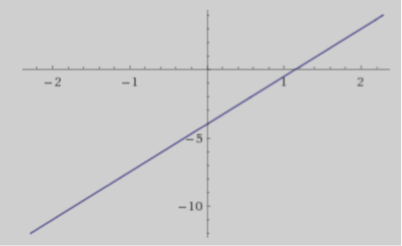
Given the graph of the line below, find the equation of the line.
Tap to see back →
To solve this question, you could use two points such as (1.2,0) and (0,-4) to calculate the slope which is 10/3 and then read the y-intercept off the graph, which is -4.
To solve this question, you could use two points such as (1.2,0) and (0,-4) to calculate the slope which is 10/3 and then read the y-intercept off the graph, which is -4.
What is the equation of the straight line passing through (–2, 5) with an x-intercept of 3?
What is the equation of the straight line passing through (–2, 5) with an x-intercept of 3?
Tap to see back →
First you must figure out what point has an x-intercept of 3. This means the line crosses the x-axis at 3 and has no rise or fall on the y-axis which is equivalent to (3, 0). Now you use the formula (y2 – y1)/(x2 – x1) to determine the slope of the line which is (5 – 0)/(–2 – 3) or –1. Now substitute a point known on the line (such as (–2, 5) or (3, 0)) to determine the y-intercept of the equation y = –x + b. b = 3 so the entire equation is y = –x + 3.
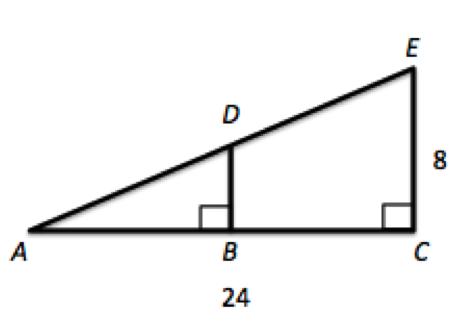
First you must figure out what point has an x-intercept of 3. This means the line crosses the x-axis at 3 and has no rise or fall on the y-axis which is equivalent to (3, 0). Now you use the formula (y2 – y1)/(x2 – x1) to determine the slope of the line which is (5 – 0)/(–2 – 3) or –1. Now substitute a point known on the line (such as (–2, 5) or (3, 0)) to determine the y-intercept of the equation y = –x + b. b = 3 so the entire equation is y = –x + 3.
A line is defined by the following equation:

What is the slope of that line?
A line is defined by the following equation:
What is the slope of that line?
Tap to see back →
The equation of a line is
y=mx + b where m is the slope
Rearrange the equation to match this:
7x + 28y = 84
28y = -7x + 84
y = -(7/28)x + 84/28
y = -(1/4)x + 3
m = -1/4
The equation of a line is
y=mx + b where m is the slope
Rearrange the equation to match this:
7x + 28y = 84
28y = -7x + 84
y = -(7/28)x + 84/28
y = -(1/4)x + 3
m = -1/4