Coordinate Geometry - GRE Quantitative Reasoning
Card 0 of 936
What is the slope of the line perpendicular to the line given by the equation
6x – 9y +14 = 0
What is the slope of the line perpendicular to the line given by the equation
6x – 9y +14 = 0
Tap to see back →
First rearrange the equation so that it is in slope-intercept form, resulting in y=2/3 x + 14/9. The slope of this line is 2/3, so the slope of the line perpendicular will have the opposite reciprocal as a slope, which is -3/2.
First rearrange the equation so that it is in slope-intercept form, resulting in y=2/3 x + 14/9. The slope of this line is 2/3, so the slope of the line perpendicular will have the opposite reciprocal as a slope, which is -3/2.
What is the slope of the line perpendicular to the line represented by the equation y = -2x+3?
What is the slope of the line perpendicular to the line represented by the equation y = -2x+3?
Tap to see back →
Perpendicular lines have slopes that are the opposite of the reciprocal of each other. In this case, the slope of the first line is -2. The reciprocal of -2 is -1/2, so the opposite of the reciprocal is therefore 1/2.
Perpendicular lines have slopes that are the opposite of the reciprocal of each other. In this case, the slope of the first line is -2. The reciprocal of -2 is -1/2, so the opposite of the reciprocal is therefore 1/2.
What is the distance between the two points, (1,1) and (7,9)?
What is the distance between the two points, (1,1) and (7,9)?
Tap to see back →
distance2 = (_x_2 – _x_1)2 + (_y_2 – _y_1)2
Looking at the two order pairs given, _x_1 = 1, _y_1 = 1, _x_2 = 7, _y_2 = 9.
distance2 = (7 – 1)2 + (9 – 1)2 = 62 + 82 = 100
distance = 10
distance2 = (_x_2 – _x_1)2 + (_y_2 – _y_1)2
Looking at the two order pairs given, _x_1 = 1, _y_1 = 1, _x_2 = 7, _y_2 = 9.
distance2 = (7 – 1)2 + (9 – 1)2 = 62 + 82 = 100
distance = 10
Consider the lines described by the following two equations:
4y = 3x2
3y = 4x2
Find the vertical distance between the two lines at the points where x = 6.
Consider the lines described by the following two equations:
4y = 3x2
3y = 4x2
Find the vertical distance between the two lines at the points where x = 6.
Tap to see back →
Since the vertical coordinates of each point are given by y, solve each equation for y and plug in 6 for x, as follows:

Taking the difference of the resulting y -values give the vertical distance between the points (6,27) and (6,48), which is 21.
Since the vertical coordinates of each point are given by y, solve each equation for y and plug in 6 for x, as follows:
Taking the difference of the resulting y -values give the vertical distance between the points (6,27) and (6,48), which is 21.
Solve the following system of equations:
–2x + 3y = 10
2x + 5y = 6
Solve the following system of equations:
–2x + 3y = 10
2x + 5y = 6
Tap to see back →
Since we have –2x and +2x in the equations, it makes sense to add the equations together to give 8y = 16 yielding y = 2. Then we substitute y = 2 into one of the original equations to get x = –2. So the solution to the system of equations is (–2, 2)
Since we have –2x and +2x in the equations, it makes sense to add the equations together to give 8y = 16 yielding y = 2. Then we substitute y = 2 into one of the original equations to get x = –2. So the solution to the system of equations is (–2, 2)
Find the point where the line y = .25(x – 20) + 12 crosses the x-axis.
Find the point where the line y = .25(x – 20) + 12 crosses the x-axis.
Tap to see back →
When the line crosses the x-axis, the y-coordinate is 0. Substitute 0 into the equation for y and solve for x.
.25(x – 20) + 12 = 0
.25_x_ – 5 = –12
.25_x_ = –7
x = –28
The answer is the point (–28,0).
When the line crosses the x-axis, the y-coordinate is 0. Substitute 0 into the equation for y and solve for x.
.25(x – 20) + 12 = 0
.25_x_ – 5 = –12
.25_x_ = –7
x = –28
The answer is the point (–28,0).
If the coordinates (3, 14) and (_–_5, 15) are on the same line, what is the equation of the line?
If the coordinates (3, 14) and (_–_5, 15) are on the same line, what is the equation of the line?
Tap to see back →
First solve for the slope of the line, m using y=mx+b
m = (y2 – y1) / (x2 – x1)
= (15 – 14) / (_–_5 _–_3)
= (1 )/( _–_8)
=_–_1/8
y = –(1/8)x + b
Now, choose one of the coordinates and solve for b:
14 = –(1/8)3 + b
14 = _–_3/8 + b
b = 14 + (3/8)
b = 14.375
y = –(1/8)x + 14.375
First solve for the slope of the line, m using y=mx+b
m = (y2 – y1) / (x2 – x1)
= (15 – 14) / (_–_5 _–_3)
= (1 )/( _–_8)
=_–_1/8
y = –(1/8)x + b
Now, choose one of the coordinates and solve for b:
14 = –(1/8)3 + b
14 = _–_3/8 + b
b = 14 + (3/8)
b = 14.375
y = –(1/8)x + 14.375
What is the equation of the line passing through (–1,5) and the upper-right corner of a square with a center at the origin and a perimeter of 22?
What is the equation of the line passing through (–1,5) and the upper-right corner of a square with a center at the origin and a perimeter of 22?
Tap to see back →
If the square has a perimeter of 22, each side is 22/4 or 5.5. This means that the upper-right corner is (2.75, 2.75)—remember that each side will be "split in half" by the x and y axes.
Using the two points we have, we can ascertain our line's equation by using the point-slope formula. Let us first get our slope:
m = rise/run = (2.75 – 5)/(2.75 + 1) = –2.25/3.75 = –(9/4)/(15/4) = –9/15 = –3/5.
The point-slope form is: y – y0 = m(x – x0). Based on our data this is: y – 5 = (–3/5)(x + 1); Simplifying, we get: y = (–3/5)x – (3/5) + 5; y = (–3/5)x + 22/5
If the square has a perimeter of 22, each side is 22/4 or 5.5. This means that the upper-right corner is (2.75, 2.75)—remember that each side will be "split in half" by the x and y axes.
Using the two points we have, we can ascertain our line's equation by using the point-slope formula. Let us first get our slope:
m = rise/run = (2.75 – 5)/(2.75 + 1) = –2.25/3.75 = –(9/4)/(15/4) = –9/15 = –3/5.
The point-slope form is: y – y0 = m(x – x0). Based on our data this is: y – 5 = (–3/5)(x + 1); Simplifying, we get: y = (–3/5)x – (3/5) + 5; y = (–3/5)x + 22/5
Which line passes through the points (0, 6) and (4, 0)?
Which line passes through the points (0, 6) and (4, 0)?
Tap to see back →
P1 (0, 6) and P2 (4, 0)
First, calculate the slope: m = rise ÷ run = (y2 – y1)/(x2 – x1), so m = –3/2
Second, plug the slope and one point into the slope-intercept formula:
y = mx + b, so 0 = –3/2(4) + b and b = 6
Thus, y = –3/2x + 6
P1 (0, 6) and P2 (4, 0)
First, calculate the slope: m = rise ÷ run = (y2 – y1)/(x2 – x1), so m = –3/2
Second, plug the slope and one point into the slope-intercept formula:
y = mx + b, so 0 = –3/2(4) + b and b = 6
Thus, y = –3/2x + 6
What line goes through the points (1, 3) and (3, 6)?
What line goes through the points (1, 3) and (3, 6)?
Tap to see back →
If P1(1, 3) and P2(3, 6), then calculate the slope by m = rise/run = (y2 – y1)/(x2 – x1) = 3/2
Use the slope and one point to calculate the intercept using y = mx + b
Then convert the slope-intercept form into standard form.
If P1(1, 3) and P2(3, 6), then calculate the slope by m = rise/run = (y2 – y1)/(x2 – x1) = 3/2
Use the slope and one point to calculate the intercept using y = mx + b
Then convert the slope-intercept form into standard form.
Let y = 3_x_ – 6.
At what point does the line above intersect the following:

Let y = 3_x_ – 6.
At what point does the line above intersect the following:
Tap to see back →
If we rearrange the second equation it is the same as the first equation. They are the same line.
If we rearrange the second equation it is the same as the first equation. They are the same line.
What is the slope of the equation 4_x_ + 3_y_ = 7?
What is the slope of the equation 4_x_ + 3_y_ = 7?
Tap to see back →
We should put this equation in the form of y = mx + b, where m is the slope.
We start with 4_x_ + 3_y_ = 7.
Isolate the y term: 3_y_ = 7 – 4_x_
Divide by 3: y = 7/3 – 4/3 * x
Rearrange terms: y = –4/3 * x + 7/3, so the slope is –4/3.
We should put this equation in the form of y = mx + b, where m is the slope.
We start with 4_x_ + 3_y_ = 7.
Isolate the y term: 3_y_ = 7 – 4_x_
Divide by 3: y = 7/3 – 4/3 * x
Rearrange terms: y = –4/3 * x + 7/3, so the slope is –4/3.
What is the slope of the line with equation 4_x_ – 16_y_ = 24?
What is the slope of the line with equation 4_x_ – 16_y_ = 24?
Tap to see back →
The equation of a line is:
y = mx + b, where m is the slope
4_x_ – 16_y_ = 24
–16_y_ = –4_x_ + 24
y = (–4_x_)/(–16) + 24/(–16)
y = (1/4)x – 1.5
Slope = 1/4
The equation of a line is:
y = mx + b, where m is the slope
4_x_ – 16_y_ = 24
–16_y_ = –4_x_ + 24
y = (–4_x_)/(–16) + 24/(–16)
y = (1/4)x – 1.5
Slope = 1/4
Which of the following lines is parallel to:

Which of the following lines is parallel to:
Tap to see back →
First write the equation in slope intercept form. Add  to both sides to get
  . Now divide both sides by
  to get
  . The slope of this line is
  , so any line that also has a slope of
  would be parallel to it. The correct answer is
  .
.
First write the equation in slope intercept form. Add
There are two lines:
2x – 4y = 33
2x + 4y = 33
Are these lines perpendicular, parallel, non-perpendicular intersecting, or the same lines?
There are two lines:
2x – 4y = 33
2x + 4y = 33
Are these lines perpendicular, parallel, non-perpendicular intersecting, or the same lines?
Tap to see back →
To be totally clear, solve both lines in slope-intercept form:
2x – 4y = 33; –4y = 33 – 2x; y = –33/4 + 0.5x
2x + 4y = 33; 4y = 33 – 2x; y = 33/4 – 0.5x
These lines are definitely not the same. Nor are they parallel—their slopes differ. Likewise, they cannot be perpendicular (which would require not only opposite slope signs but also reciprocal slopes); therefore, they are non-perpendicular intersecting.
To be totally clear, solve both lines in slope-intercept form:
2x – 4y = 33; –4y = 33 – 2x; y = –33/4 + 0.5x
2x + 4y = 33; 4y = 33 – 2x; y = 33/4 – 0.5x
These lines are definitely not the same. Nor are they parallel—their slopes differ. Likewise, they cannot be perpendicular (which would require not only opposite slope signs but also reciprocal slopes); therefore, they are non-perpendicular intersecting.
Which pair of linear equations represent parallel lines?
Which pair of linear equations represent parallel lines?
Tap to see back →
Parallel lines will always have equal slopes. The slope can be found quickly by observing the equation in slope-intercept form and seeing which number falls in the "m" spot in the linear equation (y=mx+b),
We are looking for an answer choice in which both equations have the same m value. Both lines in the correct answer have a slope of 2, therefore they are parallel.
Parallel lines will always have equal slopes. The slope can be found quickly by observing the equation in slope-intercept form and seeing which number falls in the "m" spot in the linear equation (y=mx+b),
We are looking for an answer choice in which both equations have the same m value. Both lines in the correct answer have a slope of 2, therefore they are parallel.
Which of the following equations represents a line that is parallel to the line represented by the equation  ?
?
Which of the following equations represents a line that is parallel to the line represented by the equation
Tap to see back →
Lines are parallel when their slopes are the same.
First, we need to place the given equation in the slope-intercept form.

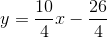

Because the given line has the slope of  , the line parallel to it must also have the same slope.
Lines are parallel when their slopes are the same.
First, we need to place the given equation in the slope-intercept form.
Because the given line has the slope of


Which of the above-listed lines are parallel?
Which of the above-listed lines are parallel?
Tap to see back →
There are several ways to solve this problem. You could solve all of the equations for  . This would give you equations in the form
  . All of the lines with the same
  value would be parallel. Otherwise, you could figure out the ratio of
  to
to  when both values are on the same side of the equation. This would suffice for determining the relationship between the two. We will take the first path, though, as this is most likely to be familiar to you.
Let's solve each for  :
:


Here, you need to be a bit more manipulative with your equation. Multiply the numerator and denominator of the  value by
  :
:


Therefore,  ,
,  , and
, and  all have slopes of
There are several ways to solve this problem. You could solve all of the equations for
Let's solve each for
Here, you need to be a bit more manipulative with your equation. Multiply the numerator and denominator of the
Therefore,
Which of the following is parallel to the line passing through  and
and  ?
?
Which of the following is parallel to the line passing through
Tap to see back →
Now, notice that the slope of the line that you have been given is  . You know this because slope is merely:

However, for your points, there is no rise at all. You do not even need to compute the value. You know it will be  . All lines with slope
  are of the form
  , where
  is the value that
  has for all
  points. Based on our data, this is
  , for
, for  is always
  —no matter what is the value for
  . So, the parallel answer choice is
  , as both have slopes of
  .
.
Now, notice that the slope of the line that you have been given is
However, for your points, there is no rise at all. You do not even need to compute the value. You know it will be
Which of the following is parallel to  ?
?
Which of the following is parallel to
Tap to see back →

To begin, solve your equation for  . This will put it into slope-intercept form, which will easily make the slope apparent. (Remember, slope-intercept form is
  , where
  is the slope.)

Divide both sides by  and you get:

Therefore, the slope is  . Now, you need to test your points to see which set of points has a slope of
  . Remember, for two points
  and
and  , you find the slope by using the equation:

For our question, the pair  and
and  gives us a slope of
  :
:

To begin, solve your equation for
Divide both sides by
Therefore, the slope is
For our question, the pair