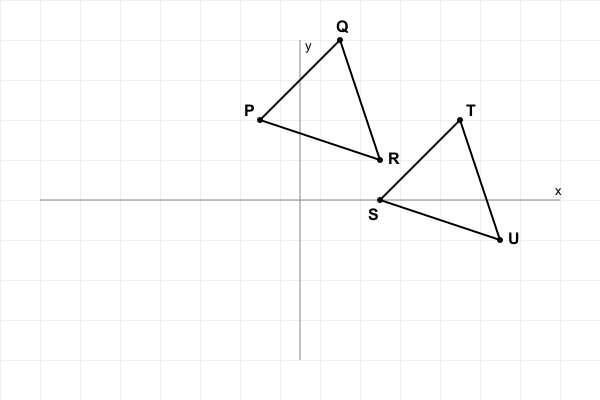
In the figure, and have , , and . A rigid motion sequence consisting of a translation followed by a rotation maps onto . If the translation vector is and point maps to point , which statement best explains why SSS congruence follows from the definition of congruence in terms of rigid motions?
- SSS works because three sides determine a unique triangle, and rigid motions preserve distances, ensuring the mapped triangle has identical side lengths (correct answer)
- SSS works because the translation preserves the triangle's orientation, and the rotation aligns corresponding sides without changing their lengths
- SSS works because any triangle can be mapped onto another triangle with the same side lengths through exactly two rigid motions
- SSS works because three equal sides guarantee that all corresponding angles are equal, which rigid motions can then preserve during mapping
Explanation: SSS congruence follows from rigid motions because: (1) three side lengths uniquely determine a triangle's shape and size, and (2) rigid motions preserve all distances. Given three sides, there is essentially only one way to construct the triangle (up to reflection), so if two triangles have the same three side lengths, one can be mapped onto the other by rigid motions. Choice B incorrectly focuses on the specific transformations rather than the fundamental principle. Choice C is wrong because the number of transformations needed can vary. Choice D reverses the causality - equal sides don't guarantee equal angles are preserved by rigid motions; rather, rigid motions preserve all geometric properties including angles.