Rhombuses - Geometry
Card 0 of 252
Which of the following shapes is a rhombus?

Which of the following shapes is a rhombus?
Tap to see back →
A rhombus is a four-sided figure where all sides are straight and equal in length. All opposite sides are parallel. A square is considered to be a rhombus.
A rhombus is a four-sided figure where all sides are straight and equal in length. All opposite sides are parallel. A square is considered to be a rhombus.
Find the area of a rhombus if the diagonal lengths are  and
and  .
.
Find the area of a rhombus if the diagonal lengths are
Tap to see back →
The area of the rhombus is given below. Substitute the diagonals into the formula.

The area of the rhombus is given below. Substitute the diagonals into the formula.

The above figure shows a rhombus  . Give its area.
The above figure shows a rhombus
Tap to see back →
Construct the other diagonal of the rhombus, which, along with the first one, form a pair of mutual perpendicular bisectors.

By the Pythagorean Theorem,

The rhombus can be seen as the composite of four congruent right triangles, each with legs 10 and  , so the area of the rhombus is
 .
.
Construct the other diagonal of the rhombus, which, along with the first one, form a pair of mutual perpendicular bisectors.
By the Pythagorean Theorem,
The rhombus can be seen as the composite of four congruent right triangles, each with legs 10 and
A rhombus has a side length of 5. Which of the following is NOT a possible value for its area?
A rhombus has a side length of 5. Which of the following is NOT a possible value for its area?
Tap to see back →
The area of a rhombus will vary as the angles made by its sides change. The "flatter" the rhombus is (with two very small angles and two very large angles, say 2, 178, 2, and 178 degrees), the smaller the area is. There is, of course, a lower bound of zero for the area, but the area can get arbitrarily small. This implies that the correct answer would be the largest choice. In fact, the largest area of a rhombus occurs when all four angles are equal, i.e. when the rhombus is a square. The area of a square of side length 5 is 25, so any value bigger than 25 is impossible to acheive.
The area of a rhombus will vary as the angles made by its sides change. The "flatter" the rhombus is (with two very small angles and two very large angles, say 2, 178, 2, and 178 degrees), the smaller the area is. There is, of course, a lower bound of zero for the area, but the area can get arbitrarily small. This implies that the correct answer would be the largest choice. In fact, the largest area of a rhombus occurs when all four angles are equal, i.e. when the rhombus is a square. The area of a square of side length 5 is 25, so any value bigger than 25 is impossible to acheive.
Assume quadrilateral  is a rhombus. The perimeter of
  is
is  , and the length of one of its diagonals is
  . What is the area of
  ?
?
Assume quadrilateral
Tap to see back →
To solve for the area of the rhombus  , we must use the equation
  , where
  and
and  are the diagonals of the rhombus. Since the perimeter of the rhombus is
  , and by definition all 4 sides of a rhombus have the same length, we know that the length of each side is
  . We can find the length of the other diagonal if we recognize that the two diagonals combined with a side edge form a right triangle. The length of the hypotenuse is
  , and each leg of the triangle is equal to one-half of each diagonal. We can therefore set up an equation involving Pythagorean's Theorem as follows:
 , where
  is equal to one-half the length of the unknown diagonal.
We can therefore solve for  as follows:

 is therefore equal to 8, and our other diagonal is 16. We can now use both diagonals to solve for the area of the rhombus:

The area of rhombus  is therefore equal to
To solve for the area of the rhombus
We can therefore solve for
The area of rhombus
Assume quadrilateral  is a rhombus. If diagonal
  and diagonal
  , what is the area of rhombus
Assume quadrilateral
Tap to see back →
Solving for the area of rhombus  requires knowledge of the equation for finding the area of a rhombus. The equation is
  , where
  and
and  are the two diagonals of the rhombus. Since both of these values are given to us in the original problem, we merely need to substitute these values into the equation to obtain:

The area of rhombus  is therefore
  square units.
Solving for the area of rhombus
The area of rhombus

What is the area of the rhombus above?
What is the area of the rhombus above?
Tap to see back →
The formula for the area of a rhombus from the diagonals is half the product of the diagonals, or in mathematical terms:
 where
where  and
and  are the lengths of the diagonals.
Substituting our values yields,

The formula for the area of a rhombus from the diagonals is half the product of the diagonals, or in mathematical terms:
Substituting our values yields,

Above is a rhombus imposed on a rectangle. What is the area of the rhombus?
Above is a rhombus imposed on a rectangle. What is the area of the rhombus?
Tap to see back →
One of the formulas for a rhombus is base times height,

Since a rhombas has equal sides, the base is 5 and the height of the rhombus is the same as the height of the rectangle, 4.
Substituting in these values we get the following:

One of the formulas for a rhombus is base times height,
Since a rhombas has equal sides, the base is 5 and the height of the rhombus is the same as the height of the rectangle, 4.
Substituting in these values we get the following:
What is the area of a rhombus with diagonal lengths of  and
and  ?
?
What is the area of a rhombus with diagonal lengths of
Tap to see back →
The area of a rhombus is given below. Plug in the diagonals and solve for the area.

The area of a rhombus is given below. Plug in the diagonals and solve for the area.
Rhombus  has perimeter 48;
  . What is the area of Rhombus
  ?
?
Rhombus
Tap to see back →
Each side of a rhombus is congruent, so if it has perimeter 48, it has sidelength 12. Also, the diagonals of a rhombus are each other's perpendicular bisectors, so if they are both constructed, and their point of intersection is called  , then
  . The following figure is formed by the rhombus and its diagonals.

 is a right triangle with its short leg half the length of its hypotenuse, so it is a 30-60-90 triangle, and its long leg measures
  by the 30-60-90 Theorem. Therefore,
  . The area of a rhombus is half the product of the lengths of its diagonals:

Each side of a rhombus is congruent, so if it has perimeter 48, it has sidelength 12. Also, the diagonals of a rhombus are each other's perpendicular bisectors, so if they are both constructed, and their point of intersection is called
A rhombus contains diagonals with the length  and
and  . Find the area of the rhombus.
A rhombus contains diagonals with the length
Tap to see back →
The equation for the area of a rhombus is given by:

where  and
and  are the two diagonal lengths.
This problem very quickly becomes one of the "plug and chug" type, where the given values just need to be substituted into the equation and the equation then solved. By plugging in the values given, we get:
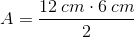


The equation for the area of a rhombus is given by:
where
This problem very quickly becomes one of the "plug and chug" type, where the given values just need to be substituted into the equation and the equation then solved. By plugging in the values given, we get:
Find the area of a rhombus if its diagonal lengths are  and
and  .
.
Find the area of a rhombus if its diagonal lengths are
Tap to see back →
Write the equation for the area of a rhombus.

Substitute the diagonals and evaluate the area.

Write the equation for the area of a rhombus.
Substitute the diagonals and evaluate the area.
Find the area of a rhombus if the diagonals lengths are  and
and  .
.
Find the area of a rhombus if the diagonals lengths are
Tap to see back →
Write the formula for finding the area of a rhombus. Substitute the diagonals and evaluate.

Write the formula for finding the area of a rhombus. Substitute the diagonals and evaluate.
Find the area of a rhombus with diagonal lengths of  and
and  .
.
Find the area of a rhombus with diagonal lengths of
Tap to see back →
Write the formula for the area of a rhombus.

Substitute the given diagonal lengths:

Use FOIL to multiply the two parentheticals in the numerator:
First: 
Outer: 
Inner: 
Last: 
Add your results together:

Divide all elements in the numerator by two to arrive at the correct answer:

Write the formula for the area of a rhombus.
Substitute the given diagonal lengths:
Use FOIL to multiply the two parentheticals in the numerator:
First:
Outer:
Inner:
Last:
Add your results together:
Divide all elements in the numerator by two to arrive at the correct answer:
Find the area of a rhombus if the both diagonals have a length of  .
.
Find the area of a rhombus if the both diagonals have a length of
Tap to see back →
Write the formula for the area of a rhombus.

Since both diagonals are equal,  . Plug in the diagonals and reduce.

Write the formula for the area of a rhombus.
Since both diagonals are equal,
What is the area of a rhombus if the diagonals are  and
and  ?
?
What is the area of a rhombus if the diagonals are
Tap to see back →
Write the formula for an area of a rhombus.

Substitute the diagonal lengths provided into the formula.

Multiply the two terms in the numerator.

You can consider the outermost division by two as multiplying everything in the numerator by  .
.

Multiply across and reduce to arrive at the correct answer.

Write the formula for an area of a rhombus.
Substitute the diagonal lengths provided into the formula.
Multiply the two terms in the numerator.
You can consider the outermost division by two as multiplying everything in the numerator by
Multiply across and reduce to arrive at the correct answer.
Find the area of a rhombus if the diagonals lengths are  and
and  .
.
Find the area of a rhombus if the diagonals lengths are
Tap to see back →
Write the formula for the area of a rhombus:

Substitute the given lengths of the diagonals and solve:

Write the formula for the area of a rhombus:
Substitute the given lengths of the diagonals and solve:
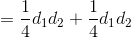
Show algebraically how the formula for the area of a rhombus is developed.

Show algebraically how the formula for the area of a rhombus is developed.
Tap to see back →
-
The given rhombus is divded into two congruent isosceles triangles.
-
Each isosceles triangle has a height  and a base
  .
.
-
The area  of each isosceles triangle is
  .
.
-
The areas of the two isosceles triangles are added together,



-
The given rhombus is divded into two congruent isosceles triangles.
-
Each isosceles triangle has a height
-
The area
-
The areas of the two isosceles triangles are added together,
A rhombus is  meters across.
  . Find the area.
A rhombus is
Tap to see back →
-
Substitute  into the expression
  ,
,  .
.
-
Substitute  and
and  into the rhombus area formula,


-
Substitute
-
Substitute
Find the area of the rhombus shown below. You will have to find the lengths of the sides as well.

The rhombus shown has the following coordinates:

Round to the nearest hundredth.
Find the area of the rhombus shown below. You will have to find the lengths of the sides as well.
The rhombus shown has the following coordinates:
Round to the nearest hundredth.
Tap to see back →
Finding the area of a rhombus follows the formula:

In this rhombus, you will find that  , which are the two x coordinates.
The length of q is a more involved process. You can find q by using the Pythagorean Theorem.

 .
.
Therefore, the area is
 .
.
Finding the area of a rhombus follows the formula:
In this rhombus, you will find that
The length of q is a more involved process. You can find q by using the Pythagorean Theorem.
Therefore, the area is