Linear Algebra - GED Math
Card 1 of 730
Find the slope and y-intercept of the line depicted by the equation:

Find the slope and y-intercept of the line depicted by the equation:
Tap to reveal answer
The equation is written in slope-intercept form, which is:

where  is equal to the slope and
  is equal to the y-intercept. Therefore, a line depicted by the equation

has a slope that is equal to  and a y-intercept that is equal to
  .
.
The equation is written in slope-intercept form, which is:
where
has a slope that is equal to
← Didn't Know|Knew It →
Find the slope and y-intercept of the line that is represented by the equation 
Find the slope and y-intercept of the line that is represented by the equation
Tap to reveal answer
The slope-intercept form of a line is:  , where
  is the slope and
  is the y-intercept.
In this equation,  and
and 
The slope-intercept form of a line is:
In this equation,
← Didn't Know|Knew It →
What is the slope and y-intercept of the following line?

What is the slope and y-intercept of the following line?
Tap to reveal answer
Convert the equation into slope-intercept form, which is  , where
  is the slope and
  is the y-intercept.


Convert the equation into slope-intercept form, which is
← Didn't Know|Knew It →
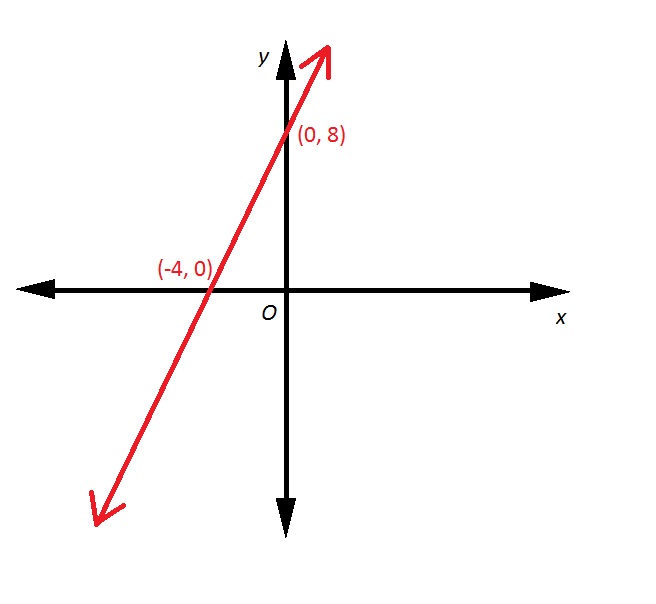
Refer to above red line. What is its slope?
Refer to above red line. What is its slope?
Tap to reveal answer
Given two points,  , the slope can be calculated using the following formula:
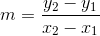
Set  :
:

Given two points,
Set
← Didn't Know|Knew It →
The grade of a road is defined as the slope of the road expressed as a percent as opposed to a fraction or decimal.
A road is graded so that for every 40 feet of horizontal distance, the road rises 6 feet. What is the grade of the road?
The grade of a road is defined as the slope of the road expressed as a percent as opposed to a fraction or decimal.
A road is graded so that for every 40 feet of horizontal distance, the road rises 6 feet. What is the grade of the road?
Tap to reveal answer
The slope is the ratio of the vertical change (rise) to the horizontal change (run), so the slope of the road, as a fraction, is  . Multiply this by 100% to get its equivalent percent:

This is the correct choice.
The slope is the ratio of the vertical change (rise) to the horizontal change (run), so the slope of the road, as a fraction, is
This is the correct choice.
← Didn't Know|Knew It →
What is the slope of the line perpendicular to  ?
?
What is the slope of the line perpendicular to
Tap to reveal answer
In order to find the perpendicular of a given slope, you need that given slope! This is easy to compute, given your equation. Just get it into slope-intercept form. Recall that it is 
Simplifying your equation, you get:


This means that your perpendicular slope (which is opposite and reciprocal) will be  .
.
In order to find the perpendicular of a given slope, you need that given slope! This is easy to compute, given your equation. Just get it into slope-intercept form. Recall that it is
Simplifying your equation, you get:
This means that your perpendicular slope (which is opposite and reciprocal) will be
← Didn't Know|Knew It →
What is the equation of a line with a slope perpendicular to the line passing through the points  and
and  ?
?
What is the equation of a line with a slope perpendicular to the line passing through the points
Tap to reveal answer
First, you should solve for the slope of the line passing through your two points. Recall that the equation for finding the slope between two points is:

For your data, this is

Now, recall that perpendicular slopes are opposite and reciprocal. Therefore, the slope of your line will be  . Given that all of your options are in slope-intercept form, this is somewhat easy. Remember that slope-intercept form is:

 is your slope. Therefore, you are looking for an equation with
The only option that matches this is:

First, you should solve for the slope of the line passing through your two points. Recall that the equation for finding the slope between two points is:
For your data, this is
Now, recall that perpendicular slopes are opposite and reciprocal. Therefore, the slope of your line will be
The only option that matches this is:
← Didn't Know|Knew It →
What is the x-intercept of  ?
?
What is the x-intercept of
Tap to reveal answer
Remember, to find the x-intercept, you need to set  equal to zero. Therefore, you get:

Simply solving, this is 
Remember, to find the x-intercept, you need to set
Simply solving, this is
← Didn't Know|Knew It →
Find the slope of the line that has the equation: 
Find the slope of the line that has the equation:
Tap to reveal answer
Step 1: Move x and y to opposite sides...
We will subtract 2x from both sides...
Result, 
Step 2: Recall the basic equation of a line...
 , where the coefficient of y is
  .
.
Step 3: Divide every term by  to change the coefficient of y to
  :
:

Step 4: Reduce...

Step 5: The slope of a line is the coefficient in front of the x term...
So, the slope is 
Step 1: Move x and y to opposite sides...
We will subtract 2x from both sides...
Result,
Step 2: Recall the basic equation of a line...
Step 3: Divide every term by
Step 4: Reduce...
Step 5: The slope of a line is the coefficient in front of the x term...
So, the slope is
← Didn't Know|Knew It →
Find the slope of the following equation: 
Find the slope of the following equation:
Tap to reveal answer
In order to find the slope, we will need the equation in slope-intercept form.

Distribute the negative nine through the binomial.

The slope is: 
In order to find the slope, we will need the equation in slope-intercept form.
Distribute the negative nine through the binomial.
The slope is:
← Didn't Know|Knew It →
What is the y-intercept of the following equation? 
What is the y-intercept of the following equation?
Tap to reveal answer
The y-intercept is the value of  when
when  .
.
Substitute the value of zero into  , and solve for
  .
.


Subtract 7 from both sides.


The answer is: 
The y-intercept is the value of
Substitute the value of zero into
Subtract 7 from both sides.
The answer is:
← Didn't Know|Knew It →
Find the slope and y-intercept, respectively, given the following equation:

Find the slope and y-intercept, respectively, given the following equation:
Tap to reveal answer
Rewrite the equation in slope-intercept format: 
Divide by negative two on both sides. This is also the same as multiplying both sides by negative half.


Rearrange the terms.

The slope is: 
The y-intercept is: 
The answer is: 
Rewrite the equation in slope-intercept format:
Divide by negative two on both sides. This is also the same as multiplying both sides by negative half.
Rearrange the terms.
The slope is:
The y-intercept is:
The answer is:
← Didn't Know|Knew It →
Find the slope of the following function: 
Find the slope of the following function:
Tap to reveal answer
Simplify the terms of the equation by distribution.


Subtract the terms.

The equation is now in slope-intercept form, where  .
.
The slope is  .
.
The answer is  .
.
Simplify the terms of the equation by distribution.
Subtract the terms.
The equation is now in slope-intercept form, where
The slope is
The answer is
← Didn't Know|Knew It →
What is the slope of the following equation? 
What is the slope of the following equation?
Tap to reveal answer
To determine the slope, we will need the equation in slope-intercept form.

Subtract  on both sides.


Divide by 9 on both sides.

Split both terms on the right side.

The slope is: 
To determine the slope, we will need the equation in slope-intercept form.
Subtract
Divide by 9 on both sides.
Split both terms on the right side.
The slope is:
← Didn't Know|Knew It →
Identify the y-intercept: 
Identify the y-intercept:
Tap to reveal answer
In order to find the y-intercept, we will need to let  and solve for
  .
.


Subtract  from both sides. Do NOT divide by
  on both sides.


The answer is: 
In order to find the y-intercept, we will need to let
Subtract
The answer is:
← Didn't Know|Knew It →
What is the x-intercept of the following equation? 
What is the x-intercept of the following equation?
Tap to reveal answer
In order to find the x-intercept, we will need to let  , and solve for
  .
.

Add  on both sides.


Divide by five on both sides.

The answer is: 
In order to find the x-intercept, we will need to let
Add
Divide by five on both sides.
The answer is:
← Didn't Know|Knew It →
A line on the coordinate plane has as its equation  .
.
Which of the following is its slope?
A line on the coordinate plane has as its equation
Which of the following is its slope?
Tap to reveal answer
Rewrite the equation in the slope-intercept form  , with
  the slope, as follows:
Subtract  from both sides:


Multiply both sides by  , distributing on the right:


In the slope-intercept form, the coefficient of  is the slope
  . This is
  .
.
Rewrite the equation in the slope-intercept form
Subtract
Multiply both sides by
In the slope-intercept form, the coefficient of
← Didn't Know|Knew It →
What is the slope of the following function? 
What is the slope of the following function?
Tap to reveal answer
To determine the slope, we will need the equation in slope-intercept form.

Divide by six on both sides.

Simplify the right side.

The answer is: 
To determine the slope, we will need the equation in slope-intercept form.
Divide by six on both sides.
Simplify the right side.
The answer is:
← Didn't Know|Knew It →
Find the slope of the following equation:

Find the slope of the following equation:
Tap to reveal answer
If we look at the following equation

we can see it is written in slope-intercept form. Slope-intercept form is

where m is the slope and b is the y-intercept.
So, given the equation,

we can see -9 is the slope.
If we look at the following equation
we can see it is written in slope-intercept form. Slope-intercept form is
where m is the slope and b is the y-intercept.
So, given the equation,
we can see -9 is the slope.
← Didn't Know|Knew It →
Find the slope of the following equation: 
Find the slope of the following equation:
Tap to reveal answer
The given equation is already in slope-intercept form.

The  represents the coefficient of the slope.
The answer is: 
The given equation is already in slope-intercept form.
The
The answer is:
← Didn't Know|Knew It →