Other Shapes - GED Math
Card 1 of 190

Note: Figure NOT drawn to scale.
Refer to the above diagram.  .
.  is a right angle. What percent of
  has been shaded in?
Note: Figure NOT drawn to scale.
Refer to the above diagram.
Tap to reveal answer
 is a right triangle with legs
  ; its area is half the product of its legs, which is

 is a right triangle with legs

and
 ;
;
its area is half the product of its legs, which is

The shaded region is the former triangle removed from the latter triangle; its area is the difference of the two:  .
.
This region is therefore
 of
of  .
.
and
its area is half the product of its legs, which is
The shaded region is the former triangle removed from the latter triangle; its area is the difference of the two:
This region is therefore
← Didn't Know|Knew It →
Note: Figure NOT drawn to scale.
Refer to the above diagram.  .
.  is a right angle. What is the area of the shaded region?
Note: Figure NOT drawn to scale.
Refer to the above diagram.
Tap to reveal answer
 is a right triangle with legs
  ; its area is half the product of its legs, which is

 is a right triangle with legs

and
 ;
;
its area is half the product of its legs, which is

The shaded region is the former triangle removed from the latter triangle; its area is the difference of the two:  .
.
and
its area is half the product of its legs, which is
The shaded region is the former triangle removed from the latter triangle; its area is the difference of the two:
← Didn't Know|Knew It →

The above hexagon is regular. Give its area.
The above hexagon is regular. Give its area.
Tap to reveal answer
A regular hexagon can be divided into six triangles, each of which can be easily proved equilateral, as seen in the diagram below:

All segments shown are congruent, and, since the diameter shown in the original diagram is 4, each sidelength is half this, or 2.
Each equilateral triangle has area
 .
.
There are six such triangles, so the total area of the hexagon is six times this, or  .
.
A regular hexagon can be divided into six triangles, each of which can be easily proved equilateral, as seen in the diagram below:
All segments shown are congruent, and, since the diameter shown in the original diagram is 4, each sidelength is half this, or 2.
Each equilateral triangle has area
There are six such triangles, so the total area of the hexagon is six times this, or
← Didn't Know|Knew It →
Give the area of a regular hexagon with perimeter 36.
Give the area of a regular hexagon with perimeter 36.
Tap to reveal answer
A hexagon has six sides; a regular hexagon with perimeter 36 has sidelength
 .
.
A regular hexagon can be divided into six triangles, each of which can be easily proved equilateral, as seen in the diagram below:

Each equilateral triangle has sidelength 6, so each has area
 .
.
The total area of the hexagon is the area of six such triangles:

A hexagon has six sides; a regular hexagon with perimeter 36 has sidelength
A regular hexagon can be divided into six triangles, each of which can be easily proved equilateral, as seen in the diagram below:
Each equilateral triangle has sidelength 6, so each has area
The total area of the hexagon is the area of six such triangles:
← Didn't Know|Knew It →
Determine the area of a square with a side length of  .
.
Determine the area of a square with a side length of
Tap to reveal answer
Write the area of a square.

Substitute the side into the formula.

The answer is: 
Write the area of a square.
Substitute the side into the formula.
The answer is:
← Didn't Know|Knew It →

Figure NOT drawn to scale.
Refer to the above figure. Every angle shown is a right angle.
Give its area.
Figure NOT drawn to scale.
Refer to the above figure. Every angle shown is a right angle.
Give its area.
Tap to reveal answer
Examine the bottom figure, in which the bottom two sides have been connected. Note that the figure is now a rectangle cut out of a rectangle, and, since the opposite sides of a rectangle have the same length, we can fill in some of the side lengths as shown:

The figure is a 60-by-40 rectangle cut from a 100-by-100 square, so, to get the area of the figure, subtract the area of the former from that of the latter. The area of a rectangle is equal to the product of its dimensions, so the areas of the rectangle and the square are, respectively,

and
 ,
,
making the area of the figure
 .
.
Examine the bottom figure, in which the bottom two sides have been connected. Note that the figure is now a rectangle cut out of a rectangle, and, since the opposite sides of a rectangle have the same length, we can fill in some of the side lengths as shown:
The figure is a 60-by-40 rectangle cut from a 100-by-100 square, so, to get the area of the figure, subtract the area of the former from that of the latter. The area of a rectangle is equal to the product of its dimensions, so the areas of the rectangle and the square are, respectively,
and
making the area of the figure
← Didn't Know|Knew It →
A circle is inscribed in square that has a side length of  , as shown by the figure below.

Find the area of the shaded region. Use  .
.
A circle is inscribed in square that has a side length of
Find the area of the shaded region. Use
Tap to reveal answer

Since the circle is inscribed in the square, the diameter of the circle is the same length as the length of a square.
Start by finding the area of the square.

For the given square,

Now, because the diameter of the circle is the same as the length of a side of the square, we now also know that the radius of the circle must be  . Next recall how to find the area of a circle.

Plug in the found radius to find the area of the circle.

Now, the shaded area is the area left over when the area of the circle is subtracted from the area of the square. Thus, we can write the following equation to find the area of the shaded region.

Since the circle is inscribed in the square, the diameter of the circle is the same length as the length of a square.
Start by finding the area of the square.
For the given square,
Now, because the diameter of the circle is the same as the length of a side of the square, we now also know that the radius of the circle must be
Plug in the found radius to find the area of the circle.
Now, the shaded area is the area left over when the area of the circle is subtracted from the area of the square. Thus, we can write the following equation to find the area of the shaded region.
← Didn't Know|Knew It →
Josh wants to build a circular pool in his square yard that measures  feet on each side. He wants to build the pool as big as possible, then pave the rest of his yard in tile. In square feet, what is the area of the yard that will be tiled? Round your answer to the nearest tenths place.
Josh wants to build a circular pool in his square yard that measures
Tap to reveal answer
Start by drawing out the square yard and the circular pool in a way that maximizes the area of the pool.

Notice that the diameter of the pool will be the same length as the side of the square.
Since the question asks about the area that is left over after the pool is built, we can find that area by subtracting the area of the pool from the area of the square.
Start by finding the area of the square.

Next, find the area of the circular pool.
Since the diameter of the pool is  , the radius of the pool must be
  . Recall how to find the area of a circle:

Plug in the radius of the circle.

Subtract the area of the circle from that of the square.

Start by drawing out the square yard and the circular pool in a way that maximizes the area of the pool.
Notice that the diameter of the pool will be the same length as the side of the square.
Since the question asks about the area that is left over after the pool is built, we can find that area by subtracting the area of the pool from the area of the square.
Start by finding the area of the square.
Next, find the area of the circular pool.
Since the diameter of the pool is
Plug in the radius of the circle.
Subtract the area of the circle from that of the square.
← Didn't Know|Knew It →
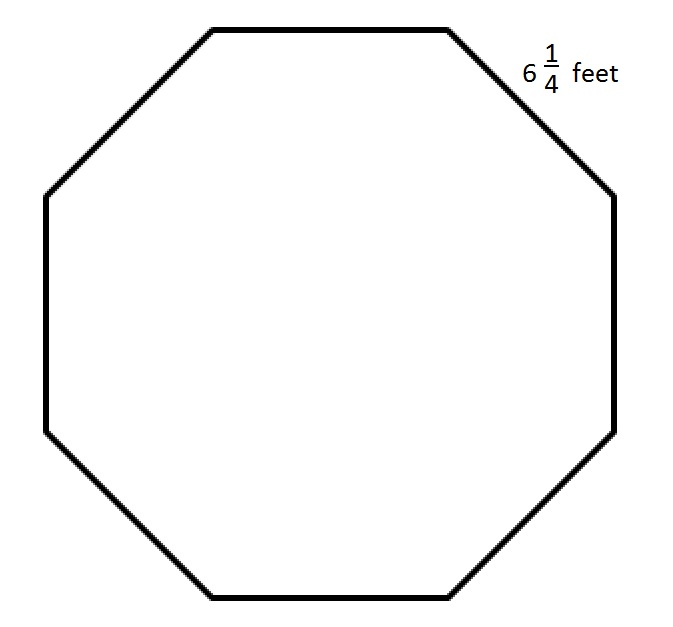
The above figure is a regular octagon. Give its perimeter in yards.
The above figure is a regular octagon. Give its perimeter in yards.
Tap to reveal answer
A regular octagon has eight sides of equal length, so multiply the length of one side by eight:
 feet.
feet.
Divide by three to get the equivalent in yards:
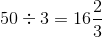 yards.
A regular octagon has eight sides of equal length, so multiply the length of one side by eight:
Divide by three to get the equivalent in yards:
← Didn't Know|Knew It →
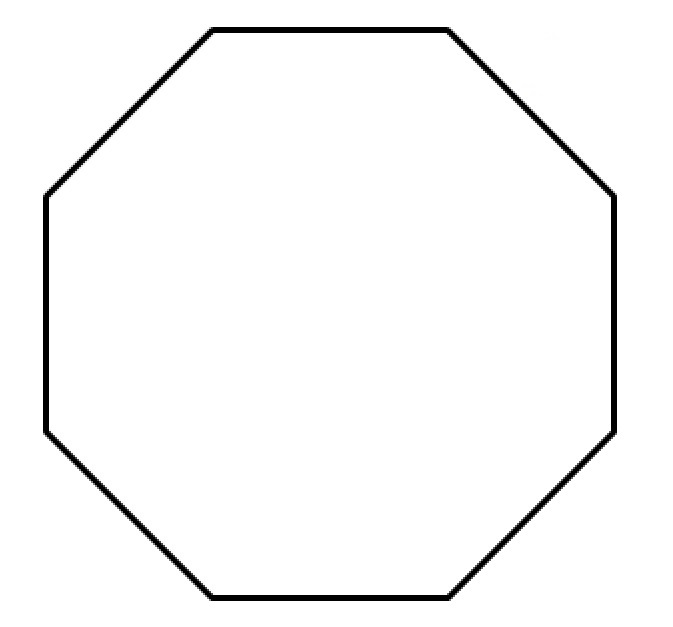
Identify the above polygon.
Identify the above polygon.
Tap to reveal answer
A polygon with eight sides is called an octagon.
A polygon with eight sides is called an octagon.
← Didn't Know|Knew It →
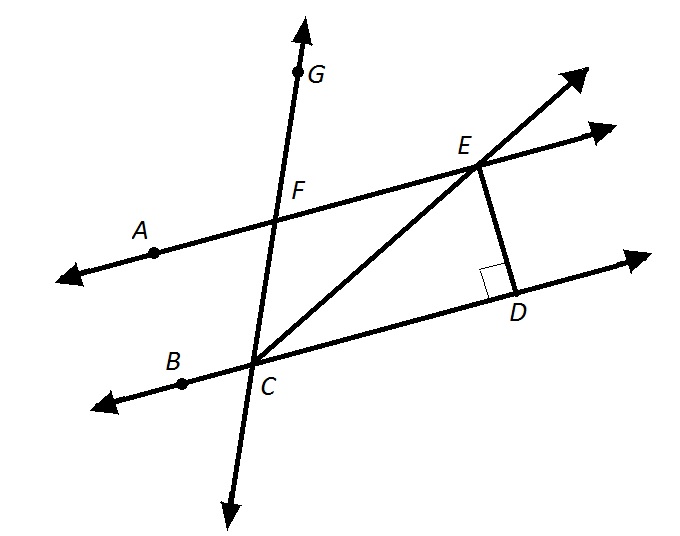
Refer to the above figure.
Which of the following is not a valid alternative name for Polygon  ?
?
Refer to the above figure.
Which of the following is not a valid alternative name for Polygon
Tap to reveal answer
In naming a polygon, the vertices must be written in the order in which they are positioned, going either clockwise or counterclockwise. Of the four choices, only Polygon  violates this convention, since
  and
and  are not adjacent vertices (nor are
  and
and  ).
).
In naming a polygon, the vertices must be written in the order in which they are positioned, going either clockwise or counterclockwise. Of the four choices, only Polygon
← Didn't Know|Knew It →
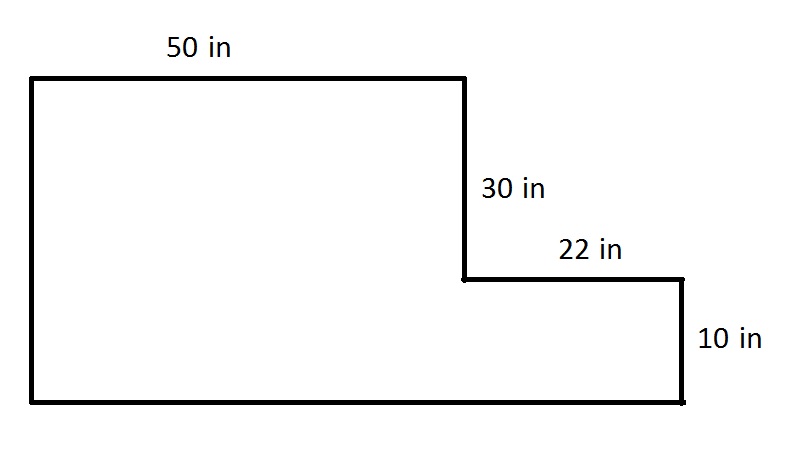
Refer to the above figure. All angles shown are right angles.
What is the perimeter of the figure?
Refer to the above figure. All angles shown are right angles.
What is the perimeter of the figure?
Tap to reveal answer
The figure can be viewed as the composite of rectangles. As such, we can take advantage of the fact that opposite sides of a rectangle have the same length, as follows:
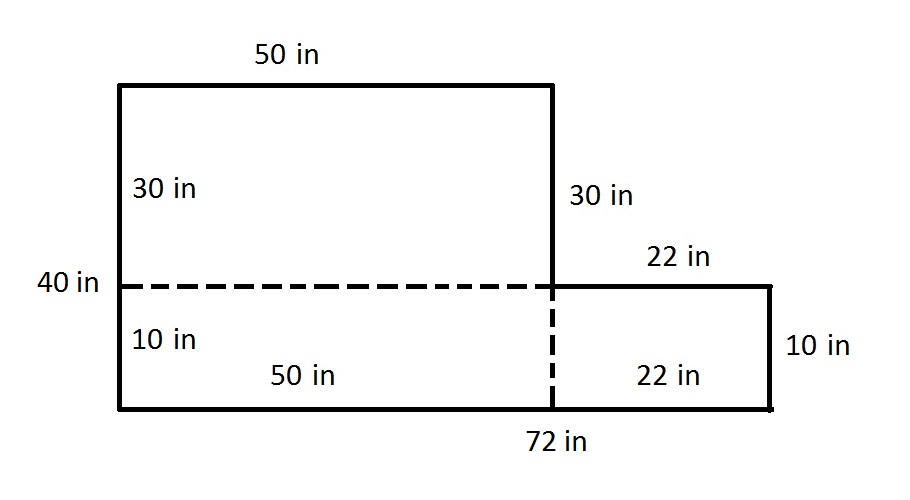
Now that the missing sidelengths are known, we can add the sidelengths to find the perimeter:

The figure can be viewed as the composite of rectangles. As such, we can take advantage of the fact that opposite sides of a rectangle have the same length, as follows:
Now that the missing sidelengths are known, we can add the sidelengths to find the perimeter:
← Didn't Know|Knew It →
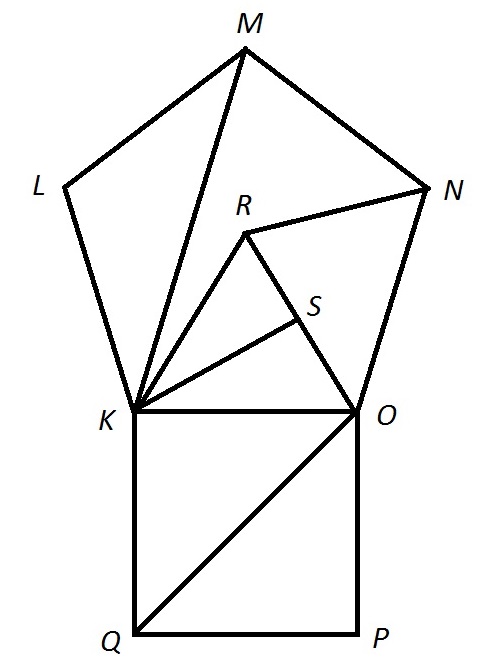
Refer to the above figure.
Which of the following segments is a diagonal of Pentagon  ?
?
Refer to the above figure.
Which of the following segments is a diagonal of Pentagon
Tap to reveal answer
A diagonal of a polygon is a segment whose endpoints are nonconsecutive vertices of the polygon. Of the four choices, only  fits this description.
A diagonal of a polygon is a segment whose endpoints are nonconsecutive vertices of the polygon. Of the four choices, only
← Didn't Know|Knew It →
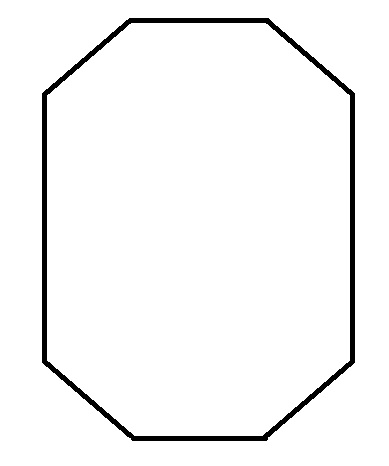
Classify the above polygon.
Classify the above polygon.
Tap to reveal answer
A polygon with eight sides is called an octagon.
A polygon with eight sides is called an octagon.
← Didn't Know|Knew It →
Hexagon  is regular. If diagonals
  and
and  are constructed, which of the following classifications applies to Quadrilateral
  ?
?
I) Rectangle
II) Rhombus
III) Square
IV) Trapezoid
Hexagon
I) Rectangle
II) Rhombus
III) Square
IV) Trapezoid
Tap to reveal answer
The figure described is below.
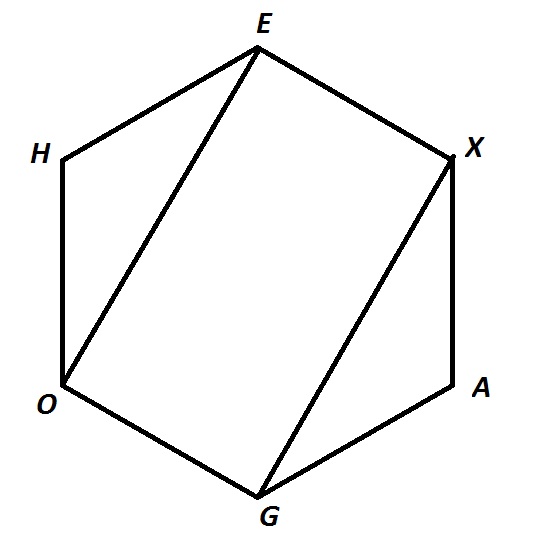
Since the hexagon is regular, its sides are congruent, and its angles each have measure  .
.
Also, each of the triangles are isosceles, and their acute angles measure 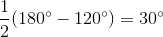 each. This means that each of the four angles of Quadrilateral measures
  , so Quadrilateral is a rectangle. However, not all sides are congruent, so it is not a rhombus. Also, since it is a rectangle, it cannot be a trapezoid.
The correct response is I only.
The figure described is below.
Since the hexagon is regular, its sides are congruent, and its angles each have measure
Also, each of the triangles are isosceles, and their acute angles measure
The correct response is I only.
← Didn't Know|Knew It →
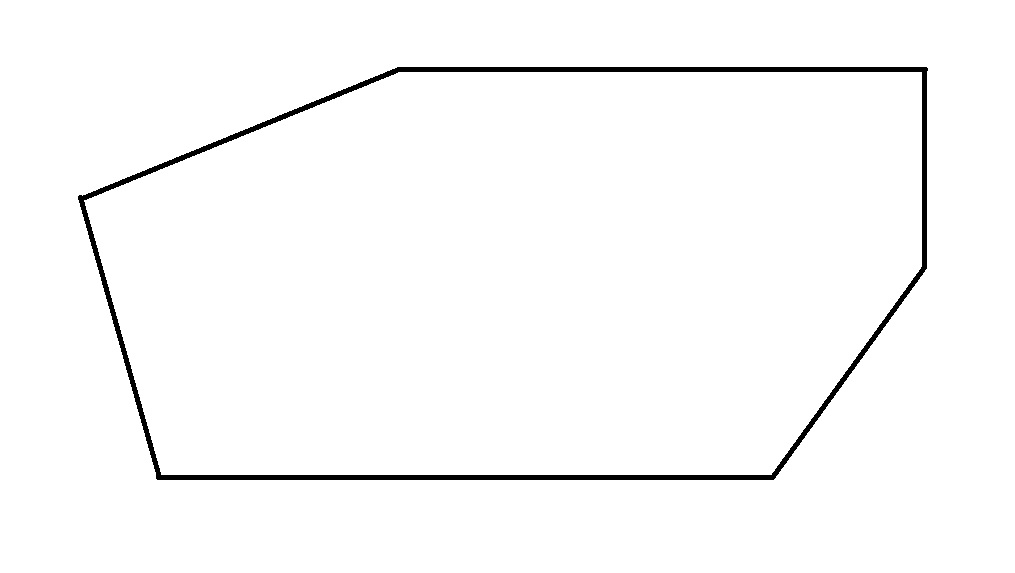
Classify the above polygon.
Classify the above polygon.
Tap to reveal answer
A polygon with six sides is called a hexagon.
A polygon with six sides is called a hexagon.
← Didn't Know|Knew It →
What is the perimeter of a semicircle with an area of  ?
?
What is the perimeter of a semicircle with an area of
Tap to reveal answer
Write the formula for the area of a semicircle.

Substitute the area.

Multiply by 2, and divide by pi on both sides.
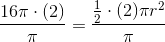
The equation becomes:

Square root both sides and factor the right side.


The diameter is double the radius.

The circumference is half the circumference of a full circle.
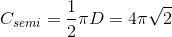
The perimeter is the sum of the diameter and the half circumference.
The answer is: 
Write the formula for the area of a semicircle.
Substitute the area.
Multiply by 2, and divide by pi on both sides.
The equation becomes:
Square root both sides and factor the right side.
The diameter is double the radius.
The circumference is half the circumference of a full circle.
The perimeter is the sum of the diameter and the half circumference.
The answer is:
← Didn't Know|Knew It →
A hexagon has a perimeter of 90in. Find the length of one side.
A hexagon has a perimeter of 90in. Find the length of one side.
Tap to reveal answer
A hexagon has 6 equal sides. The formula to find perimeter of a hexagon is:

where a is the length of any side. Now, to find the length of one side, we will solve for a.
We know the perimeter of the hexagon is 90in. So, we will substitute and solve for a. We get


Therefore, the length of one side of the hexagon is 15in.
A hexagon has 6 equal sides. The formula to find perimeter of a hexagon is:
where a is the length of any side. Now, to find the length of one side, we will solve for a.
We know the perimeter of the hexagon is 90in. So, we will substitute and solve for a. We get
Therefore, the length of one side of the hexagon is 15in.
← Didn't Know|Knew It →
A hexagon has a perimeter of 138cm. Find the length of one side.
A hexagon has a perimeter of 138cm. Find the length of one side.
Tap to reveal answer
A hexagon has 6 equal sides. The formula to find perimeter of a hexagon is

where a is the length of any side. To find the length of one side, we solve for a.
Now, we know the perimeter of the hexagon is 138cm. So, we can substitute and solve for a. We get


Therefore, the length of one side of the hexagon is 23cm.
A hexagon has 6 equal sides. The formula to find perimeter of a hexagon is
where a is the length of any side. To find the length of one side, we solve for a.
Now, we know the perimeter of the hexagon is 138cm. So, we can substitute and solve for a. We get
Therefore, the length of one side of the hexagon is 23cm.
← Didn't Know|Knew It →
A hexagon has a perimeter of 126in. Find the length of one side.
A hexagon has a perimeter of 126in. Find the length of one side.
Tap to reveal answer
A hexagon has 6 equal sides. The formula to find perimeter of a hexagon is:

where a is the length of any side. Now, to find the length of one side, we will solve for a.
We know the perimeter of the hexagon is 126in. So, we will substitute and solve for a. We get


Therefore, the length of one side of the hexagon is 21in.
A hexagon has 6 equal sides. The formula to find perimeter of a hexagon is:
where a is the length of any side. Now, to find the length of one side, we will solve for a.
We know the perimeter of the hexagon is 126in. So, we will substitute and solve for a. We get
Therefore, the length of one side of the hexagon is 21in.
← Didn't Know|Knew It →