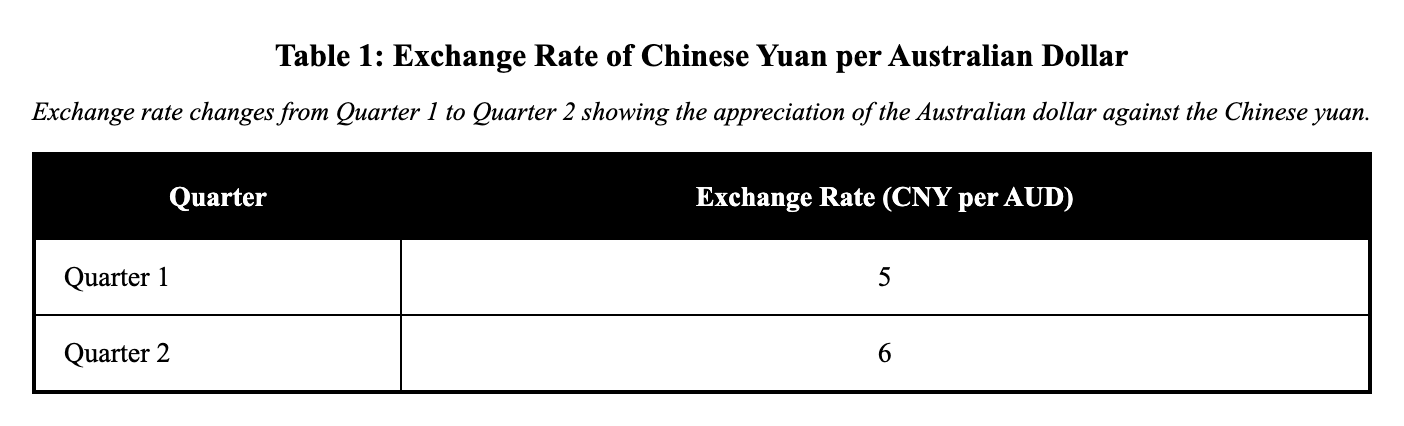
Based on the exchange rate shown in the table (quoted as Chinese yuan per 1 Australian dollar), which statement correctly describes what happened to the Australian dollar and the likely effect on Australian export prices to China (in yuan)?
Exchange Rate: CNY per 1 AUD
- Quarter 1: 5 CNY per AUD
- Quarter 2: 6 CNY per AUD
- The Australian dollar depreciated, and Australian exports to China tend to become more expensive in yuan.
- The Australian dollar appreciated, and Australian exports to China tend to become more expensive in yuan. (correct answer)
- The Chinese yuan appreciated, and Australian exports to China tend to become cheaper in yuan.
- The Australian dollar appreciated, and Australian exports to China tend to become cheaper in yuan.
- The exchange rate change is a change in Australia's real GDP, so export prices rise with output.
Explanation: The exchange rate is the rate at which one currency trades for another, shown as Chinese yuan per Australian dollar. Appreciation is when a currency's value rises, allowing it to exchange for more foreign currency, while depreciation is the opposite. The rate increased from 5 to 6 CNY per AUD, demonstrating that the Australian dollar appreciated against the yuan, as one AUD buys more CNY. As a result, Australian exports to China tend to become more expensive in yuan, potentially reducing demand. A common misconception is believing appreciation always boosts exports, but it actually raises foreign prices. Apply the transferable strategy: state the currency first, then direction, such as 'Australian dollar appreciated,' for clear analysis of export pricing.