Fundamental Theorem of Calculus - AP Calculus AB
Card 0 of 363
Write the domain of the function.
$f(x)=\frac{(x^{4}$$$-81)^{1/2}$}{x-4}
Write the domain of the function.
$f(x)=\frac{(x^{4}$$$-81)^{1/2}$}{x-4}
Tap to see back →
The answer is 
The denominator must not equal zero and anything under a radical must be a nonnegative number.
The answer is
The denominator must not equal zero and anything under a radical must be a nonnegative number.
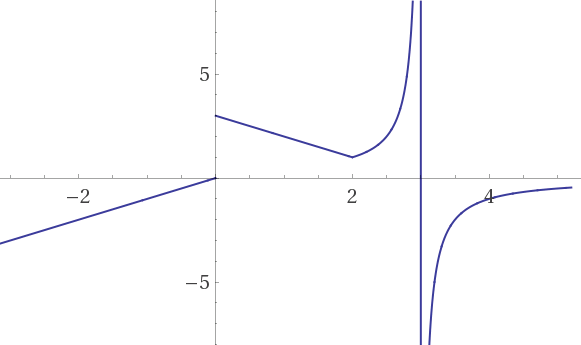
Find 
Find
Tap to see back →
The one side limits are not equal: left is 0 and right is 3
The one side limits are not equal: left is 0 and right is 3
Which of the following is a vertical asymptote?
Which of the following is a vertical asymptote?
Tap to see back →
When  approaches 3,
  approaches
  .
.
Vertical asymptotes occur at  values. The horizontal asymptote occurs at
 .
.
When
Vertical asymptotes occur at
Evaluate the following limit:
$lim_{xrightarrow infty $}$$\frac{1-x^4$$}{x^2$$-4x^4$}$
Evaluate the following limit:
$lim_{xrightarrow infty $}$$\frac{1-x^4$$}{x^2$$-4x^4$}$
Tap to see back →
First, let's multiply the numerator and denominator of the fraction in the limit by $$\frac{1}{x^{4}$$}.
$lim_{xrightarrow infty $}$$\frac{1-x^4$$}{x^2$$-4x^$4$}$=lim_{xrightarrow infty $}$$\frac{(frac{1}{x^4$$}$)(1-x^4$$)}{$\frac{1}{x^{4}$$$}(x^2$$-4x^4$)}
$=lim_{xrightarrow infty $}$$\frac{frac{1}{x^4$$}$-1}{$\frac{1}{x^2$}$-4}
As  becomes increasingly large the $$\frac{1}{x^{4}$$} $and$\frac{1}{x^{2}$$} ^{} terms will tend to zero. This leaves us with the limit of
  .
.
$lim_{xrightarrow infty }$$\frac{-1}{-4}$=\frac{1}{4}$.
The answer is $\frac{1}{4}$.
First, let's multiply the numerator and denominator of the fraction in the limit by $$\frac{1}{x^{4}$$}.
$lim_{xrightarrow infty $}$$\frac{1-x^4$$}{x^2$$-4x^$4$}$=lim_{xrightarrow infty $}$$\frac{(frac{1}{x^4$$}$)(1-x^4$$)}{$\frac{1}{x^{4}$$$}(x^2$$-4x^4$)}
$=lim_{xrightarrow infty $}$$\frac{frac{1}{x^4$$}$-1}{$\frac{1}{x^2$}$-4}
As
$lim_{xrightarrow infty }$$\frac{-1}{-4}$=\frac{1}{4}$.
The answer is $\frac{1}{4}$.
Let  and
and  be inverse functions, and let
 .
.
What is the value of  ?
?
Let
What is the value of
Tap to see back →
Since  and
and  are inverse functions,
  . We can differentiate both sides of the equation
  with respect to
  to obtain the following:
g'(f(x))cdot f'(x)=1
We are asked to find  , which means that we will need to find
  such that
  . The given information tells us that
  , which means that
  . Thus, we will substitute 3 into the equation.
g'(f(3))cdot f'(3)=1
The given information tells us that .
.
The equation then becomes g'(4)cdot (-2)=1.
We can now solve for  .
.
g'(4)=-$\frac{1}{2}$.
The answer is -$\frac{1}{2}$.
Since
g'(f(x))cdot f'(x)=1
We are asked to find
g'(f(3))cdot f'(3)=1
The given information tells us that
The equation then becomes g'(4)cdot (-2)=1.
We can now solve for
g'(4)=-$\frac{1}{2}$.
The answer is -$\frac{1}{2}$.
Using the fundamental theorem of calculus, find the integral of the function  from
from  to
to  .
.
Using the fundamental theorem of calculus, find the integral of the function
Tap to see back →
The fundamental theorem of calculus is,  , now lets apply this to our situation.

We can use the inverse power rule to solve the integral, which is  .
.


The fundamental theorem of calculus is,
We can use the inverse power rule to solve the integral, which is

What are the horizontal asymptotes of  ?
?
What are the horizontal asymptotes of
Tap to see back →
Compute the limits of  as
as  approaches infinity.
Compute the limits of
What is the value of the derivative of  at x=1?
What is the value of the derivative of
Tap to see back →
First, find the derivative of the function, which is:

Then, plug in 1 for x:

The result is  .
.
First, find the derivative of the function, which is:
Then, plug in 1 for x:
The result is
Using the Fundamental Theorem of Calculus solve the integral.

Using the Fundamental Theorem of Calculus solve the integral.
Tap to see back →
To solve the integral using the Fundamental Theorem, we must first take the anti-derivative of the function. The anti-derivative of  is
is  . Since the limits of integration are 1 and 3, we must evaluate the anti-derivative at these two values.
 denotes the anti-derivative.
When we do this,
 and
and  .
.
The next step is to find the difference between the values at each limit of integration, because the Fundamental Theorem states
 .
.
Thus, we subtract  to get a final answer of
  .
.
To solve the integral using the Fundamental Theorem, we must first take the anti-derivative of the function. The anti-derivative of
When we do this,
The next step is to find the difference between the values at each limit of integration, because the Fundamental Theorem states
Thus, we subtract
Using the Fundamental Theorem of Calculus and simplify completely solve the integral.

Using the Fundamental Theorem of Calculus and simplify completely solve the integral.
Tap to see back →
To solve the integral, we first have to know that the fundamental theorem of calculus is
 .
.
Since  denotes the anti-derivative, we have to evaluate the anti-derivative at the two limits of integration, 3 and 6.
To find the anti-derivative, we have to know that in the integral,  is the same as
  .
.
The anti-derivative of the function  is
is  , so we must evaluate
  .
.
According to rules of logarithms, when subtracting two logs is the same as taking the log of a fraction of those two values:
 .
.
Then, we can simplify to a final answer of 
To solve the integral, we first have to know that the fundamental theorem of calculus is
Since
To find the anti-derivative, we have to know that in the integral,
The anti-derivative of the function
According to rules of logarithms, when subtracting two logs is the same as taking the log of a fraction of those two values:
Then, we can simplify to a final answer of
Solve  using the Fundamental Theorem of Calculus.
Solve
Tap to see back →
To solve the integral, we first have to know that the fundamental theorem of calculus is
 .
.
Since  denotes the anti-derivative, we have to evaluate the anti-derivative at the two limits of integration, 0 and 3.
The anti-derivative of the function  is
is  , so we must evaluate
  .
.
When we plug 3 into the anti-derivative, the solution is  , and when we plug 0 into the anti-derivative, the solution is 0.
To find the final answer, we must take the difference of these two solutions, so the final answer is  .
.
To solve the integral, we first have to know that the fundamental theorem of calculus is
Since
The anti-derivative of the function
When we plug 3 into the anti-derivative, the solution is
To find the final answer, we must take the difference of these two solutions, so the final answer is
Solve  using the Fundamental Theorem of Calculus.
Solve
Tap to see back →
To solve the integral, we first have to know that the fundamental theorem of calculus is
 .
.
Since  denotes the anti-derivative, we have to evaluate the anti-derivative at the two limits of integration, 0 and 2.
The anti-derivative of the function

is
 ,
,
so we must evaluate  .
.
When we plug 3 into the anti-derivative, the solution is  , and when we plug 0 into the anti-derivative, the solution is 0.
To find the final answer, we must take the difference of these two solutions, so the final answer is  .
.
To solve the integral, we first have to know that the fundamental theorem of calculus is
Since
The anti-derivative of the function
is
so we must evaluate
When we plug 3 into the anti-derivative, the solution is
To find the final answer, we must take the difference of these two solutions, so the final answer is
Use the fundamental theorem of Calculus to evaluate the definite integral

Use the fundamental theorem of Calculus to evaluate the definite integral
Tap to see back →
Here we use the fundamental theorem of Calculus: 

Here we do not worry about adding a constant c because we are evaluating a definite integral.


Here we use the fundamental theorem of Calculus:
Here we do not worry about adding a constant c because we are evaluating a definite integral.
Evaluate  .
.
Evaluate
Tap to see back →
We can integrate this without too much trouble
 . Start
 . Rewrite the power
 . Integrate
 . Evaluate
 . Simplify
Note that we were not asked to evaluate  , so you should not attempt to use part one of the Fundamental Theorem of Calculus. This would give us the incorrect answer of
  .
.
We can integrate this without too much trouble
Note that we were not asked to evaluate
Evaluate the indefinite integral:

Evaluate the indefinite integral:
Tap to see back →

First compute the indefinite integral:

Note that the  is the derivative of
  . So proceed by defining a new variable:

Now the the integral can be written in terms of 

Therefore:

When we go to compute the indefinite integral the constant of integration  will be ignored since it will be subtracted out when we evaluate.
We can precede by either going back to the original variable  and evaluate over the original limits of integration, or we can find new limits of integration corresponding to the new variable
  . Let's look at both equivalent methods:
Solution 1)

 so the last term vanishes. The first term reduces to
  since the tangent function is equal to
  .
.

Solution 2)
We could have also solved without converting back to the original variable. Instead, we could just change the limits of integration. Use the definition assigned to the variable  , which was
  and then use this to find which value
  takes on when
  (lower limit) and when
  (upper limit).


First compute the indefinite integral:
Note that the
Now the the integral can be written in terms of
Therefore:
When we go to compute the indefinite integral the constant of integration
We can precede by either going back to the original variable
Solution 1)
Solution 2)
We could have also solved without converting back to the original variable. Instead, we could just change the limits of integration. Use the definition assigned to the variable

Tap to see back →
Derivatives and anti derivatives annihilate each other. Therefore, the derivative of an anti derivative is simply the function in the integral with the limits substituted in multiplied by the derivative of each limit. Also, be careful that the units will match the outermost units (which comes from the derivative).


Derivatives and anti derivatives annihilate each other. Therefore, the derivative of an anti derivative is simply the function in the integral with the limits substituted in multiplied by the derivative of each limit. Also, be careful that the units will match the outermost units (which comes from the derivative).

Tap to see back →
This is a Fundamental Theorem of Calculus problem. Since a derivative and anti-derivative cancel each other out, we simply have to plug the limits into our function (with the outside variable). Then, we multiply each by the derivative of the bound:


This is a Fundamental Theorem of Calculus problem. Since a derivative and anti-derivative cancel each other out, we simply have to plug the limits into our function (with the outside variable). Then, we multiply each by the derivative of the bound:

Tap to see back →
Using the Fundamental Theorem of Calculus, the derivative of an anti-derivative simply gives us the function with the limits plugged in multiplied by the derivative of the respective bounds:


In the last step, we made use of the following trigonometric identity:

Using the Fundamental Theorem of Calculus, the derivative of an anti-derivative simply gives us the function with the limits plugged in multiplied by the derivative of the respective bounds:
In the last step, we made use of the following trigonometric identity:
Evaluate the following indefinite integral:

Evaluate the following indefinite integral:
Tap to see back →
Evaluate the following indefinite integral:

Recall that we can split subtraction and addition within integrals into separate integrals. This means that we can look at our problem in two steps.
Recall that we can integrate any exponential term by adding 1 to the exponent and dividing by the new exponent.
So,

Next, recall that the integral of sine is negative cosine. However, we already have a negative sine, so we should get positive cosine.

Now, we can combine our two halves to get our final answer.

Notice that we only have one "c" because c is just a constant, not a variable.
Evaluate the following indefinite integral:
Recall that we can split subtraction and addition within integrals into separate integrals. This means that we can look at our problem in two steps.
Recall that we can integrate any exponential term by adding 1 to the exponent and dividing by the new exponent.
So,
Next, recall that the integral of sine is negative cosine. However, we already have a negative sine, so we should get positive cosine.
Now, we can combine our two halves to get our final answer.
Notice that we only have one "c" because c is just a constant, not a variable.
Evaluate the given definite integral:

Evaluate the given definite integral:
Tap to see back →
Evaluate the given definite integral:

Let's look at this integral as three separate parts, then we'll combine those parts to evaluate the answer.
First, the integral of  is just
Second, The integral of any exponential term can be found by increasing the exponent by 1 and then dividing by the new number.
Third, the integral of cosine is simply positive sine.
Put all this together to get:

Now, we need to evaluate our answer by finding the difference between the limits of integration.

First, let's see what we get when we plug in 0

Next, let's use 5

Next, find the difference of F(5)-F(0)

So our answer is: -2388.89.
Evaluate the given definite integral:
Let's look at this integral as three separate parts, then we'll combine those parts to evaluate the answer.
First, the integral of
Second, The integral of any exponential term can be found by increasing the exponent by 1 and then dividing by the new number.
Third, the integral of cosine is simply positive sine.
Put all this together to get:
Now, we need to evaluate our answer by finding the difference between the limits of integration.
First, let's see what we get when we plug in 0
Next, let's use 5
Next, find the difference of F(5)-F(0)
So our answer is: -2388.89.