Derivative at a point - AP Calculus AB
Card 0 of 1287
Which of the following functions contains a removeable discontinuity?
Which of the following functions contains a removeable discontinuity?
Tap to see back →
A removeable discontinuity occurs whenever there is a hole in a graph that could be fixed (or "removed") by filling in a single point. Put another way, if there is a removeable discontinuity at  , then the limit as
  approaches
  exists, but the value of
  does not.
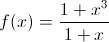
For example, the function $f(x)=\frac{1+x^3$}{1+x}$ contains a removeable discontinuity at  . Notice that we could simplify
 as follows:
$f(x)=\frac{1+x^3$$}{1+x}$=\frac{(1+x)(x^2$$-x+1)}{1+x}$=x^{2}$-x+1, where xneq -1.
Thus, we could say that $lim_{xrightarrow $-1}$$\frac{1+x^$3$}{1+x}$=lim_{xrightarrow $-1}$x^2$$-x+1=(-1)^2$-(-1)+1=3.
As we can see, the limit of  exists at
  , even though
  is undefined.
What this means is that  will look just like the parabola with the equation $x^{2}$-x+1 EXCEPT when
 , where there will be a hole in the graph. However, if we were to just define
  , then we could essentially "remove" this discontinuity. Therefore, we can say that there is a removeable discontinuty at
  .
.
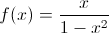
The functions
 , and
, and

have discontinuities, but these discontinuities occur as vertical asymptotes, not holes, and thus are not considered removeable.
The functions
 and $f(x)=\frac{x+1}{1+x^{2}$$} are continuous over all the real values of
  ; they have no discontinuities of any kind.
The answer is
 .
.
A removeable discontinuity occurs whenever there is a hole in a graph that could be fixed (or "removed") by filling in a single point. Put another way, if there is a removeable discontinuity at
For example, the function $f(x)=\frac{1+x^3$}{1+x}$ contains a removeable discontinuity at
$f(x)=\frac{1+x^3$$}{1+x}$=\frac{(1+x)(x^2$$-x+1)}{1+x}$=x^{2}$-x+1, where xneq -1.
Thus, we could say that $lim_{xrightarrow $-1}$$\frac{1+x^$3$}{1+x}$=lim_{xrightarrow $-1}$x^2$$-x+1=(-1)^2$-(-1)+1=3.
As we can see, the limit of
What this means is that
The functions
have discontinuities, but these discontinuities occur as vertical asymptotes, not holes, and thus are not considered removeable.
The functions
The answer is
If f(x)=|x-1|+3 , what is the value of f'(1)?
If f(x)=|x-1|+3
Tap to see back →
The function is not differentiable at  . So the derivative at
  does not exist.
The function is not differentiable at
Tap to see back →
Tap to see back →
Tap to see back →
Tap to see back →
Tap to see back →
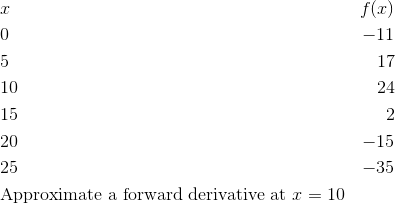
Tap to see back →
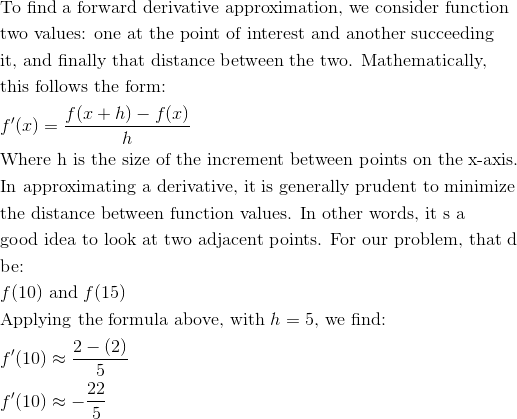
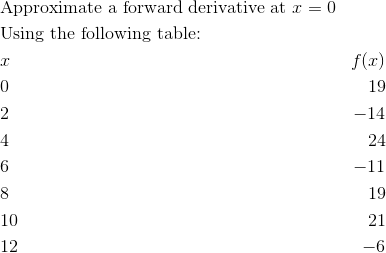
Tap to see back →
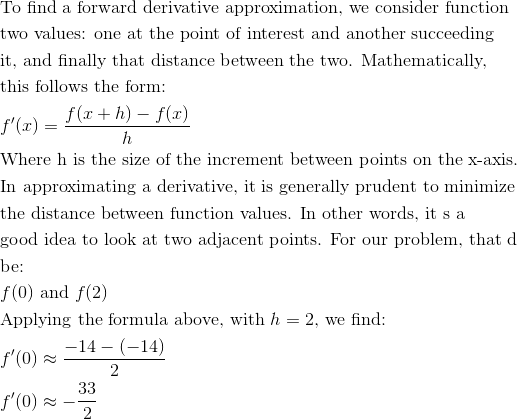
Tap to see back →
Tap to see back →
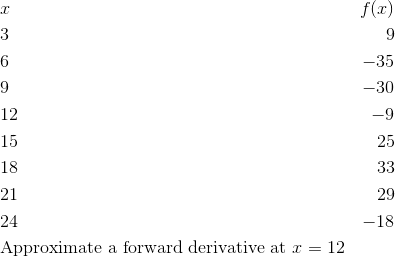
Tap to see back →
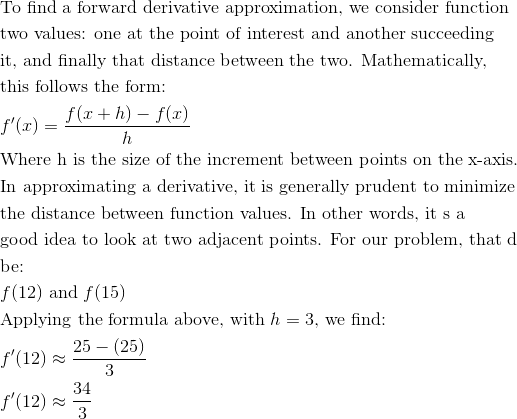

Tap to see back →


Tap to see back →


Tap to see back →


Tap to see back →


Tap to see back →


Tap to see back →


Tap to see back →


Tap to see back →
