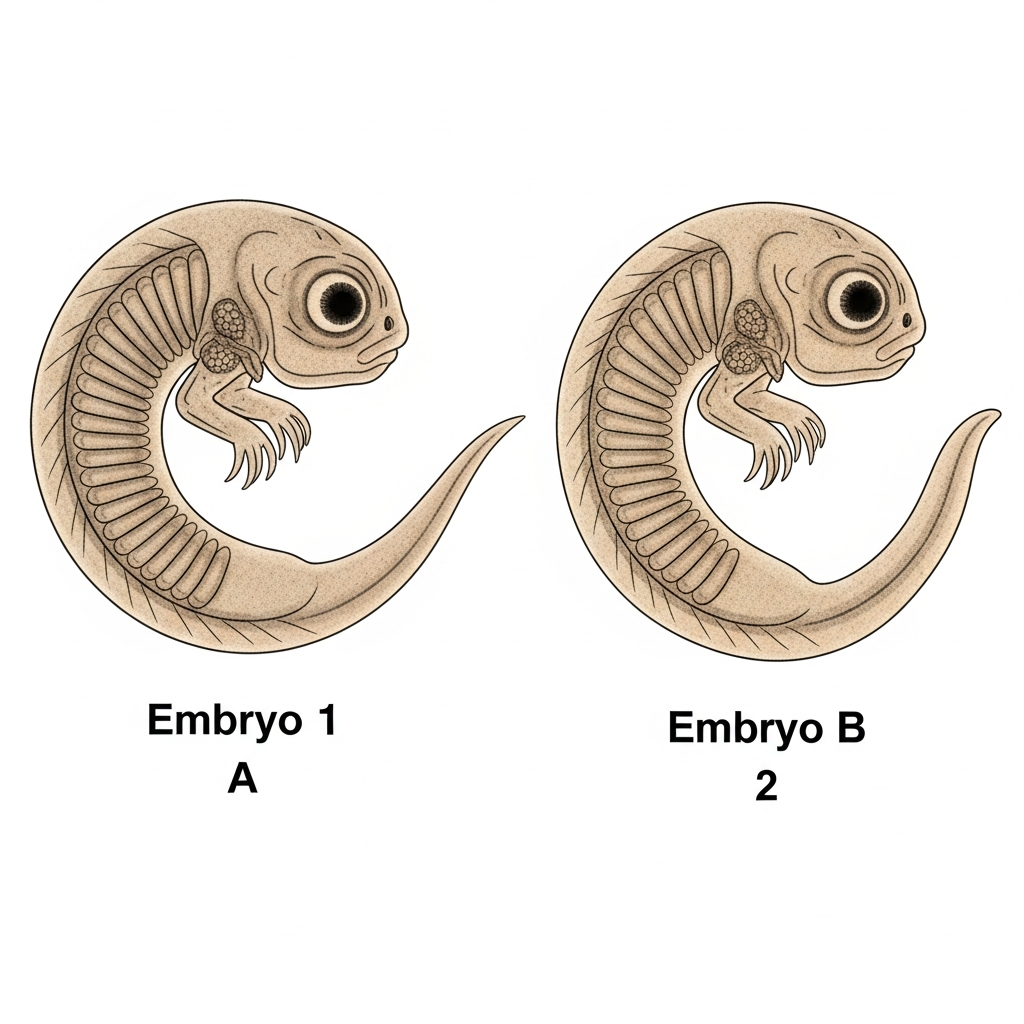
A student says, "These embryos are identical, so they must be the same species." Use the diagram (embryos at a comparable early stage) as evidence. Which response best evaluates the student's claim using embryo comparison?
- The claim is correct because the more similar embryo is the direct ancestor of the other.
- The claim is correct because early embryos always look exactly the same within and across species.
- The claim is correct because embryos change shape to match their environment.
- The claim is not supported: the embryos share some features, but the diagram shows differences (like tail length), and similarity does not mean the same species. (correct answer)
Explanation: Comparing embryo images requires distinguishing between similarity and identity when examining different species. Embryos from distinct species often share features like curved bodies and tail-like extensions while maintaining species-specific differences. These images show both shared characteristics and unique features that allow for meaningful comparison between species. To check claims about embryo similarity, look for both common features and differences rather than assuming complete identity. A misconception is thinking that similar appearance means identical species, when embryos can look alike due to shared ancestry while still being different species. These embryological similarities reflect common developmental patterns inherited from shared ancestors, not species identity. Recognizing that similarity doesn't equal sameness is crucial for understanding how embryo comparisons reveal evolutionary relationships.