What this quiz covers
This quiz focuses on Geometry 3d, giving you a quick way to practice the rules, question types, and explanations that matter most for GED Math.
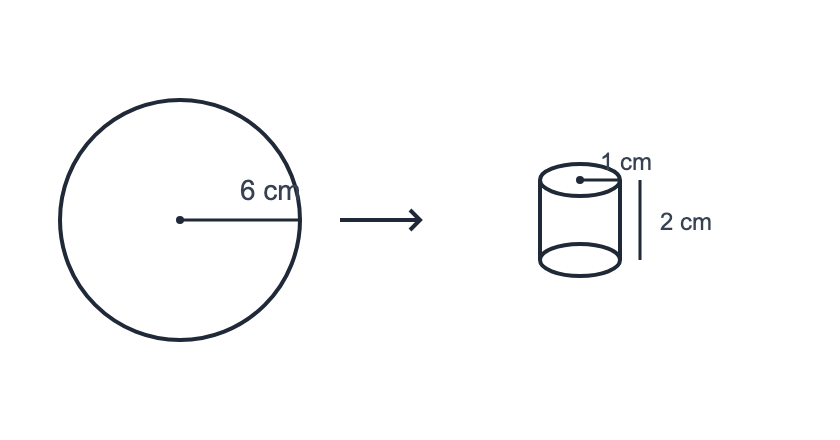
Refer to the figure. A solid metal sphere of radius 6 cm is melted and recast into small cylinders, each with radius 1 cm and height 2 cm. Assuming no metal is lost, what is the maximum number of complete small cylinders that can be made?
GED Math Quiz
Practice Geometry 3d in GED Math with focused quiz questions that help you check what you know, review explanations, and build confidence with test-style prompts.
This quiz focuses on Geometry 3d, giving you a quick way to practice the rules, question types, and explanations that matter most for GED Math.
Try each quiz question before looking at the correct answer. Use the explanations to review missed ideas, then come back to similar questions until the pattern feels familiar.
Refer to the figure. A solid metal sphere of radius 6 cm is melted and recast into small cylinders, each with radius 1 cm and height 2 cm. Assuming no metal is lost, what is the maximum number of complete small cylinders that can be made?
A cube has a total surface area of 486 cm2. What is the volume of the cube?
A shipping box is a right rectangular prism that measures 18 in long, 12 in wide, and 10 in high. What is the volume of the box?
A grain silo is shown in the figure. It consists of a cylinder with a hemisphere on top. The cylindrical portion has a radius of 4 feet and a height of 15 feet. Refer to the figure. What is the total volume of the silo, in cubic feet, rounded to the nearest cubic foot?
A cone has the dimensions shown. Refer to the figure. If the radius is doubled and the height is halved, by what factor does the volume change?
Refer to the figure. A cylindrical water tank has an inner radius of 3 feet and a height of 8 feet. The tank is currently filled with water to 43 of its capacity. How many cubic feet of water are in the tank? (Use π≈3.14.)
Refer to the figure. A sphere is inscribed in a cube of edge length 10 cm so that the sphere touches all six faces. What is the volume of the empty space inside the cube but outside the sphere, in cubic cm, to the nearest whole number?
Refer to the figure. A cone has a radius of 5 cm and a height of 12 cm. What is the lateral (side) surface area of the cone, in square centimeters? Leave the answer in terms of π.
Refer to the figure. A cylindrical candle has a diameter of 8 cm and a height of 15 cm. A wax manufacturer wants to wrap the curved (lateral) surface and the top circular face of each candle with a decorative film. How many square centimeters of film are needed per candle? (Use π≈3.14.)
Refer to the figure. A hemispherical bowl has an inner radius of 6 inches. Water is poured into the bowl until it is filled to a depth equal to the full radius (completely full). The water is then poured into a cylindrical container with an inner radius of 4 inches. To what height, in inches, will the water rise in the cylinder?
Refer to the figure. A regular hexagonal prism has a base edge length of 4 cm and a height of 10 cm. What is the volume of the prism, in cubic centimeters? (The area of a regular hexagon with side s is 233s2.)
A cylindrical water tank has a radius of 4 feet and a height of 12 feet. If the tank is currently filled to 75% of its capacity, how many cubic feet of water need to be added to fill it completely?
A cylindrical can has a radius of 4 cm and a height of 15 cm. What is the surface area of the can to the nearest square centimeter? (Use π=3.14.)
A cone-shaped paper cup has a radius of 5 cm and a height of 9 cm. How many cubic centimeters of water can the cup hold when filled to the brim? (Use π=3.14.)
The ice‐cream scoop forms a perfect sphere with a diameter of 6 cm. What is the volume of one scoop? (Use π=3.14.)