Home

Tutoring

Subjects

Live Classes

Study Coach

Essay Review

On-Demand Courses

Colleges

Games

Opening subject page...

Loading your content

AP Physics C Electricity and Magnetism

AP Physics C Electricity and Magnetism Practice Test: Practice Test 7

Practice Test 7 for AP Physics C Electricity and Magnetism: real questions and explanations from the Varsity Tutors practice-test pool.

0%

0 / 25 answered

Question 1 of 25

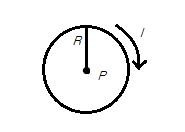
Ring

Consider a current-carrying loop with current , radius , and center .

What would happen to the magnetic field at point if the radius was halved and current was multiplied by four?

Question Navigator

All questions

Question 1

Ring

Consider a current-carrying loop with current , radius , and center .

What would happen to the magnetic field at point if the radius was halved and current was multiplied by four?

  1. The new magnetic field would be eight times as strong as the original (correct answer)
  2. The new magnetic field would reverse direction
  3. The new magnetic field would be four times as strong as the original
  4. The new magnetic field would be eight times weaker than the original
  5. The new magnetic field would be four times weaker than the original

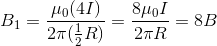
Explanation: The current flowing clockwise through the wire will induce a magentic field directed into the screen. The magnitude of such a magnetic field is given by the equation: Using out altered values, we can derive a ratio to determine the change in magnetic field. The resulting field will be eight times stronger than the original.

Question 2

A 0.8kg ball is dropped from rest from a cliff that is 150m high. Use conservation of energy to find the vertical velocity of the ball right before it hits the bottom of the cliff.

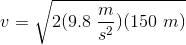
  1. (correct answer)

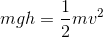
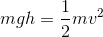
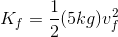
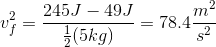
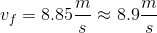
Explanation: The conservation of energy equation is . The ball starts from rest so . It starts at a height of 150m, so . When the ball reaches the bottom, height is zero and thus, and . The conservation of energy equation can be adjusted below. Solve for v.

Question 3

A proton moves in a straight line for a distance of . Along this path, the electric field is uniform with a value of . Find the potential difference created by the movement.

The charge of a proton is .

  1. (correct answer)

Explanation: Potential difference is given by the change in voltage Work done by an electric field is equal to the product of the electric force and the distance travelled. Electric force is equal to the product of the charge and the electric field strength. The charges cancel, and we are able to solve for the potential difference.

Question 4

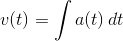
A car undergoes acceleration according to the given function. How fast is the car moving after four seconds?

  1. (correct answer)

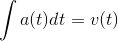
Explanation: We can find the car's velocity by taking the integral of the acceleration function during the given time interval. Solve the integral for the time interval of 0s to 4s. This will give us the final velocity.

Question 5

An object of mass m sits at rest on a rough inclined ramp at an angle of θ with the horizontal, which is increased until the object begins to slide. Which will not affect the acceleration of the object down the ramp?

  1. The mass of the object (correct answer)
  2. The angle of incline
  3. The acceleration due to gravity
  4. The coefficient of kinetic friction between the ramp and the object
  5. All of the above affect the acceleration of the object

Explanation: The acceleration of the object can be determined by setting the net force equal to ma: ma=mgsinθ-μmgcosθ, where the first term is the component of the gravitational force parallel to the surface of the ramp and the second term is the force due to friction. The mass of the object cancels.

Question 6

A crate is pulled across a horizontal floor at a constant velocity of . The coefficient of kinetic friction between the crate and the floor is . If the rope pulling the crate is angled at above the horizontal, what force must be applied to maintain this constant velocity?

  1. (correct answer)

Explanation: Relevant equations: Write net force equations for horizontal and vertical directions: Horizontal: Vertical: Since the crate is not accelerating, in each direction, implying that . Horizontal: Vertical: Express the horizontal and vertical components of the pulling force in terms of the total pulling force, . Horizontal: Vertical: Replace force of friction with its expression in terms of the normal force. Horizontal: Rearrange to isolate the normal force. Horizontal: Substitute this term for the normal force in the net vertical force equation. Vertical: Solve to isolate the pulling force. Use the given values for the mass of the box, coefficient of friction, and acceleration of gravity to solve for the pulling force.

Question 7

A 30kg cart travels at 9m/s and it hits another cart of mass 46kg traveling at 4m/s in the opposite direction. After the collision, they stick together to form one cart. Find the speed of this cart

  1. (correct answer)

Explanation: For the 30 kg cart, we know and for the 46 g cart, we know . After the collision, we have . Use conservation of momentum to solve this problem.

Question 8

![Ap physics c e m potential problems 2 6 16 2 ](https://vt-vtwa-assets.varsitytutors.com/vt-vtwa/uploads/problem_question_image/image/30995/AP_Physics_C_E_M_Potential_Problems__2-6-16 2_.jpg)

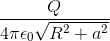
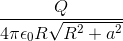
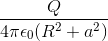
A uniformly charged ring of radius carries a total charge . Calculate the potential a distance from the center, on the axis of the ring.

  1. (correct answer)

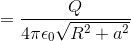
Explanation: Use the linear charge density and length element . The distance from each point on the ring to the point on the axis is . Lastly, integrate over from to to obtain

Question 9

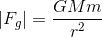
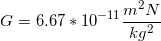
What is the gravitational force of the sun on a book on the earth's surface if the sun's mass is and the earth-sun distance is ?

  1. (correct answer)

Explanation: Relevant equations: Use the given values to solve for the force.

Question 10

Three identical point charges with are placed so that they form an equilateral triangle as shown in the figure. Find the electric potential at the center point (black dot) of that equilateral triangle, where this point is at a equal distance, , away from the three charges.

3_charges

  1. (correct answer)

Explanation: The electric potential from point charges is . Knowing that all three charges are identical, and knowing that the center point at which we are calculating the electric potential is equal distance from the charges, we can multiply the electric potential equation by three. Plug in the given values and solve for .

Question 11

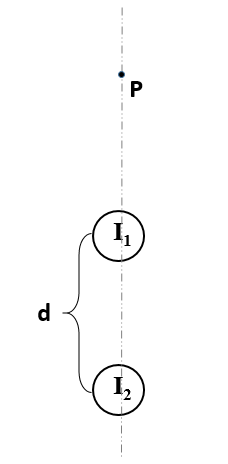
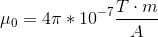
Two infinitely long wires having currents and are separated by a distance .

Ps0_twowiresbfield

The current is 6A into the page. The current is 9A into the page. The distance of separation is 1.5mm. The point lies 1.5mm away from on a line connecting the centers of the two wires.

What is the magnitude and direction of the net magnetic field at the point ?

  1. (correct answer)

Explanation: At point , the magnetic field due to points right (via the right hand rule) with a magnitude given by: At point , the magnetic field due to points right (via the right hand rule) with a magnitude given by: The addition of these two vectors, both pointing in the same direction, results in a net magnetic field vector of magnitude to the right.

Question 12

A box moves down a rough ramp on an incline at a constant velocity. How many forces are acting upon the box?

  1. Three (correct answer)
  2. Four
  3. Five
  4. Two
  5. One

Explanation: To figure out how many forces are acting on the box, let's consider all the things happening in the situation: the box has mass, so therefore there is a force of gravity on the box, its weight; there is a normal force by the ramp that pushes back on the box; and there is a frictional force that acts in the opposite direction of the box's motion. So there are three total forces acting on the box.

Question 13

A truck traveling at suddenly brakes and skids to a halt. If the coefficient of kinetic friction between the tires and the road is , how far does the truck skid before stopping?

  1. (correct answer)

Explanation: Relevant equations: Determine the truck's change in kinetic energy. Note that the final kinetic energy will be zero because it has no final velocity. Using the work-energy theorem, set change in kinetic energy equal to the work done by friction. Substitute the equation for force of friction. Use the given values for coefficient of friction, mass, and acceleration of gravity to solve for the distance.

Question 14

In an inelastic collision, which combination of quantities is conserved?

  1. Mass and momentum (correct answer)
  2. Mass, kinetic energy, and momentum
  3. Kinetic energy and potential energy
  4. Momentum and kinetic energy
  5. Mass and potential energy

Explanation: In a perfectly inelastic collision, the two colliding objects stick together; the two colliding objects deform, but mass is still conserved. Momentum is conserved during collisions of any sort, including inelastic collisions. Kinetic energy is reduced during an inelastic collision, and is only conserved in elastic collisions. During inelastic collisions, some kinetic energy is lost to the environment in the form of heat or sound. The problem does not give any information regarding position, and thus we cannot comment on any changes or lack of changes in potential energy.

Question 15

Ring

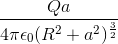
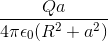
Consider a current-carrying loop with current , radius , and center .

What is the magnitude of the magnetic field at point ?

  1. (correct answer)
  2. There is no magnetic field at point

Explanation: The current flowing clockwise through the wire will induce a magentic field directed into the screen. The magnitude of such a magnetic field is given by the equation:

Question 16

If two identical parallel plate capacitors of capacitance are connected in series, which is true of the equivalent capacitance, ?

  1. (correct answer)

Explanation: Relevant equations: Use the series equation, replacing C1 and C2 with the given constant C: This agrees with the general rule that the equivalent capacitance in series is less than the capacitance of any of the individual capacitors.

Question 17

You are standing on top of a very large positively charged metal plate with a surface charge of .

Assuming that the plate is infinitely large and your mass is , how much charge does your body need to have in order for you to float?

  1. (correct answer)

Explanation: Consider the forces that are acting on you. There is the downward (negative direction) force of gravity, . In order for you to float, there has to be an upward (positive direction) force, and that upward force is coming from the metal plate, . To show that you would float, the net force equation is written as , where is the charge on you. For plates that are charged, know that . Knowing this, the force equation becomes . Solve for . Now we can plug in our given values, and solve for the charge.

Question 18

Two positive point charges of and are place at a distance away from each other, as shown below. If a positive test charge, , is placed in between, at what distance away from will this test charge experience zero net force?

Charges

  1. (correct answer)

Explanation: To find the location at which the test charge experience zero net force, write the net force equation as , where is the force on the test charge from , and is the force on the same test charge from . Using Coulomb's law, we can rewrite the force equation and set it equal to zero. In this equation, the distance, , is how far away the test charge is from , while represents how far away the test charge is from . Now, we simplify and solve for . Cross-multiply. We can cancel and . We do not need to know these values in order to solve the question. Now that we have isolated , we can plug in the values given in the question and solve.

Question 19

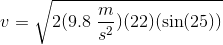
Starting from rest, a skateboarder travels down a 25o incline that's 22m long. Using conservation of energy, calculate the skateboarder's speed when he reaches the bottom. Ignore friction.

  1. (correct answer)

Explanation: Conservation of energy states that . The skateboarder starts from rest; thus, and . At the bottom of the incline, and . Solve for v. Using trigonometry, .

Question 20

A truck traveling at suddenly brakes and skids to a halt. If the coefficient of kinetic friction between the tires and the road is , how far does the truck skid before stopping?

  1. (correct answer)

Explanation: Relevant equations: Determine the truck's change in kinetic energy. Note that the final kinetic energy will be zero because it has no final velocity. Using the work-energy theorem, set change in kinetic energy equal to the work done by friction. Substitute the equation for force of friction. Use the given values for coefficient of friction, mass, and acceleration of gravity to solve for the distance.

Question 21

A bowling ball is dropped from above the ground. What will its velocity be when it is above the ground?

  1. (correct answer)

Explanation: Relevant equations: Determine initial kinetic and potential energies when the ball is dropped. Determine final kinetic and potential energies, when the ball has fallen to above the ground. Use conservation of energy to equate initial and final energy sums. Solve for the final velocity.

Question 22

The plates of a parallel plate capacitor are apart and in area. A potential difference of is applied across the capacitor. Find the capacitance.

  1. (correct answer)

Explanation: Capacitance is related to plate area and distance by the equation . Given the area and distance, we can solve for capacitance. The voltage, in this case, is irrelevant.

Question 23

A car undergoes acceleration according to the given function. What distance has the car traveled after three seconds?

  1. (correct answer)

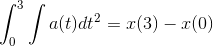
Explanation: We can determine the velocity by taking the second integral of acceleration for the time interval of 0s to 3s. Solve for the first integral. Solve for the second integral, using the time interval.

Question 24

The plates of a parallel plate capacitor are apart. A potential difference of is applied across the capacitor. Compute the magnitude of the generated electric field.

  1. (correct answer)

Explanation: The electric field given by a capacitor is given by the formula . We do not have these variables, so we will have to adjust the equation. The capacitance can be determined by the area of the plates and the distance between them. This equation simplifies to , allowing us to solve using the values given in the question.

Question 25

A baseball player hits a baseball initially moving at , returning it at a speed of along the same path. If the ball was in contact with the bat for , what magnitude of force did the ball experience during the moment of contact?

  1. (correct answer)

Explanation: Relevant equations: Evaluate the impulse based on the mass and change of velocity. Use the total impulse and time in the second equation. Solve for the average force.