All questions
Question 1
Three resistors R1, R2, and R3 and the capacitor, C, are connected to an ideal battery V to complete the circuit as shown.
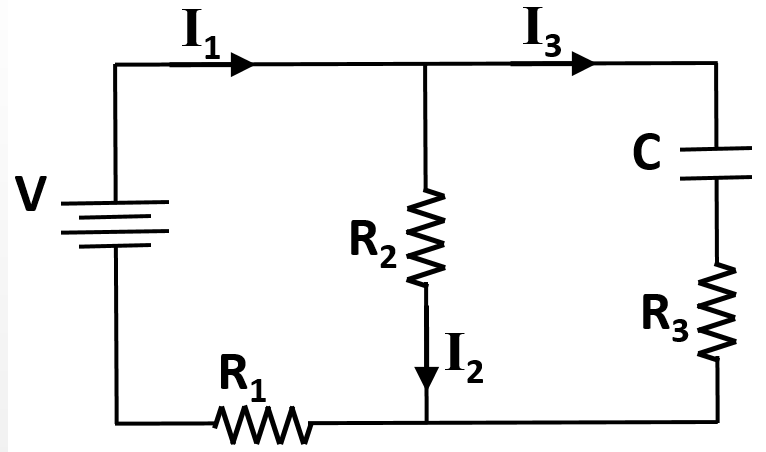
After the circuit has been connected for a very long time, the currents in each branch of the circuit are measured to be some values  ,
,  , and
, and  , and the charge on the capacitor some value
  .
.
Which of the following equations is a correct expression regarding the voltage of the circuit after a long time?
 (correct answer)
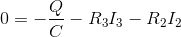

Explanation: Identifying the sum of the voltage drops and rises (Kirchoff's Loop Law) around the three possible loops of this circuit is the key to answering this question correctly. The following signs can be assigned to each of the circuit elements based on the direction of the currents given.
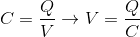
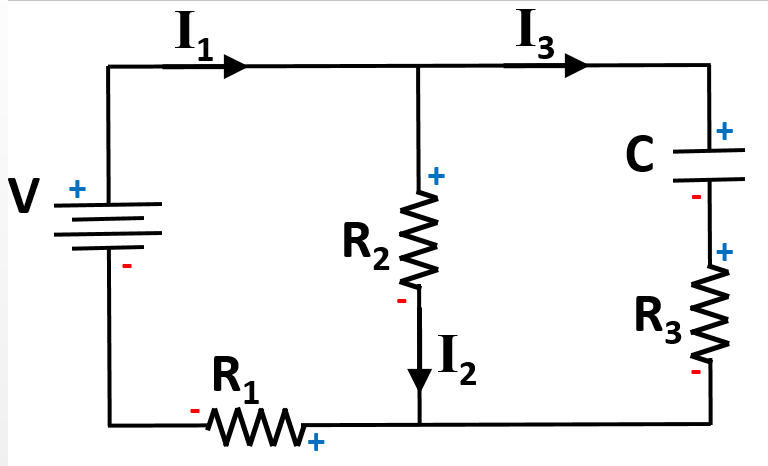 Use Ohm's law and the equation for capacitance to derive terms for the voltage across each element of the circuit.

 There are three possible paths through the circuit, resulting in three correct equations that could be derived:

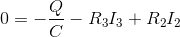
 Only one of the given answer options matches up correctly to these.
Question 2
 (correct answer)


Explanation: By the Pythagorean theorem, the distance from point P to charge  is
is  . Because point P is also
  from charge
  , it follows that the potential is


Question 3
A proton moves in a straight line for a distance of  . Along this path, the electric field is uniform with a value of
  . Find the force on the proton.
The charge of a proton is  .
.
 (correct answer)


Explanation: The force of an electric field is given by the equation  , where
  is the charge of the particle and
  is the electric field strength. We can use the given values from the question to solve for the force.

Question 4
A plane weighing 1500kg dives 40m with its engine off before it goes into a circular pattern with a radius of 200m while maintaining its speed at the end of its dive. How much centripetal force, in Newtons, is acting on the plane?
 (correct answer)


Explanation: First, find the gravitational potential energy of the drop. Then, set it equal to the kinetic energy at the end of the drop and solve for the velocity.
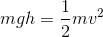 The mass cancels.
 Isolate the velocity and solve.

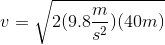
 This gives you the last term you need to solve for the centripetal force.


Question 5
Three point charges are arranged around the origin, as shown.


Calculate the total electric potential at the origin due to the three point charges.

 (correct answer)


Explanation: Electric potential is a scalar quantity given by the equation:
 To find the total potential at the origin due to the three charges, add the potentials of each charge.


Question 6
A proton moves in a straight line for a distance of  . Along this path, the electric field is uniform with a value of
  . Find the work done on the proton by the electric field.
The charge of a proton is  .
.
 (correct answer)


Explanation: Work done by an electric field is given by the product of the charge of the particle, the electric field strength, and the distance travelled.
 We are given the charge (
 ), the distance (
 ), and the field strength (
 ), allowing us to calculate the work.


Question 7
We have a point charge of  . Determine the electric field at a distance of
  away from that charge.

 (correct answer)


Explanation: Coulomb's law for the electric field from point charges is  , where we know the values of the following variables.


 Using these values, we can solve for the electric field.


Question 8
An object of mass 0.5 kg is accelerating with a vector (2, 4). A drag force of (-1, 3) is acting upon this object. Which of the following represents the vector of the other agent acting upon the object?
- (2, -1) (correct answer)
- (1, 7)
- (-3, -1)
- (-1, 2)
- (3, 1)
Explanation: To figure out the force vector of the other agent acting on the object, let's recall Newton's Second Law of Motion: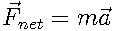 (-1, 3) + (x1, y1) = 0.5(2, 4)(x1 - 1, y1 + 3) = (1, 2)x1 - 1 = 1x1 = 2y1 + 3 = 2y1 = -1So the force vector of the other agent acting on the object is (2, -1).
Question 9
A parallel plate capacitor has a capacitance of  . If the plates are
  apart, what is the area of the plates?
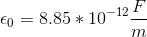
 (correct answer)


Explanation: The relationship between capacitance, distance, and area is  . We can rearrange this equation to solve for area.
 Now, we can use the values given in teh question to solve.

Question 10
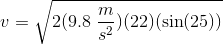
Starting from rest, a skateboarder travels down a 25o incline that's 22m long. Using conservation of energy, calculate the skateboarder's speed when he reaches the bottom. Ignore friction.
 (correct answer)


Explanation: Conservation of energy states that  .
The skateboarder starts from rest; thus,
.
The skateboarder starts from rest; thus,  and
and  . At the bottom of the incline,
  and
and  .
.

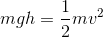 Solve for v.
 Using trigonometry,
  .
.

Question 11
 (correct answer)


Explanation: Use a polar coordinate system with surface charge density  and area element
  . The distance from the point of interest to a point a distance
  from the center is
  , so the potential is


Question 12
A mass oscillates on a spring with period  . If the mass is doubled, what is the new period of oscillation?
 (correct answer)


Explanation: The formula for the period of oscillation is
 .
When we double the mass, we get:
.
When we double the mass, we get:
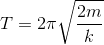 Because the new factor of 2 is under the square root sign, and also in the numerator, the new period will be increased by
  .
.
Question 13
 (correct answer)


Explanation: Relevant equations:
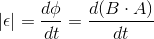

 Write the expression for the flux using the given expression for the magnetic field strength:
 Take the derivative of this flux to find the induced emf:
 Determine the maximum value of
  , and replace
  with this value, to find the maximum induced emf:
 Plug this maximum induced emf into
  , to find the maximum induced current:

Question 14
A battery is measured to have a potential of 5V. When connected to a wire with no resistors or other components, the voltage measured is 4.9V.
Why was the potential of the battery measured differently when the wire was connected?
- The wire has a slight internal resistance and caused a potential drop (correct answer)
- Once the current is distributed across the wire, there is less charge per unit length of the circuit and so the voltage is lower
- The wire is causing electrons to be lost to the air, which lowers the potential measured
- The difference in potential measured is small enough to be disregarded
- The wire connected to the battery must be connected to something else where this potential is being lost
Explanation: All wires have at least some internal resistance. The most likely explanation for this is that the wire is displaying slight resistance, and therefore caused the measured potential to be less than it was before.
Question 15
Three resistors and a battery form the following circuit.
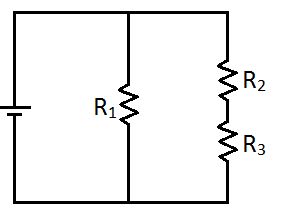
Calculate the equivalent resistance if the resistors have the following values.


 (correct answer)



Explanation: First, calculate the equivalent resistance of  and
and  . Since these two resistors are arranged in series, we just take the sum of their values.


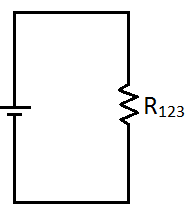
 With resistors 2 and 3 combined together in a single value, the following circuit is formed.
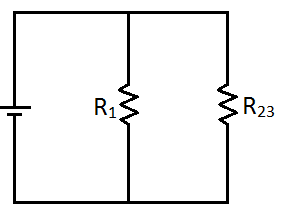 Notice that
  and
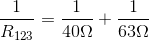
and  are arranged in parallel. To calculate the equivalent resistance of this parallel pair, we use the following equation.
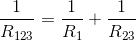 Plug in the values, and solve for
  .
.
 This is just like the circuit shown below.
Question 16
If a particle moves with a constant velocity of 6 meters per second, find the position function if the particle begins at position x = 10 meters.
- x(t) = 6t + 10 (correct answer)
- x(t) = 6t - 10
- x(t) = 10t - 6
- x(t) = 10t + 6
- x = 6t
Explanation: To find the position function when given a velocity function, we need to integrate the velocity function and apply the initial condition to the antiderivative. The antiderivative of a constant velocity function of 6 meters per second is 6t. Applying the initial condition that x(0) = 10, we find that x(t) = 6t + 10.
Question 17
 (correct answer)


Explanation: Relevant equations:
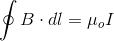
 Step 1: Find the original and new magnetic fields created by wire 1 at wire 2, using Ampere's law with an Amperian loop of radius
  or
or  , respectively.
Original
, respectively.
Original
 New
New
 Since the wires are parallel to each other and wire 1's field is directed circularly around it, in each case wire 1's field is perpendicular to wire 2.
Step 2: Find the original and new magnetic forces per unit length on wire 2, due to the field created by wire 1.
Since the wires are parallel to each other and wire 1's field is directed circularly around it, in each case wire 1's field is perpendicular to wire 2.
Step 2: Find the original and new magnetic forces per unit length on wire 2, due to the field created by wire 1.
 Original
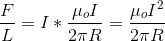 New
New
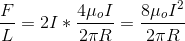 So, the new force per unit length is 8 times greater than the original.
Question 18
 (correct answer)


Explanation: To find the distance between the two charges, use Coulomb's Law.
 Since we want to find distance,
  , we solve for
  .
.
 We know the values of the force and the two charges.


 We can plug in these values and solve for the distance.


Question 19
A  ball is thrown horizontally from the top of a
  high building. It has an initial velocity of
  and lands on the ground
  away from the base of the building. Assuming air resistance is negligible, which of the following changes would cause the range of this projectile to increase?
I. Increasing the initial horizontal velocity
II. Decreasing the mass of the ball
III. Throwing the ball from an identical building on the moon
- I and III (correct answer)
- I and II
- I, II, and III
- I only
- II only
Explanation: Relevant equations:
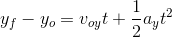
 Choice I is true because
  is proportional to the range
  , so increasing
  increases
  if
if  is constant. This relationship is given by the equation:
 Choice II is false because the motion of a projectile is independent of mass.
Choice III is true because the vertical acceleration on the moon
Choice II is false because the motion of a projectile is independent of mass.
Choice III is true because the vertical acceleration on the moon  would be less. Decreasing
  increases the time the ball is in the air, thereby increasing
  if
if  is constant. This relationship is also shown in the equation:

Question 20
For a ring of charge with radius  and total charge
  , the potential is given by
  .
.
Find the expression for electric field produced by the ring.
 (correct answer)


Explanation: We know that  .
Using the given formula, we can find the electric potential expression for the ring.
.
Using the given formula, we can find the electric potential expression for the ring.
 Take the derivative and simplify.

Question 21

Three equal point charges  are placed at the vertices of an equilateral triangle of side length
  . Calculate the potential at the center of the triangle, labeled P.
 (correct answer)


Explanation: Draw a line from the center perpendicular to any side of the triangle. This line divides the side into two equal pieces of length  . From the center, draw another line to one of the vertices at the end of this side. This produces a 30-60-90 triangle with longer leg
  , so the hypotenuse (the distance from the vertex to the center) is
  . The potential at the center is due to three of these charges, so it must be


Question 22
 (correct answer)


Explanation: Electric flux is given by either side of the equation of Gauss's Law:
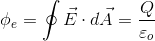 Since the charge is the same for both spherical surfaces, even though these surfaces are of different radii, the amounts of electric flux passing through each surface is the same.
Question 23
A battery is measured to have a potential of 5V. When connected to a wire with no resistors or other components, the voltage measured is 4.9V.
If the current through the wire is measured to be 2A, how much thermal energy is being lost per second as soon as the wire is connected to the battery?
 (correct answer)


Explanation: First, we must know that the wire has some internal resistance  . To calculate this, we need to know the potential drop through the wire, which must be the difference we saw from the initial voltage reading to the second. This value, 0.1V, we plug into Ohm's law to calculate the resistance of the wire.


 The question asks for energy lost per second; this value is equivalent to the power.
 Use our values to solve.

Question 24
 (correct answer)


Explanation: Capacitance is related to plate area and distance by the equation  .
Given the area and distance, we can solve for capacitance. The voltage, in this case, is irrelevant.
.
Given the area and distance, we can solve for capacitance. The voltage, in this case, is irrelevant.

Question 25
An infinitely long wire has a current of  running through it. Calculate the magnetic field at a distance
  away from the wire.
 (correct answer)


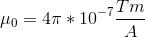
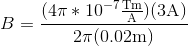
Explanation: For infinitely long wires, the formula for the magnetic field is  , where
  is the current and
  is the distance from the wire.
The magnetic field is calculated using our given values.
is the distance from the wire.
The magnetic field is calculated using our given values.


 and
and  are separated by a distance
  . Calculate the potential at point P, a distance
  from charge
  in the direction perpendicular to the line connecting the two charges.
 and outer radius
  , and carries a total charge
  . Calculate the potential a distance
  from the center, on the axis of the disk.
 is placed in a magnetic field whose magnitude varies with time according to the equation
  . The loop is held in place, perpendicular to the field. If the wire has resistance
  , what is the magnitude of the maximum instantaneous current induced in the loop?
 apart each carry a current
  , and repel each other with a force
  per unit length. If the current in each wire is doubled to
  , and the distance between them is halved to
  , by what factor does the force per unit length change?
 exerts a force of
  on another charge with
  . How far apart are the two charges?
 , is enclosed by two spherical surfaces of radii
  and
and  , with
  . The cross-sectional side view is shown.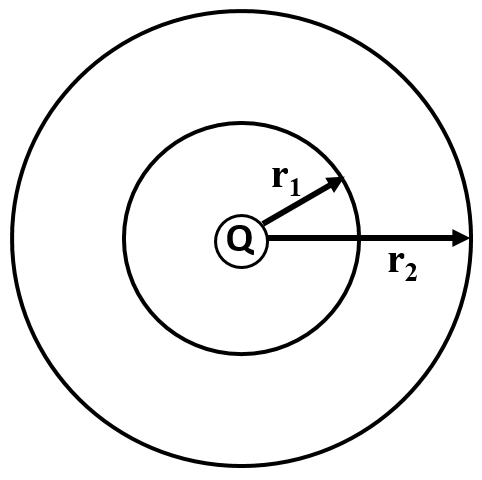
 apart and
  in area. A potential difference of
  is applied across the capacitor. Find the capacitance.